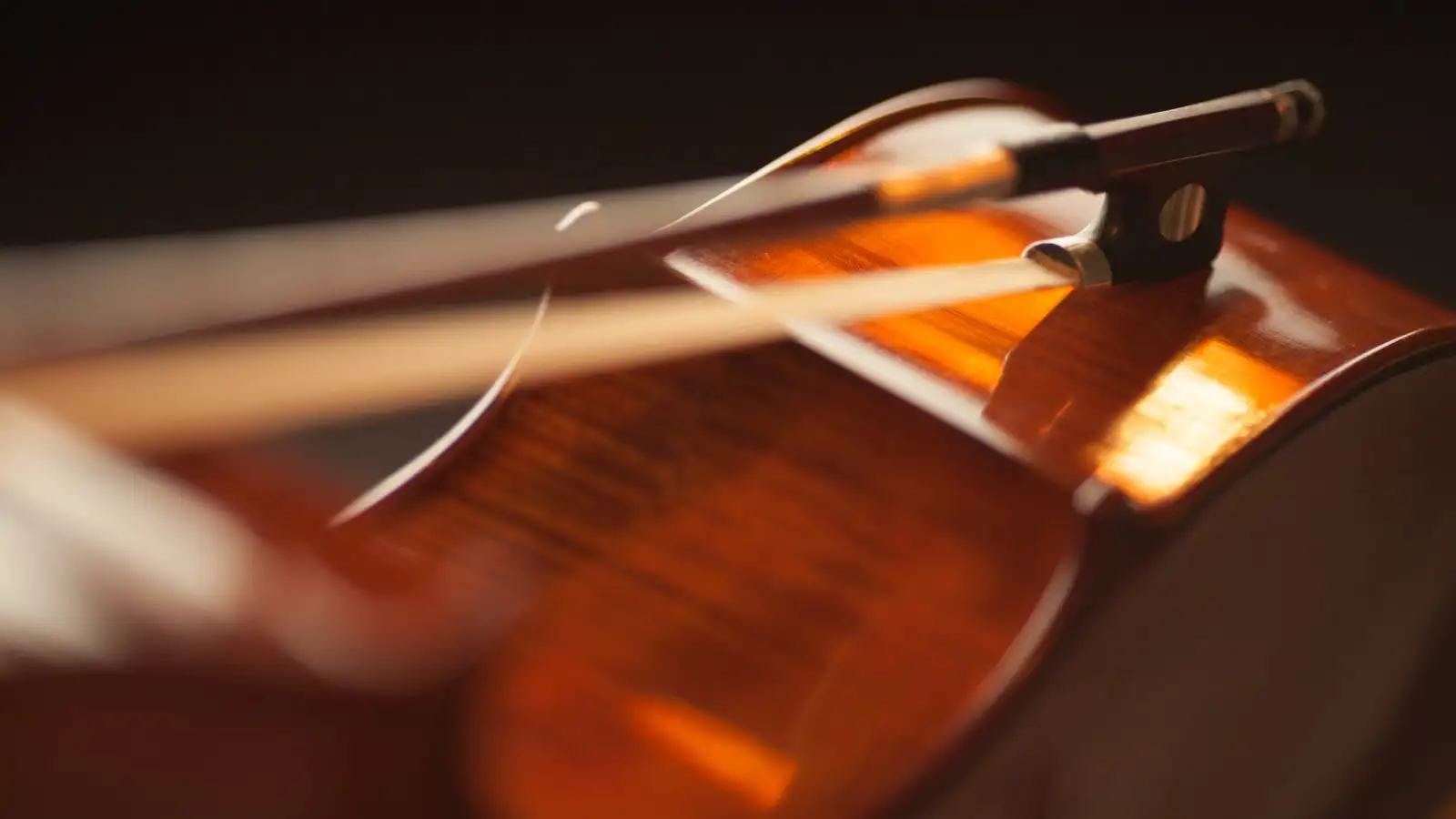
Tone breaks because the bow stops meeting the string the same way from one moment to the next, and the repair almost always lives in the hand and the bow's path — not in how much weight gets pressed into the string or how fast the arm moves. Before any pressure or speed adjustment, get the hold into a shape where the fingers stay curved and springy, keep the bow traveling parallel to the bridge, and let the elbow and upper arm carry the stroke as one piece.
I keep a mirror propped on the piano bench, angled so I can watch the bow from the side. Not because I don't trust my ears. I trust them fine. It's that ears tell you something went wrong, and the mirror tells you what — and with a bow, the what is almost always visible.
So stand where I stand and watch one stroke. Slow down bow on the open A. Round at the start, still round through the first third, and then somewhere near the middle it goes thin and airy, like the string is only half awake. Or maybe yours does the other thing: a gritty, papery edge that shows up right next to the frog and then disappears by the tip.
Those are the same problem wearing two coats. Look at the contact point, where the hair crosses the string between the bridge and the end of the fingerboard. At the start of the stroke the hair sits about a finger's width from the bridge, running parallel to it. Halfway through, it isn't parallel anymore. It has crept diagonally toward the fingerboard, and that's your thin sound. Or it has swung the other way and crowded the bridge, and that's the grit. The bow is supposed to travel parallel to the bridge for its whole length, and most beginners' bows don't. That's the entire first diagnosis, and it costs nothing to run.
While you're watching, watch the stick too. Some teachers keep beginners with the hair flat on the string, some tilt the bow slightly toward the fingerboard side. Both work. What doesn't work is the stick rolling as you bow, because then the amount of hair touching the string changes mid-stroke and the tone changes with it.
The hand gets blamed for the arm's job
Here's the thing I wish somebody had said to me early: when the bow drifts, the bow hand is usually innocent. The hand is doing exactly what it was told. The arm is what steered.
Your wrist can really only do one of two jobs at a time. It can hold the bow's angle steady and let the fingers do the flexing, or it can lead the stroke and sweep the bow in an arc. If it leads, the arc is narrow at the ends and wide in the middle, which is exactly the shape of a drifting contact point. The fix is boring. Move from the elbow and upper arm together, as one unit, and let the wrist stay quiet, roughly in line with the forearm. It feels stiff and wrong for about a week. Then it feels like nothing, and your bow tracks.
I test this on myself without playing a note. Slow bows in front of the mirror, frog to tip, watching the bow stay parallel to an imaginary line running from the bridge to the fingerboard. If the bow wobbles, my wrist is working. If the bow tracks, my arm is.
Curved fingers, and two levers
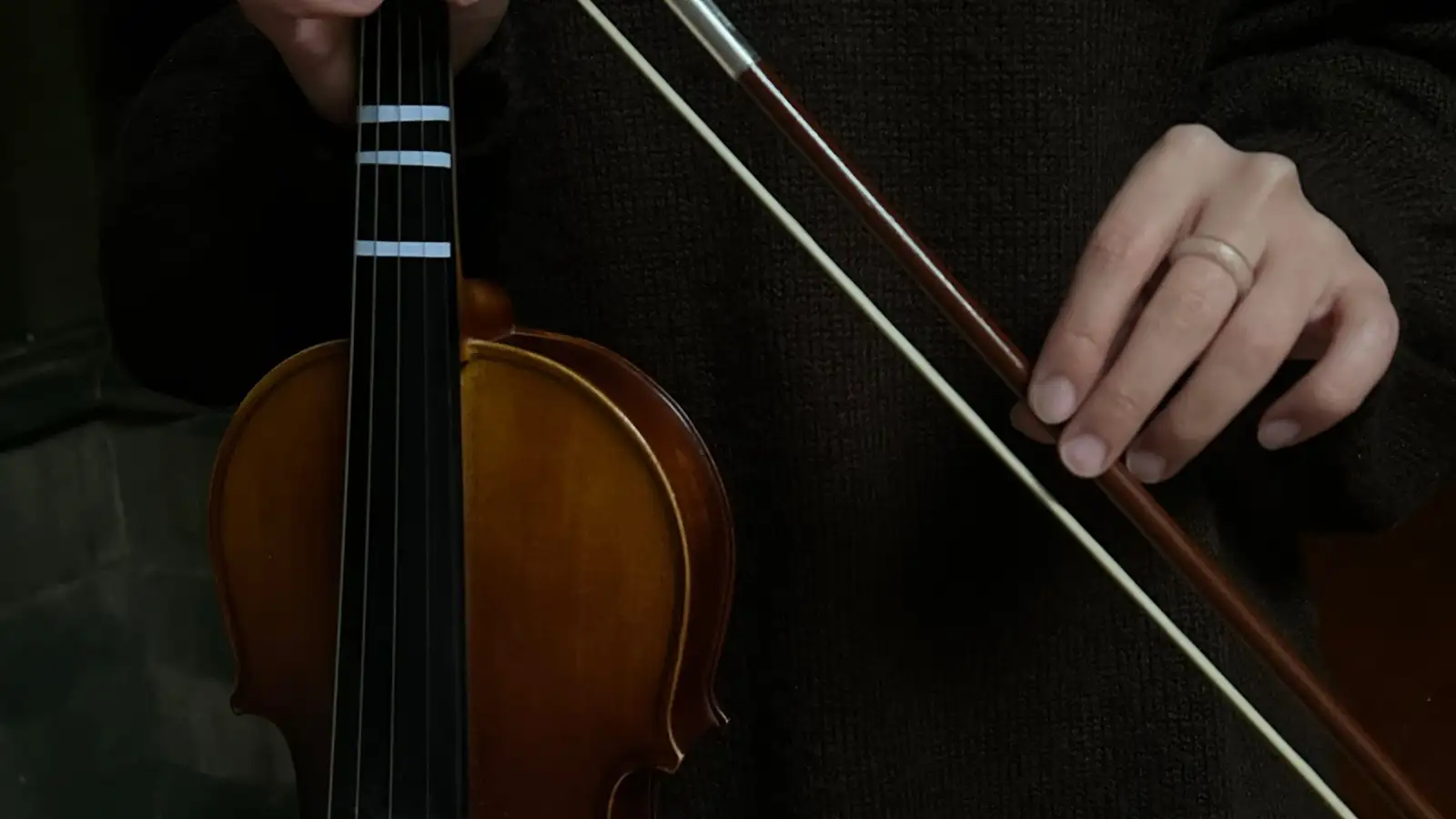
Then there's the hold itself, and I get careful here, because there is no single correct bow hold and I'm not going to pretend there is. Different schools put the fingers in different places, and hands come in different shapes. Short pinkies, wide palms, a thumb that bends backward — all of that changes the picture. What doesn't change is the principle underneath: every joint in the hand stays slightly curved and free to flex, so the bow has a suspension system instead of a clamp.
Curved fingers do one specific job. They let the weight of your arm arrive at the string through a spring rather than a squeeze. When the fingers lock — thumb straight, knuckles caved in, whole hand clenched — the bow becomes a rigid bar, and a rigid bar can't absorb anything. Every direction change jolts the string. That jolt is what a bounce is.
Two fingers matter more than the others, and neither one of them is a grip.
The index finger is where arm weight gets metered. It lies along the stick and curves over it, and its job is to let a little more weight down when the bow is out near the tip and the bow's own mass is working against you.
The pinky sits on top of the stick, curved over the wood, and near the frog it does the opposite job. It lifts, taking weight off the string so the bow doesn't dig in and crush the sound. If your pinky is straight, locked, or floating off the stick, you'll hear it at the frog: a crunch at the top of every down bow.
If you're squeezing either one, you'll know within five minutes, because the back of your hand or the base of your thumb will ache. That ache is information. It means the bow is being held instead of balanced.
And if you're the parent sitting beside a kid, resist the urge to rearrange their fingers mid-stroke. Watch the contact point from the side and let the drift tell you which part is moving. Grabbing a hand teaches a hand to freeze, and a frozen hand is the thing you're trying to fix.
Where tone actually breaks: the two ends
The ends of the bow are where most tone breaks, and they break for a physical reason. At the frog, the bow's mass is stacked right next to your hand, so the string feels heavy and a small movement of the arm turns into a big sound. At the tip, all that mass is out at the far end and the bow feels light, so the string gets starved.
So the ends need opposite adjustments. Coming into the frog, I ease the index finger off and let the pinky carry a bit more, and I keep the bow from stalling — if the bow nearly stops before it turns around, the string loses its ring. Coming into the tip, I lean the index in slightly and keep a little more speed going. Frog: pinky on, index off. Tip: index on, pinky off. That's the whole idea, and you can practice it on one open string with no music in front of you.
Do those ends slowly. Slower than you want to. Everybody wants to practice the fast part.
When it isn't the hold
I'd be lying if I said the hold fixes everything. It doesn't.
If the hair is over-tight, the bow can't flex, and it will bounce no matter how soft your hand is. If the hair is too loose, the stick bottoms out on the string and you get a flabby, thudding sound. If the bow itself is warped, no hand shape on earth will make it track. A shoulder rest that tilts the violin into an odd angle will drag the bow along with it. Strings that have been on the instrument for a very long time will make everything you do sound dull.
So I check the cheap stuff first. Hair tension, rosin, the angle of the violin. It's a little embarrassing how often it's the cheap stuff.
I also don't police the shape of anybody's hold, including my own. What I watch for is whether the joints can move. That's the test that survives every school, every hand, every teacher.
One honest limit: if something in your hand, wrist, or shoulder hurts in a way that lingers after you put the bow down, that's a different problem from a drifting bow, and it isn't one to practice through.
Five minutes, once a day
Here's what I actually do, and what I hand to anyone I'm helping.
Mirror angled at the bow. Hair at a normal tension, not banjo-tight. Open A. Ten slow bows, frog to tip, watching the hair cross the string in a line parallel to the bridge. Then ten more with my eyes closed, listening for whether the contact point held, because I want the sound of a straight bow memorized in my ear, not just seen in the glass.
Then the ends. Eight slow bows that stop just short of the frog and just short of the tip, easing the index and the pinky through the change so the tone doesn't flicker.
That's it. Not exciting. But a drifting bow is never one big mistake. It's a small one, repeated on every stroke, all the way down the bow. Fix the hold and the path first, and the pressure and speed problems you thought you had usually turn out to have been downstream of them the whole time.