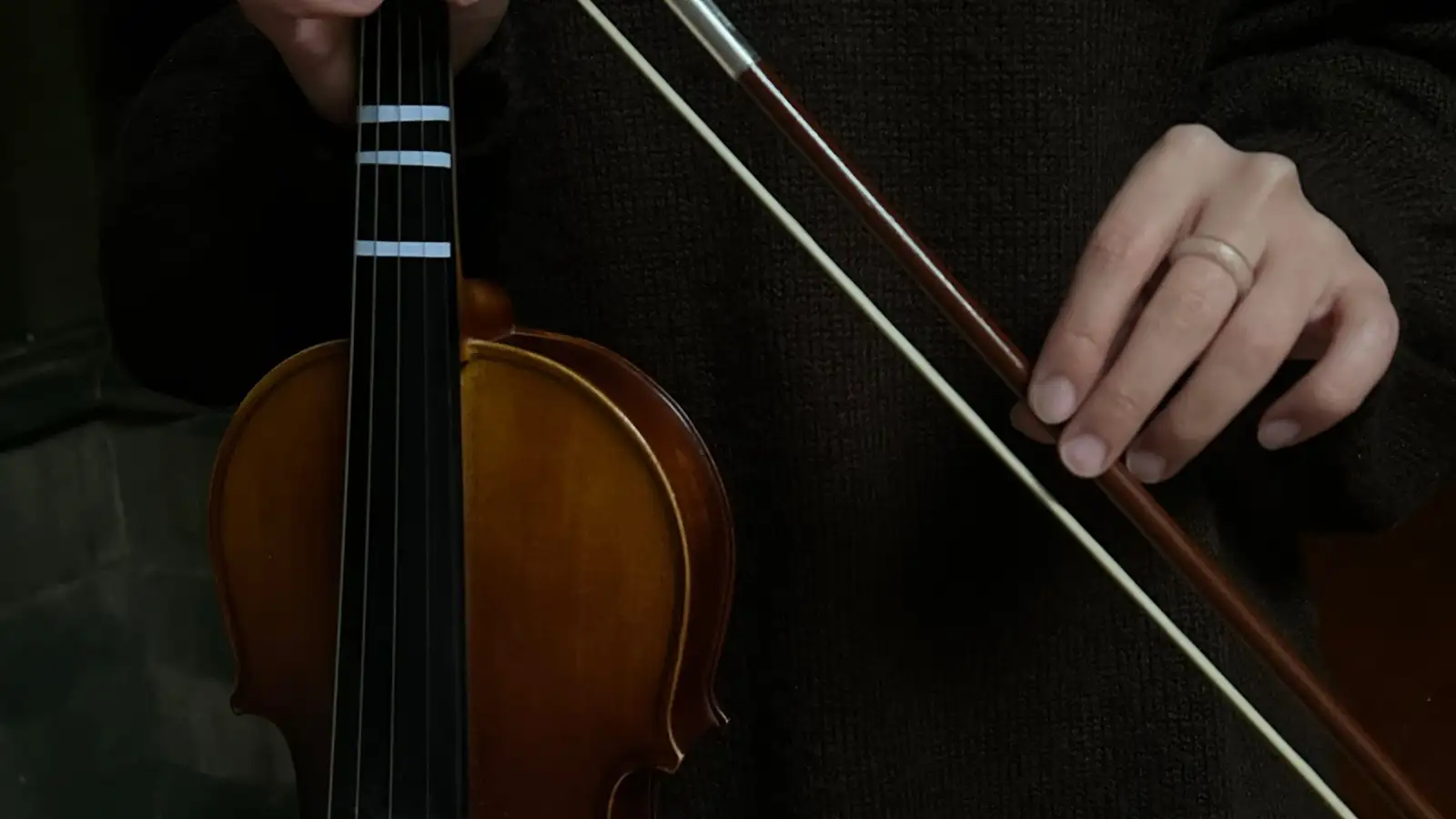
Violin tone comes down to three bow variables working as a set: bow speed, bow pressure, and contact point - how far from the bridge the hair meets the string. None of the three shapes tone on its own, and changing just one almost always makes the sound worse before it gets better, because the other two are still set for the old balance. That balance is the whole skill, and it's learnable on an open string in a few minutes a day rather than being a talent you either have or don't.
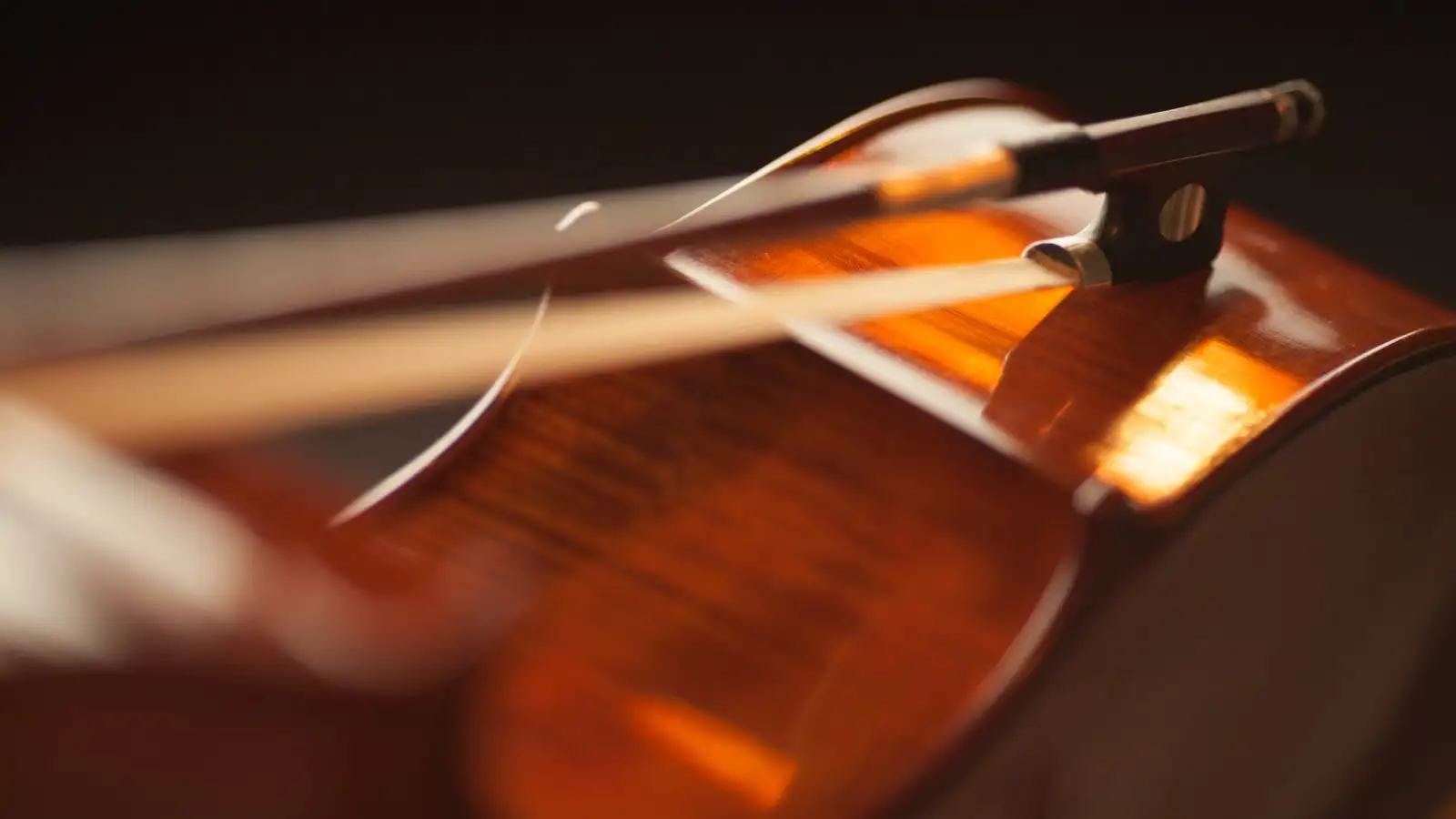
There's a violin on a stand in the corner of my living room, which means I hear a lot of bad tone. Most of it is mine. Come stand next to me. Bow hair flat on the A string, somewhere in the middle of the bow, and I drew a slow four-count downbow. What came out was a chair-dragging sound - buzzy underneath, thin on top, no pitch you'd want to hum. For a long time I thought that sound meant I needed a better instrument, or that I simply wasn't musical. It doesn't. It means speed, weight, and contact point were out of step, and once you can feel which one is off, you can fix it in about eight seconds.
Three dials, wired together
Picture a control panel with three knobs. They are not independent. Turn one and the other two effectively shift with it, whether you meant them to or not.
The reason is mechanical. The hair has to catch the string and let it go, over and over, hundreds of times a second. If it never catches, you get air. If it catches and never releases, you get a crunch. Speed, weight, and contact point are the three ways you control that catch-and-release, and they trade against each other constantly.
Which is why "how do I get better tone" is the wrong question in the form it usually gets asked. The better question is "which of the three is off right now."
Speed on its own
Keep the weight the same and change nothing but how fast the bow travels. Double the speed and the tone thins out - lighter, airier, and eventually so weak that the pitch itself gets fuzzy. Halve the speed with the same weight and the opposite happens: the hair lingers on each inch of string, the vibration gets crowded, and the sound turns crunchy, then gritty.
That's the first thing I'd have you notice. It's also the reason a careful, cautious slow bow with a heavy arm sounds so bad. Slow motion plus heavy weight is the classic beginner combination, and it produces exactly the scratch most people blame on their instrument.
Weight is where the instinct is backwards
When the sound isn't big enough, the hand wants to press. Pressing doesn't add volume. It adds friction, and friction kills the string's freedom to swing. Extra weight flattens the vibration instead of feeding it, and past a certain point the tone doesn't just get louder - it strangles, and you can hear the pitch start to close up.
The weight you actually need is small, roughly what the arm already weighs plus a nudge. And it isn't constant along the bow, because the bow isn't. The end near your hand carries more of the bow's mass, so the same relaxed arm puts more weight on the string there; down at the tip there's less bow behind the hair, so the same arm feels lighter. Most people compensate unconsciously by doing the opposite of what they should - bearing down at the tip and easing off near the frog. If your tone fades out in the last third of a downbow, that's usually why.
So: scratchy sound, first move is less weight and more speed, not less of both.
Contact point is where tone changes character
Speed and weight change the tone's health. Contact point changes its personality.
Slide the bow a half inch toward the bridge, same speed, same weight, and the sound sharpens and starts to carry - brighter, edgier, more projecting. Slide a half inch toward the fingerboard and it goes soft and flutey, rounder, with less core.
What's underneath that: near the bridge the string is stiff and resists the hair, so the same bow input produces a waveform with many more upper harmonics. Near the fingerboard the string is loose and easy to set moving, and you get a rounder, more diffuse sound with fewer of those harmonics. Neither is better. A lullaby lives near the fingerboard. A passage that has to reach the back of a hall lives near the bridge.
There's a reason contact point feels slippery to beginners, and it isn't their imagination. The bow doesn't travel in a perfectly straight line across the string unless you steer it. Left alone, it drifts. Along one long downbow, the sounding point naturally slides toward the fingerboard unless the arm adjusts, and the tone fades out with it. That's why keeping the bow parallel to the bridge is the one thing worth watching in a mirror - not for looks, but because it's what holds the contact point steady.
The rule that ties all three together
As you move the contact point toward the bridge, speed and weight both have to go up, together. Not one, not the other - both.
Move to the bridge and add weight without adding speed, and the string can't release; you get a squeak or a scrape. Move to the bridge and add speed without weight and the bow skates across the top of the string in a thin whistle. Move toward the fingerboard and change nothing else, and you get a soft, hollow sound with no center. The narrow path between those is the tone.
The practical loop I use: pick a contact point, use the least weight that keeps the string speaking, add speed until the sound opens up, then if it turns glassy, add a little weight back. Two variables, adjusted against each other, over and over. It takes a couple of seconds once you've done it a hundred times.
Open strings, one variable at a time
This is the drill that actually taught me any of this, and it's boring in the way that works. All of it on open strings, no left hand, four-count bows.
First pass: weight light, contact point parked at the midpoint, varying only speed - slow, medium, fast. Listen for the moment the pitch stops being clear.
Second pass: speed and contact point fixed, varying only weight - barely touching, natural arm weight, then deliberately too much. You want to hear the crunch on purpose so your arm learns where the edge is.
Third pass: speed and weight fixed, three lanes - near the fingerboard, in the middle, near the bridge. Same bow, three different voices.
Fourth pass: move to the bridge lane and bring speed and weight up together, then back off. That's the actual skill, in miniature.
Five minutes of this is worth more than an hour of playing through pieces, because in a piece everything changes at once and you can't tell what caused what. Some people keep a written note of which pass sounded best; I just do it before I play anything else, the way you'd tune.
When it still sounds bad
Three variables explain most of it, not all of it. Some honest caveats.
Rosin matters at the margins. Too much and the hair grabs and crunches; too little and it slides and whispers. You're looking for the middle, not for more.
Strings age. A dead string has fewer overtones no matter where your bow is, and no amount of contact point work brings them back.
Every instrument has a ceiling and a shape. A dark, mellow violin will never sound bright - you can only move it along the range it actually has. Some violins genuinely choke when you play very close to the bridge, and no technique changes that. You learn the instrument's edges and work inside them.
And the balance is different every day. How much weight your arm carries without thinking depends on how tired you are, how you slept, whether the air is humid. The setting that sounded good yesterday isn't a saved preset. You rebuild it each time you pick up the bow, which is exactly why tone feels mysterious to people who've been told it's about talent. It isn't a setting you find once. It's a balance you renegotiate, every single session, and once you accept that, it stops being frustrating and starts being the most interesting five minutes of your practice.