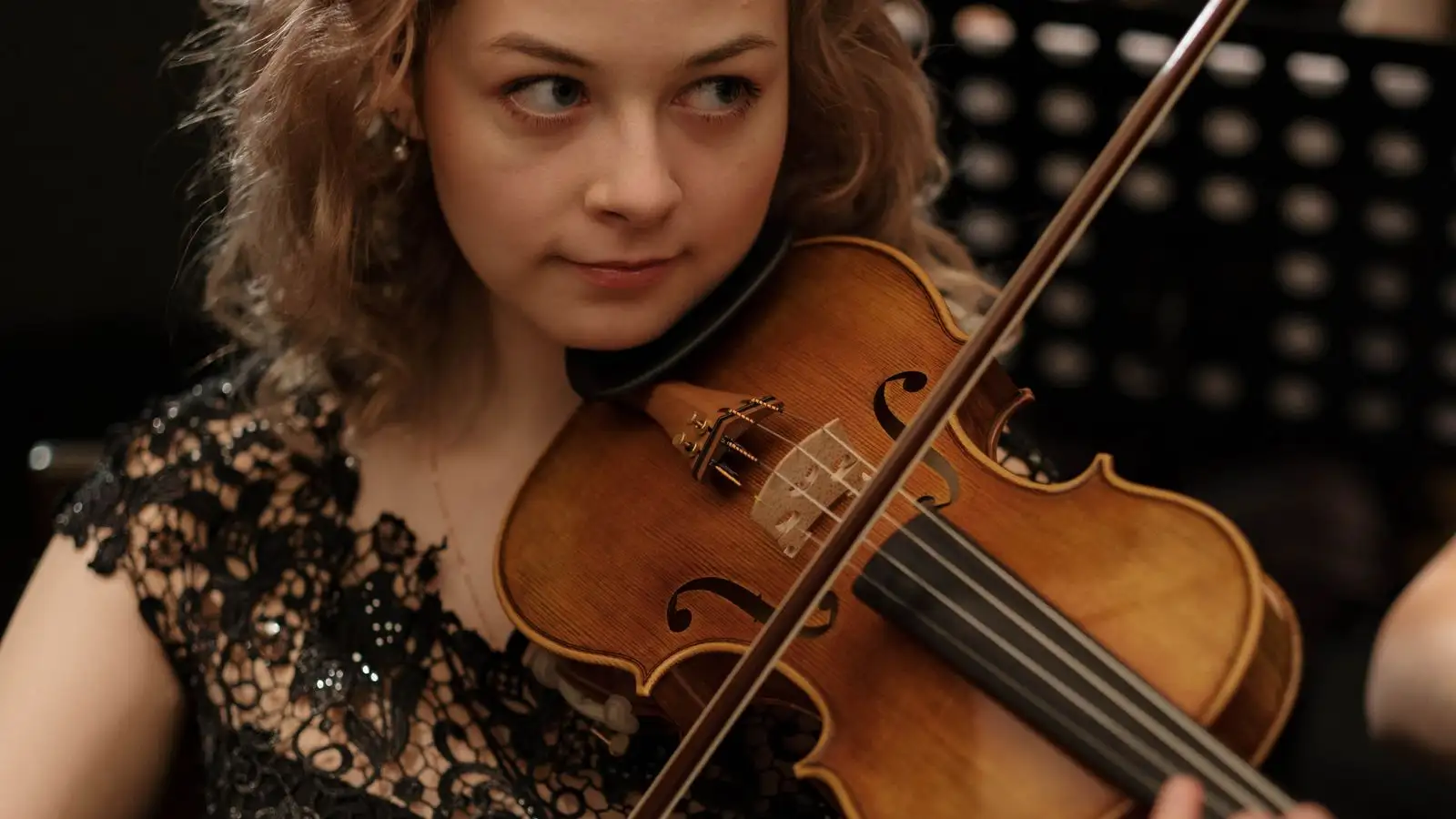
Reading violin music as an adult beginner is not a gate you have to clear before you are allowed to play. It is a second skill that develops alongside your hands, and it arrives in a predictable order: pitch first, rhythm second, key signature third, and the marks that describe how to play a note last. Trying to swallow all four at once is what makes the page feel impossible.
The ten minutes after dinner
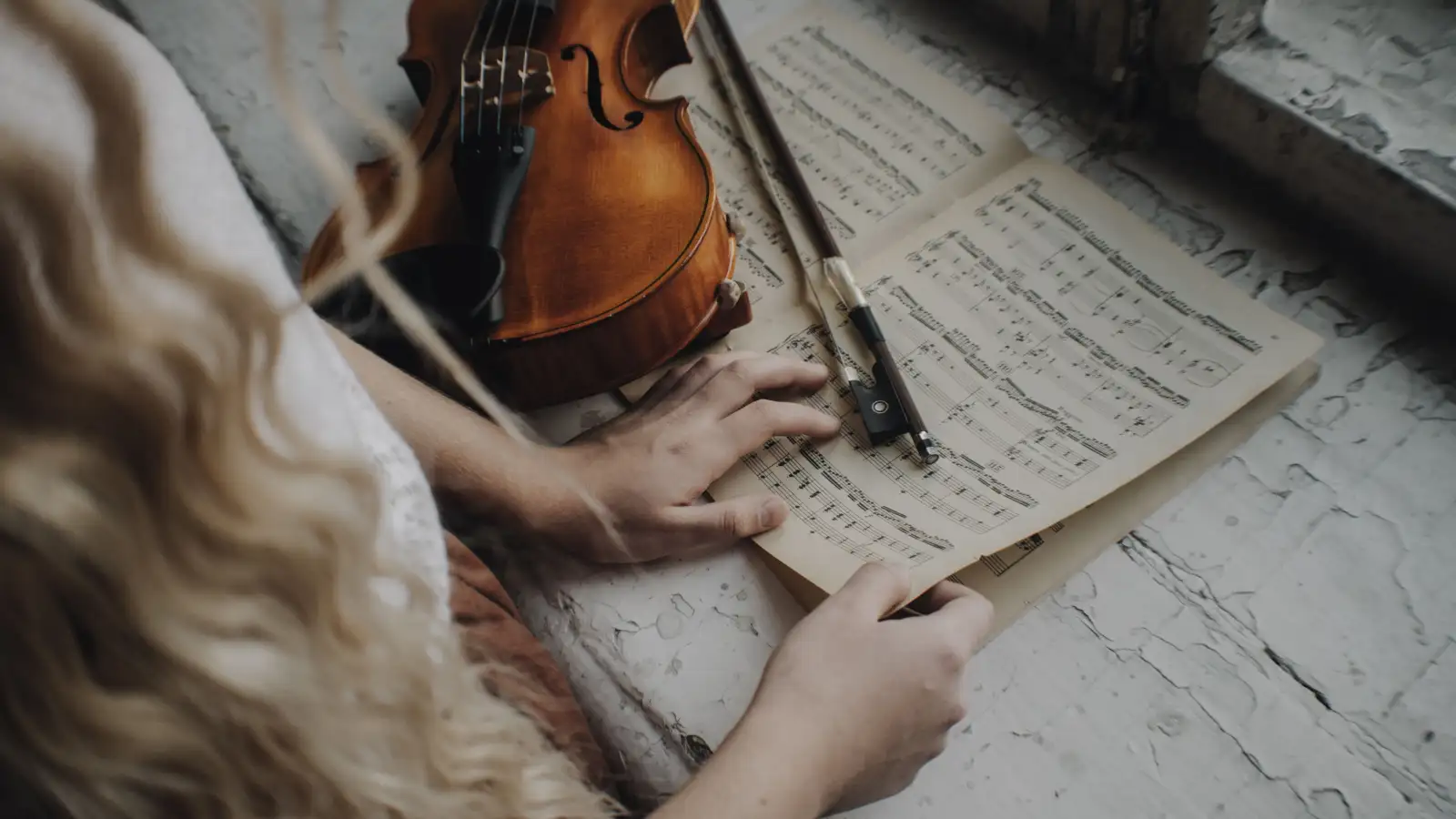
The stand lives beside the bookshelf. The reading block happens after dinner, before the kitchen light goes off. Violin back in the case, pencil in the crease of the book, timer face down. Ten minutes. Not tone. Not technique. Just the page.
Open to the first line. Four bars. And about sixty seconds of looking before a single note gets played.
Here is what those sixty seconds are actually for, and it is the thing I wish someone had said out loud when I started: every printed note is two questions, not one. Which note is it, and how long does it last. Beginners answer the first and guess at the second, then wonder why the tune limps.
Pitch starts with the staff. Five lines, four spaces, and for violin the clef at the far left is the one that curls around the second line from the bottom. That is treble clef. Almost everything a beginner plays lives on that staff or just outside it. The lowest note you will see for a long while is the open G, sitting in the space below the second ledger line under the staff. The highest, in the first months, is whatever is under your top three fingers on the E string, above the top line.
Ledger lines are where the counting gets real. Notes that do not fit on the staff get a short line drawn through or under them, and each new line extends the staff one step at a time. Line, space, line, space. I still catch myself counting them. Three ledger lines above the staff is a note I will see, name, and then play, in that order, slowly, for a while yet.
Then duration, which lives in the shape of the note head and its stem. Hollow with a stem: half note, two beats in the common count. Filled with a stem: quarter note, one beat. Filled with a stem plus a flag, or beamed to its neighbors: eighth notes, half a beat each, arriving in pairs or fours. That is most of what a first-year page contains.
Next come the two numbers at the left, the time signature. The top number is how many beats are in each measure. The bottom number tells you which note value receives one beat. Four over four means four quarter-note beats to a bar. Three over four means three. Early on I read those numbers once and forgot them. Now I check them every time I open something new, because they set the pulse I am about to count in, and getting that wrong makes everything downstream wrong too.
The key signature is the cluster of sharps or flats sitting immediately after the clef, and it is easy to underestimate. It is not a note-by-note instruction. It is a standing rule for the whole piece: every matching note gets that sharp or flat automatically, for as long as the piece lasts, or until a new key signature appears at a section change. The only thing that cancels it is a natural sign, and only for that note, in that measure. I spent a ridiculous amount of time early on re-reading the same sharp every time it appeared, as if it were new information each time.
The order matters more than the list. Rhythm shows up on day one. The key signature usually shows up after you can already find the notes, because most very first tunes have no sharps or flats at all, or exactly one. That is the reverse of what adults brace for. We prepare for the sharps and flats and assume the counting will sort itself out, and it is almost always the counting that is actually holding the tune back.
Marks that tell you how, not which
The small marks written above and below the notes belong to a different category entirely. They describe how to play a note you have already identified.
A down bow and an up bow symbol tell you which direction to move the bow. A slur curving over a group of notes says to play them in one bow stroke. A p or an f is a dynamic, telling you soft or loud. Fingering numbers, 1 through 4, with 0 for an open string, tell you which finger to drop.
The fingering numbers are worth dwelling on, because they are not the same kind of information as a piano fingering. On a keyboard, a written note determines a key. On a violin, a written note often leaves you a choice. The same pitch can be played on more than one string, and the choice changes the color and the ease of the phrase. So the number over the note is somebody's decision, not an inevitability. That is also why an edited part can carry penciled numbers that differ from the printed ones.
This is the reason the page gets denser without getting harder. Once pitch and duration are automatic, the attention you used to spend decoding is free for the bowing and the dynamics. The page is not adding difficulty. It is spending attention you no longer need.
Why the book moves so slowly
A method book introduces one new note, one new rhythm, and one new string at a time, and it does that on purpose. Adults read the pace as condescension. It is closer to load management. Reading and playing draw on the same attention, and if both get harder in the same week, the week falls apart. When a book adds a single note and holds everything else steady, it is keeping the reading load level with the playing load.
The practical consequence is that you should not try to outrun it. Skipping ahead to a piece with three new notes, a new rhythm, and two ledger lines means the page stops being readable and starts being a decoding exercise you happen to be holding a violin during.
The block that does the actual work
Five to ten minutes a day of reading, kept separate from technique practice, builds fluency faster than occasional long sessions. Separate is the operative word. If reading only ever happens while you are also working on bowing and tone, it never gets practiced on its own, and it stays expensive.
What I do in that block is simple. Read the notes out loud by name, in rhythm, without the instrument. Then play the same line slowly enough that the eyes stay one or two notes ahead of the hands. The eyes-ahead part is the whole skill. It is the difference between reading and reacting.
It depends on your background, and it is worth being honest about that. If you already read piano music, pitch naming will feel familiar within weeks, and the real work will be learning that a single melodic line maps onto strings and fingers you choose, not keys that are simply there. If you come from guitar, the treble clef will look familiar too, but guitar music is written an octave higher than it sounds, so a written note and a violin note are not the same note. That trips up more transfer readers than anything on the staff itself.
What none of it requires is a finished course in music theory before you are allowed to make a sound. The notes, the counting, the key signature, and the bowing marks are not a checklist you complete. They are a sequence you walk through, over and over, each pass a little cheaper than the last.