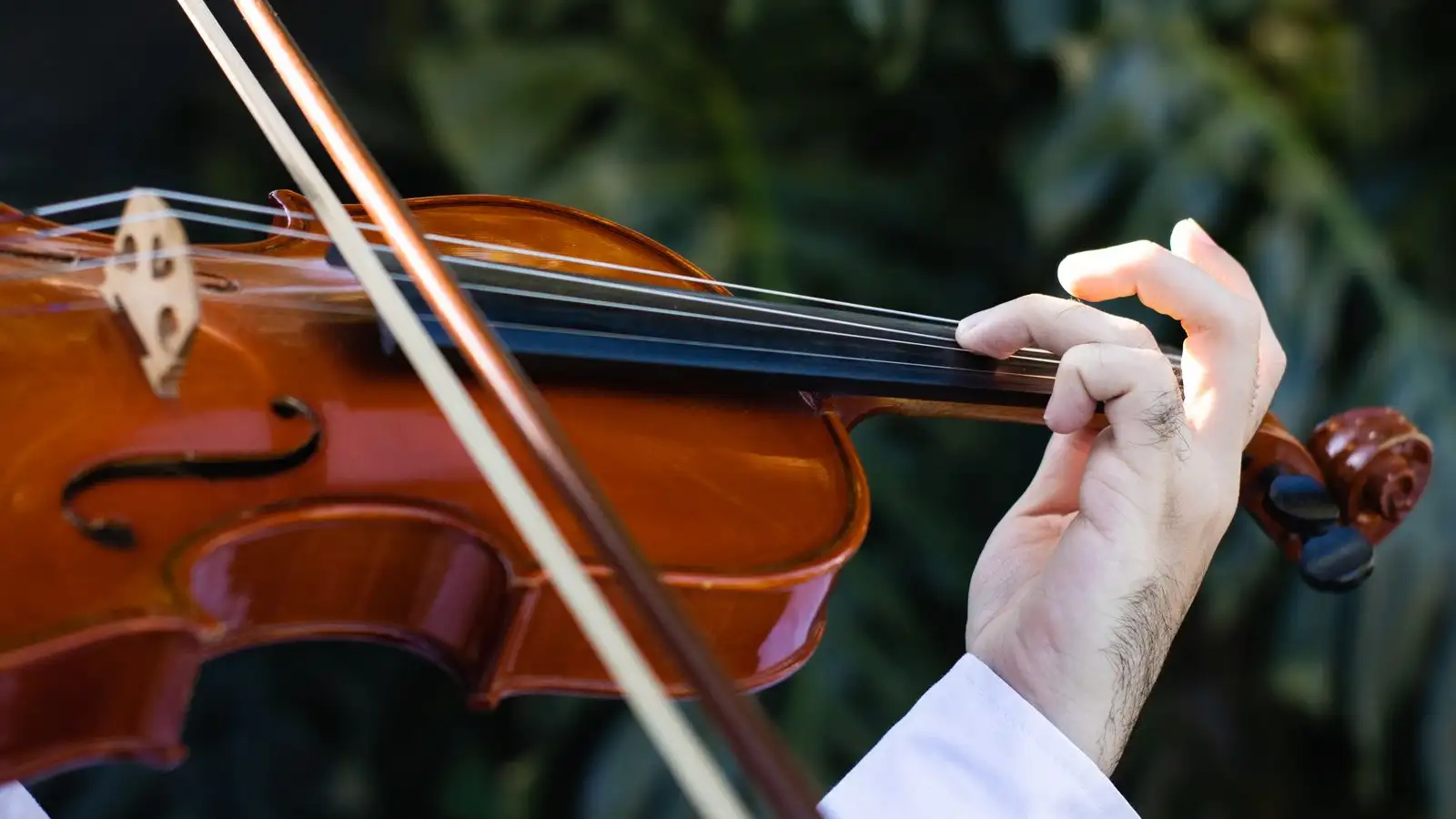
Almost all of the left-hand work an adult beginner needs can be done with the bow lying on the bed, so a late-night, thin-walled-apartment practice window is not a watered-down session — it is a complete one. Finger independence, the knuckle-led drop, and silent presses on the strings train the same coordination the bow would only make audible later, and a few minutes most nights builds it faster than one long weekend session.
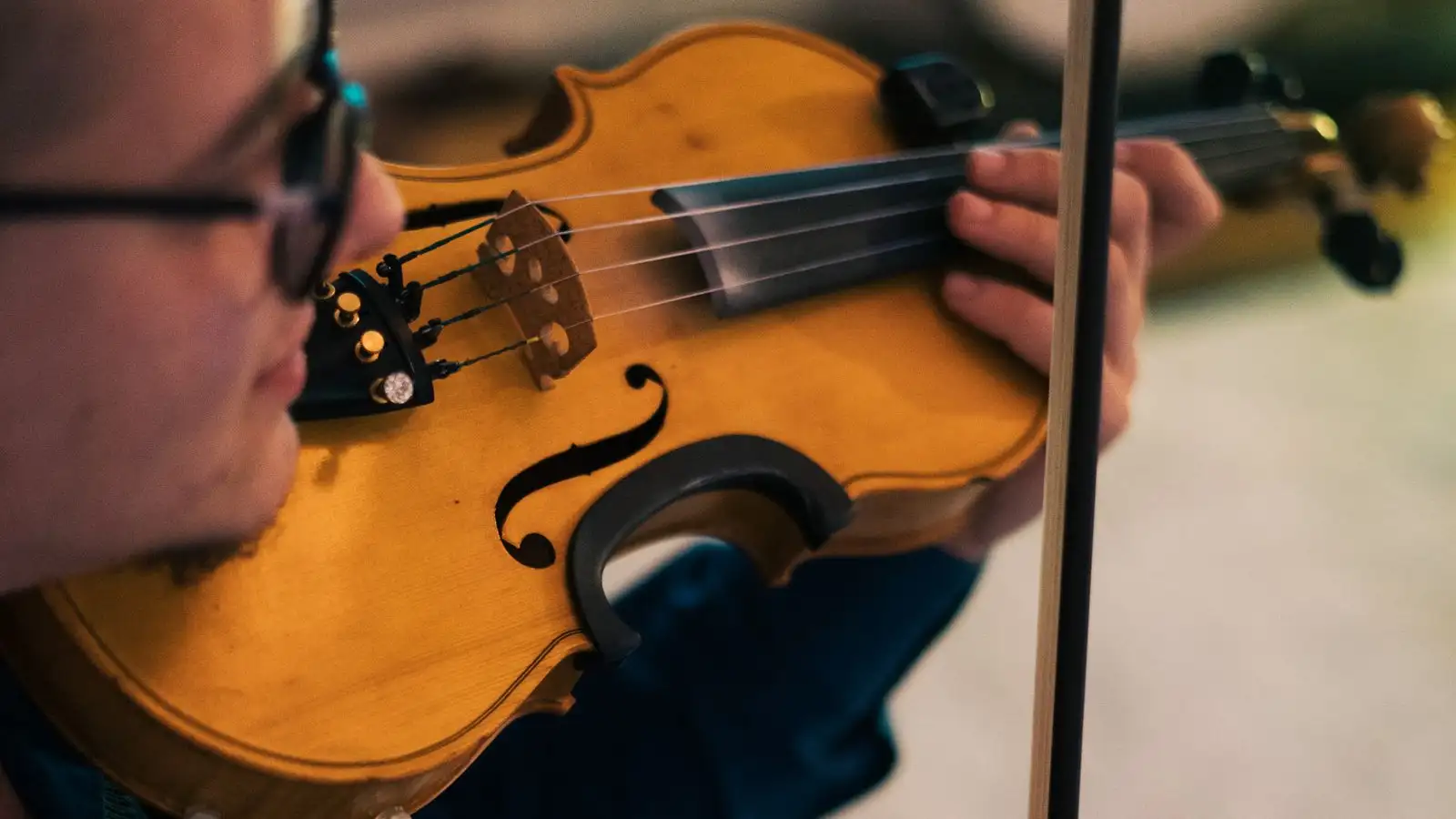
The bow is on the bed, still rosined from yesterday. The radiator is ticking. It is a little before midnight, and I am on the floor with my back against the bed frame, violin on my shoulder, left hand up at the neck. My right hand is doing nothing at all.
This is most of my practice now, and it took me an embarrassingly long time to stop treating it as the leftovers of real practice. When a neighbor is on the other side of the wall and the alarm goes off at 6:20, the useful question is not "how do I make the violin quieter." It is "what can this hand learn while the bow stays where it is." The answer, at my level and probably at yours, is almost everything the left hand does for the first couple of years.
The bow makes the hand audible. It does not teach it.
Think about what actually goes wrong when a note change sounds messy. Say you are moving between two fingers in first position and one note smears into the next. Most of the time the bow is not the problem. A finger that was supposed to stay planted lifted a little. Or a finger that was supposed to drop landed a quarter inch off and slid. Or the whole hand squeezed to help a weak finger reach, and the squeeze moved everything else.
None of those are bow problems. All of them are visible, and fixable, in a room with no sound in it.
Once that landed for me, the quiet window stopped being a limitation and turned into the place where most of my progress happens.
Start at a table, not at the violin
Sit down somewhere. Put your forearm flat on the table, palm facing down, fingers curved as if they were sitting on strings — round, not flat, not clenched. Thumb relaxed underneath, not gripping the edge. Now tap index, middle, ring, pinky in order, one at a time, and come back down the way you came. If you count them the way violinists do, that is 1 through 4, index to pinky.
That is the whole drill. It is also the drill most people do wrong.
The first failure is speed. Tapping fast feels like progress and it is not; it lets the fingers slap down from the middle joint and hides whatever the other three fingers are doing. The second failure is that people watch the finger that is tapping. Watch the ones that are not. Put your index down and hold it there. Now tap the middle finger ten times. Did the index move? Did it twitch at the tip, or lift slightly at the base? If it did, that is the exact motion that turns a clean note change into a bump, and it is worth two minutes right there at the table.
Then make it harder. Hold 1 and 2 down, tap 3. Hold 1, 2 and 3 down, tap 4. The pinky usually gives the game away, and the culprit is almost never the pinky itself — it is the hand rotating or the index's base joint collapsing to buy the pinky some reach.
I do this on the table, on my thigh while the coffee heats up, on the arm of the couch. It costs nothing, needs no instrument, and nobody in the building knows it is happening.
The finger should fall from the knuckle, not reach from the wrist
This one changed my intonation more than any amount of slow bowing. When I started, I dropped my fingers by straightening them. The finger came down mostly from the middle joint, so the tip traveled in a curve, arrived at a slightly different place every time, and the palm tensed up to compensate. My notes were close enough to fool me and never close enough to fool anyone else.
The fix is to drop from the base knuckle — the joint where the finger meets the hand. Keep the finger already curved the way it will be when it lands, and let it fall and lift from that base joint in a short, nearly straight line. Because the path is short and vertical, the tip comes back to the same spot. That is most of what "accurate finger placement" means at the beginning: the same spot, repeatedly, without the hand doing anything else.
There is a cheap test for whether you are doing it. Put a fingertip lightly on a string. Lift it a quarter inch, no more, and let it come straight back down. Do that ten times. If the tip lands on the same millimeter every time, you are hinging from the base. If it drifts up or down the string, the finger is reaching, and the reach is what needs fixing, not the target.
On the strings, in near silence
Once the table version gets boring, move to the instrument without the bow.
Two versions, and both are quiet enough for a shared wall at midnight. The first is the silent press: set a finger on a string and press just until the string touches the fingerboard. You hear a soft, muffled tick, quieter than a page turning. Release. Do it again. What you are checking is whether the string is fully seated before you move on, because a string that is not quite down is the reason a note buzzes or sounds thin later.
The second is a barely-there pluck: right thumb, one string, just enough to hear the pitch. A few in a row tell you whether the finger landed cleanly, and they are quiet enough that the sound does not leave the room. Keep the count low. Loud is not available at this hour, and you do not need it — the information is in whether the note rings clear or chokes.
A few things I watch for while doing this:
- The index finger's base joint collapsing every time the pinky reaches for its note, especially in first position on the low strings, where the reach is the longest of the basic hand shapes.
- The thumb creeping up above the neck or squeezing against the side of it. That is usually a sign the hand is helping a finger that has not been drilled enough on its own.
- The wrist bending to carry the hand sideways instead of the elbow swinging under the instrument. You can train this silently: walk a scale pattern with no bow and no sound, letting the elbow do the traveling under the violin while the hand shape stays put.
Now and then I prop my phone against a mug and record twenty seconds of the hand in low light, or watch it in a mirror. Watching it back tells me more than how it felt, because it felt fine right up until I saw the palm rotating.
Two minutes is a session
The biggest advantage of bowless practice is that it fits into the gaps in a day. Two minutes between the dishes and the laundry. Three minutes on the couch before bed. That is not a lesser version of practice. For finger coordination in the first year or two, it may be the better version, because that kind of control settles in through repetition and sleep rather than through volume.
Thirty minutes on Saturday, once, mostly gets me a tired hand, a bit of tension, and the habit of practicing tension. Three focused minutes on a Tuesday night builds something that is still there on Wednesday. So I stopped grading sessions by length. A quiet session counts if the fingers did something they could not do last week, even slightly, even silently.
What this will not do
The left hand is not the whole instrument, and a bowless hour does not make up for a week of not bowing. Tone, bow distribution, string crossings that sound smooth — none of that is in here, and no amount of tabletop tapping gets you there. When I only get quiet windows for several days, it is my bow arm that goes rusty, not my fingers.
The other limit matters more. There is a version of "I will just practice on my own quietly" that turns into months of drilling a habit that is slightly wrong, because from the inside, wrong and right feel nearly identical. A few minutes with a teacher watching your hand catches things a mirror and a phone camera will not. And if something hurts — a persistent ache in the thumb, wrist or forearm, or tingling that lingers — that is a stop-and-ask-someone situation, not a drill-harder situation. New-use soreness in the fingertips is one thing. Pain that stays is another.
The last five minutes
By the time I finish, the neighbor's TV has clicked off and the building is quiet in that specific way old buildings get after midnight. I play one slow scale with no bow and no sound, just to feel whether the hand is less braced than it was forty minutes ago — whether the fingers are falling or reaching. Then the violin goes back in the case and the bow stays exactly where I left it.
Four fingers, a tabletop, and a door that stays closed. That is the session.