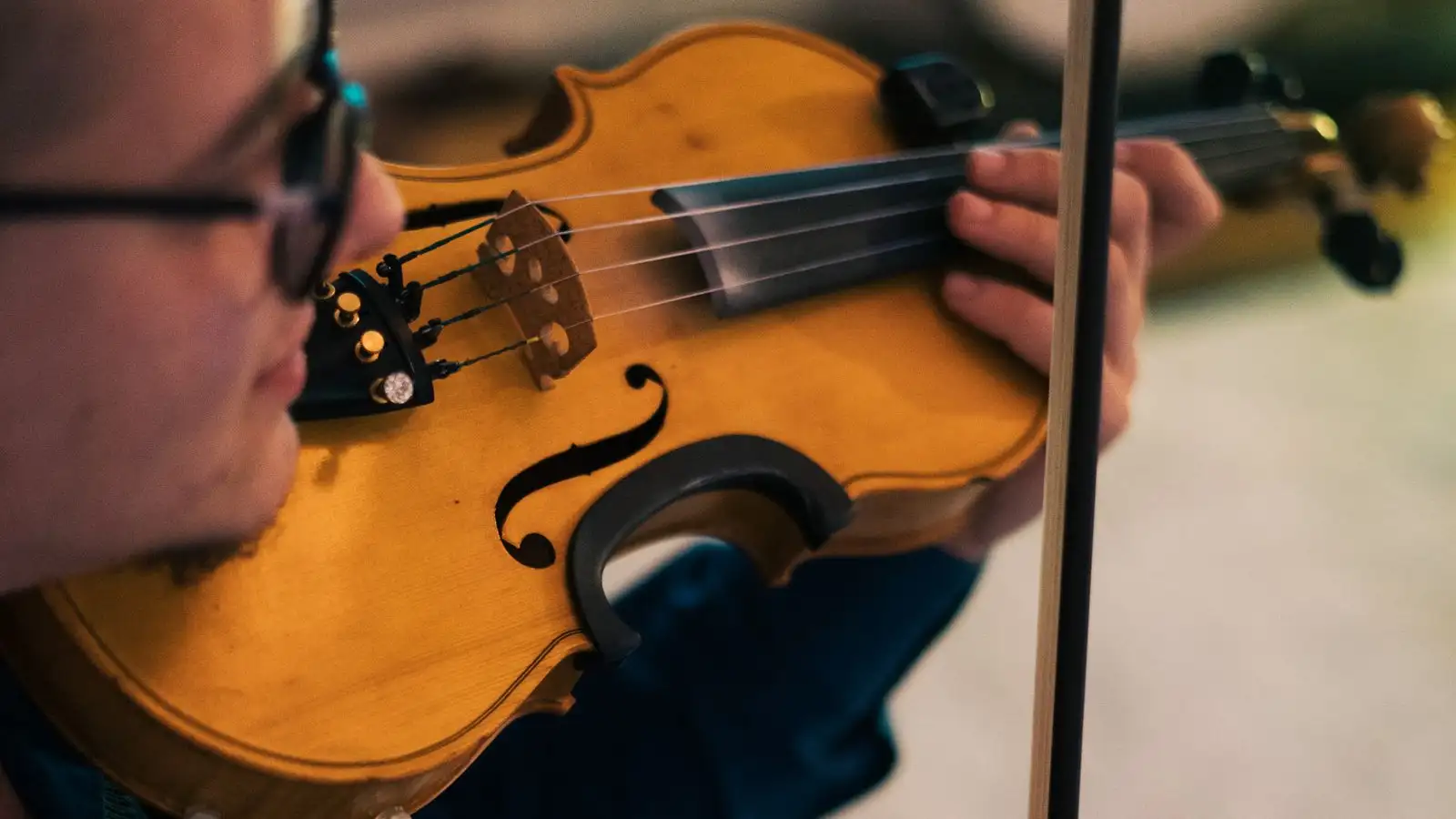
A violin slides toward your chest when you reach for the G string because the left hand is being asked to do two jobs at once — hold the instrument up and travel across the strings — and it can only do one of them well. Getting the fingers over to the G string is a rotation that starts at the elbow, not at the fingertips. When the elbow is parked back against the ribs, that rotation has nowhere to come from, so the hand pulls the neck across instead, and the whole instrument pivots on the chin and collarbone. Put the violin's weight on the chin and shoulder where it belongs, then bring the left elbow forward and under the body of the violin, roughly in line with the scroll. Most slides die right there.
The thirty seconds that made it click for me
Sit on a hard chair, feet flat, violin up. Play a slow open D — four counts down bow, four counts up — and let it ring while you notice what's actually touching you. The chinrest at the jaw. The back edge of the instrument resting on the collarbone and the front of the shoulder. That's it. That is the entire support system, and it's carrying the violin. The left hand is a passenger along for the ride.
Now, still bowing, slide your first finger across to the G string and change nothing else. Don't adjust your elbow, don't think about your wrist. Just reach with your fingers.
You feel it before you hear it. The scroll swings left. The chin contact point creeps to a different spot on your jaw. The bow — which you didn't move — is suddenly closer to the fingerboard, so the tone thins out and goes glassy. If you keep your eyes on the scroll, you can watch it dip.
Set up again, and this time move the elbow first. Bring it forward and under, pointing roughly where the scroll points, and let the hand ride the elbow over to the G string.
The violin stays put. Maybe the note is still ugly. But it stays put, and that's the part you're fixing today.
The hand can hold the violin or it can travel along the neck, not both
This is the whole idea, and I had it backwards for a long time. I thought a sliding violin meant I wasn't holding firmly enough, so I clamped harder with my chin and pressed harder with my thumb. That works for about eight bars. Then your jaw aches, your thumb locks, and the moment you reach for the G string again the violin rotates anyway, because you've just added two more rigid points to a system that needs to move.
Test it in five seconds. Get the violin comfortable under your chin, then lift your left hand completely away from the neck. Let the arm hang. The violin should stay exactly where it was — same height, same angle, scroll level. If the scroll dives or the instrument rolls forward, the left hand has been carrying weight the chin and shoulder should own.
This is also why the left hand feels better on the A and D strings than on the G. Your hand's neutral, relaxed shape sits over the middle of the fingerboard. The G string and the E string are both a reach away from that neutral shape, and the reach has to come from somewhere. If it doesn't come from the arm, it comes from the neck, and the neck brings the whole violin with it.
The elbow is a hinge, and it points at the scroll
The left elbow belongs under the body of the violin, roughly in line with the scroll. Not tucked back against the ribs. That tucked-back position is the one most of us default to, because it feels like the arm is out of the way and the violin is closer to the body. Mine drifted there constantly.
The quickest way to feel the difference is to deliberately find the wrong position first. Touch your left ribs with your elbow. Bow a few notes on the D string. It's fine, right? Comfortable, even. Now reach for the G string and notice how much of the movement comes out of your hand and wrist. All of it. Your elbow is a dead end back there, so the reaching has to happen in a joint that isn't built for it, and the pull travels straight up the neck into the chin contact point.
Now rotate the elbow forward, around, and under the instrument. It should feel like it's pointing along the same line as the scroll.
Once the elbow is under there, it becomes a hinge, and the hinge is what aims the fingers. Rotate it slightly inward and the fingers rotate toward the G string. Rotate it slightly outward and they rotate back over toward the E. You're not stretching your fingers further. You're turning the whole forearm and letting the fingers arrive wherever they land.
That's the part that surprised me. The G string isn't a long reach. It's a small turn. Players who reach for it with their fingers get a slide and a pinched note where the flesh catches the side of the string. Players who turn from the elbow get a note that lands where they expected it to.
Keep the wrist in the line
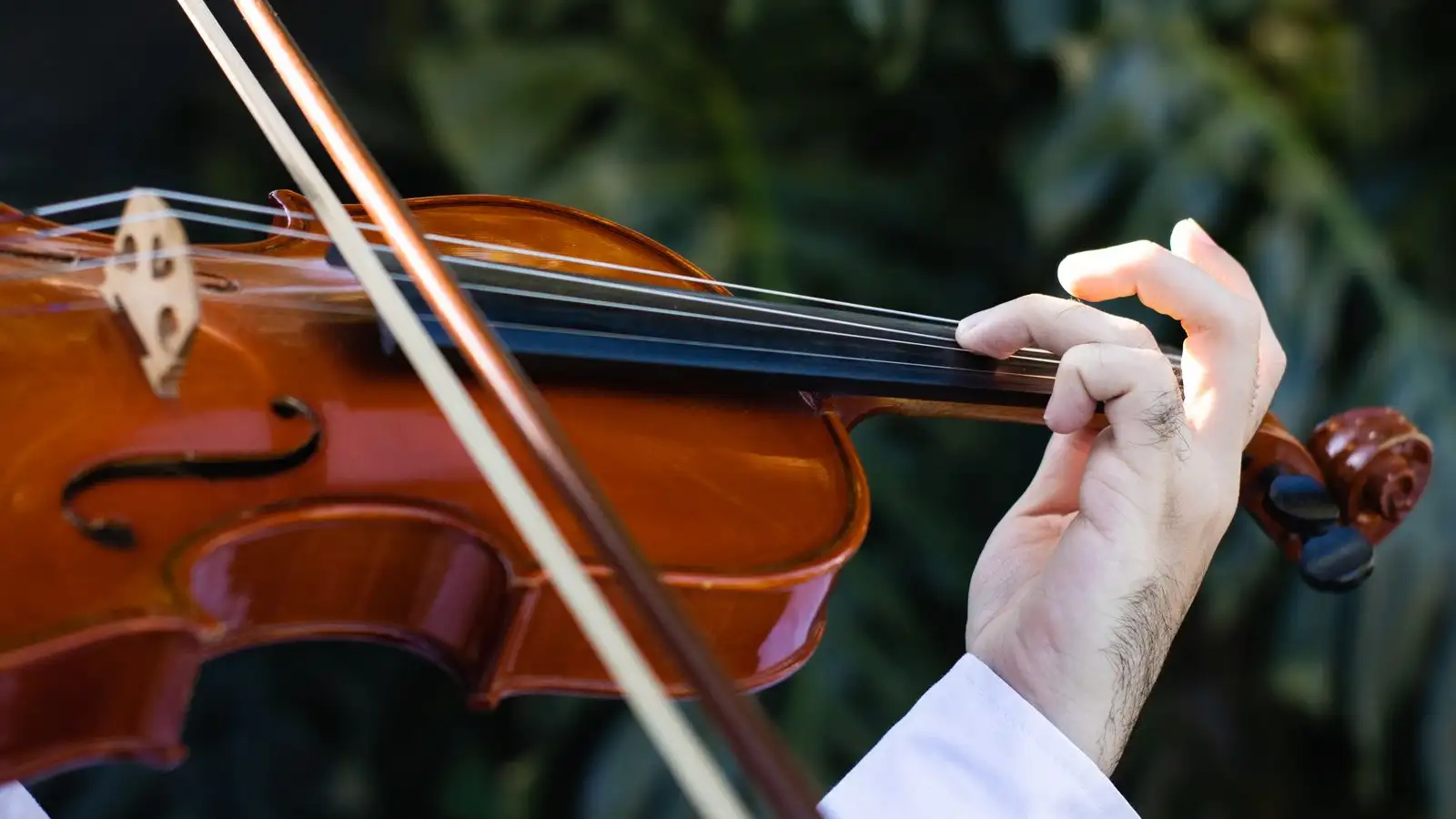
Here's the second half of it. Forearm, wrist, and hand should form something close to a straight line. Not rigid, not locked — just not broken.
When the wrist collapses — bends toward the palm, which is the instinct when you're straining to reach — you lose reach. You'd think bending would get you further, the way your fingers curl forward, but the collapse rotates the hand down and back, and the fingers end up pointing at the fingerboard from a worse angle. The hand has to make up the difference somehow, and the somewhere is the neck, which means pulling.
A collapsed wrist and a sliding violin are the same problem wearing two different hats. Straighten the wrist and half the slide goes away on its own.
The arm rises toward the G and lowers toward the E
The left arm isn't a fixed bracket. It should ride up slightly as the hand crosses toward the G string and settle down as it crosses back toward the E. Watch a player who's locked it in one position and you'll see the compensation show up in the shoulders, the head, the chin — the instrument rolls, the head tilts, the bow drifts. The arm has to follow the strings, or everything else tries to follow for it.
Try a slow scale on the G and D strings in first position, one octave, no rush. Then do the same octave on the A and E strings. Watch the scroll in a mirror or in the reflection of a dark window while you do it. On the G-string octave the scroll should sit level or just slightly high. On the E-string octave it should stay level while the arm settles back down.
If the scroll is doing a little dive-and-recover on every string crossing, that's the slide in slow motion, and you've just caught it in time.
What actually goes wrong when you grip harder
Everyone's first instinct is more chin pressure. I understand it. It feels like the instrument is loose and you're the clamp.
But a clamp only works if the thing it's clamping is rigid, and your head isn't. Press your chin down hard and you lock your jaw, tilt your head forward, and push the violin out of the natural pocket under your jaw. Now the instrument is sitting on a worse base and you need even more pressure to hold it. That's the loop.
The chin contact is a resting point, not a grip. Most of the stability comes from the simple fact that the violin is lying on a shelf made by your collarbone and shoulder, with the chinrest sitting lightly against the jaw. The thumb on the neck is a guide for where the hand is, not a clamp for keeping the violin from falling.
Where your body shape changes the answer
I'd be lying if I said there's one universal position. There isn't.
If you have a long neck, the violin will want to sit low under your chin and you'll find yourself dropping the scroll to see the strings. A little more height under the shoulder fixes the geometry and changes the elbow angle you need.
If your arms are short, the violin may need to come around toward the front a bit more so the elbow can reach its under-the-body position without your shoulder hunching up to help.
Kids on fractional-size instruments have their own version of this. A violin that's too large for the arm forces the elbow back into exactly the position that causes the slide, so a child fighting this is sometimes fighting a size, not a technique.
And if you use a shoulder rest, its height matters more than its shape. A rest that's too high tips the violin up and pushes your chin contact toward your jaw hinge; one that's too low lets the instrument sink and drags your elbow back. Change one thing, play ten seconds, notice where your elbow wants to go. That's the whole adjustment.
The five-minute check I still run
Get the violin up and play open D.
Lift the left hand off entirely for two seconds. Did the violin move? If yes, the hand is carrying it. Reset.
Bring the left elbow forward and under, roughly in line with the scroll.
Rotate the elbow inward and cross to the G string without letting the thumb do more than lightly guide the neck. Watch the scroll. It should not dive.
Straighten the wrist. Bow four slow notes on the G string. If the tone goes thin and the bow walks up to the fingerboard, the violin has rotated and you've found the leak.
Cross back to the E and let the arm settle down. Watch the scroll again.
That's it. No new notes, no new music, no metronome. You're just teaching the arm that it's the support structure and teaching the fingers that they're the crew.
The slide stops being mysterious the moment you stop trying to fix it with your hand.