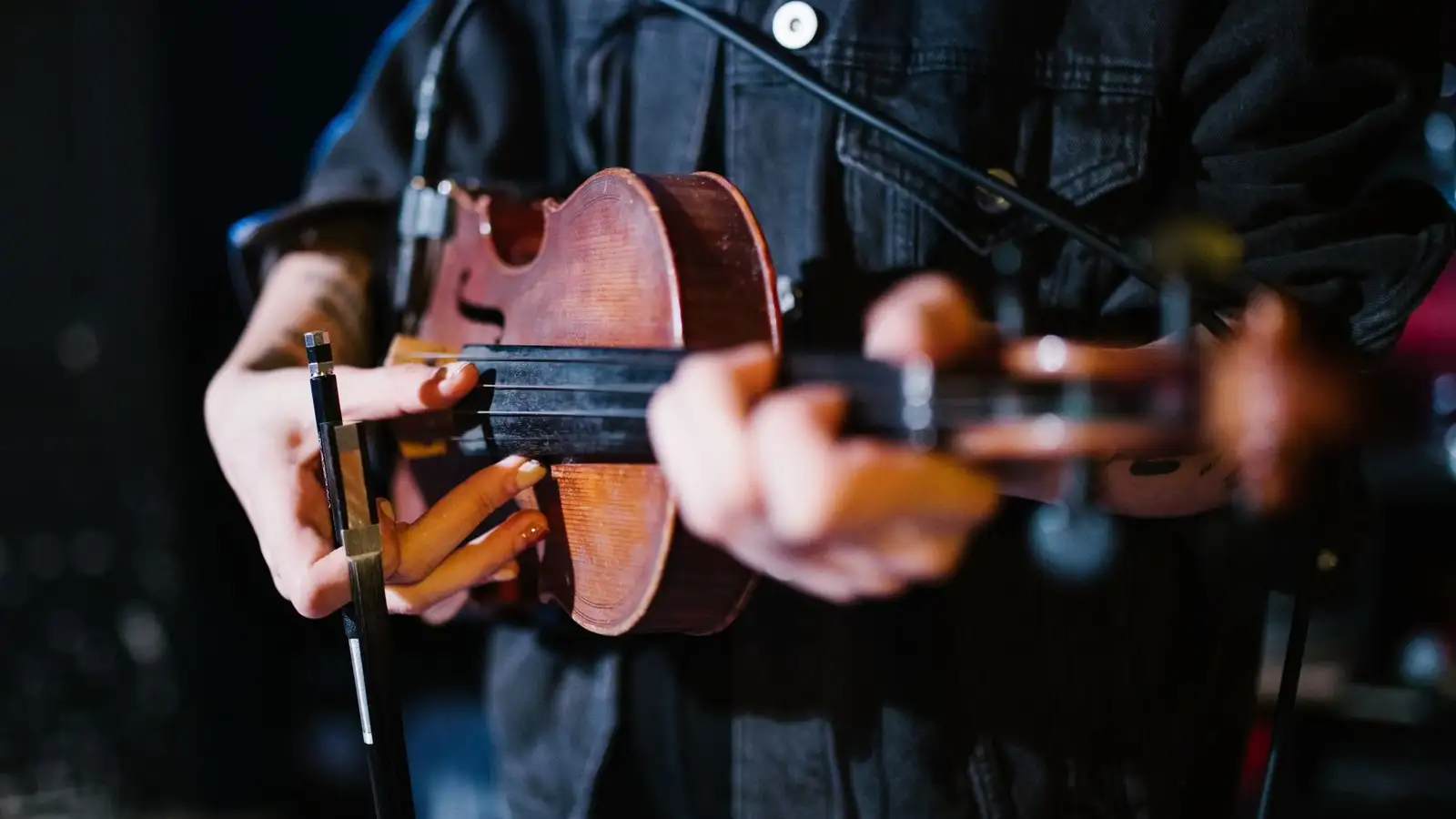
The simplest way to hear an electric violin without an amp is to find out which of two instruments you actually own before you plug anything in. If there is a headphone jack and a volume knob on the body, put headphones straight into it and you are finished. If the only output is a standard 1/4-inch jack, the shortest working chain is violin, one cable, one small headphone amp or audio interface, headphones — a single gain stage, not a rig. Almost every dead end starts with buying the middle of the chain before checking the ends of it.
I did it backward. Ten at night, sitting on the carpet with the violin face down across my knee, phone propped against a book so the flashlight would hit the side panel, and I was already annoyed at a small box I'd bought that had four knobs and no obvious job. The instrument had a volume wheel and a battery door I had never opened. It also had a 1/4-inch jack. That was the whole story, and it took twenty minutes of turning the thing over to read it.
Turn yours over now. Look for three things: a jack, a wheel or a switch, and a battery compartment. A jack alone means the violin is passive — the pickup is making a signal, but nothing inside the instrument is boosting or shaping it. A jack plus a battery door means there is a preamp in there, and the violin can usually drive headphones by itself. That distinction decides everything downstream, and it is printed on the instrument in the form of hardware, not words.
What the box actually has to do
A pickup on a violin produces a small, thin signal, and it does it at a high impedance — think of it as a signal that is easy to weaken and hard to push. Whatever you plug into has one job: raise that signal to something headphones can use without loading it down so much that it goes quiet and scratchy. A headphone amp does that. An audio interface does that and also sends the sound into a computer. An instrument amplifier does that and then makes it loud in the room, which is usually more than the moment requires.
Notice what is not on that list: a full performance amplifier. Nothing about practicing at eleven at night needs a speaker moving air. The amp is for the other thing — the gig, the band, the room. The practice job is headphones.
The chain, link by link
Here is the sequence I run through when someone tells me their electric violin doesn't work.
Start with the violin itself. If it takes a battery, put a fresh one in. A dead battery in an active violin produces total silence, and it produces it in a way that feels exactly like a broken instrument. I have watched people start shopping for pickups over a battery.
Then the cable. The end that goes into the violin is a 1/4-inch plug, the same size as a guitar cable. One end there, the other end into the box. If the box only accepts a 3.5 mm input, you need an adapter, and this is where a lot of silence lives. An adapter that changes the size but also changes the wiring — mono to stereo, or the reverse — can give you half a signal, a weak signal, or a hum instead of a note. If you get sound in one ear only, suspect the adapter before you suspect the violin.
Then the headphones. Plug them into the box, not into the violin, unless the violin has its own headphone jack. Bring the box's volume up slowly from zero, because the pickup is quiet and the gain is doing real work.
Last, the box's power. Most small headphone amps run on a battery or over USB. An interface usually has to be connected to a computer or a phone before it will pass any sound at all, which surprises people. If it has a light, the light matters. No light, no signal path.
The passive violin problem
This is the one that costs beginners the most time. A passive electric violin — pickup, jack, nothing else — plugged straight into a pair of headphones will not work, and it will not work in a way that teaches you anything. Headphones need a powered signal. A passive pickup cannot supply one.
The same violin plugged into a device with a low-impedance input can also sound wrong instead of silent: thin, quacky, weak on the low strings, loud in bow noise. That is an impedance mismatch, not a bad violin. An external preamp — a box whose only job is to present the pickup with a friendly load and hand a healthier signal to the next thing — fixes it. Some headphone amps have enough input flexibility to manage this on their own and some don't. If your setup makes sound but sounds bad, that is the likely reason, and it is a matching problem, not a quality problem.
What the smallest setup gives you that a rig doesn't
Here is the part I would have wanted someone to tell me earlier. When you practice in headphones at low volume, you hear things a speaker in a room hides: the scrape before the tone, the weight of the bow change, the exact moment the intonation drifts. There is nothing between your ears and the pickup. It is unforgiving, it is fast, and it is the reason I stopped dragging an amp into my practice.
The tradeoff is real, though. Headphones can flatter a bad bow change in one way and expose it in another, and a thin-sounding setup will tempt you to dig in harder than you should to compensate for it. If everything sounds harsh, back the volume off first and ask whether the harshness is the gear or the bow. And keep the violin's own faint acoustic whisper in the room as a reference — it is honest about pitch in a way the pickup isn't.
Where the simple answer runs out
There are setups where a headphone amp is genuinely the wrong tool. If you need to play with a band, you need to move air and be heard, and that means an amplifier or a powered speaker. If you want to record yourself and listen back, an interface earns its extra step. If you're plugging into a house system at a gig, you want the box the sound engineer expects to see, which is not the one on your nightstand.
But those are later problems. Tonight the only question is whether sound comes out of the headphones, and the answer is nearly always one of four things: the violin needs a battery, the cable is in the wrong hole, the adapter is the wrong adapter, or the box isn't powered. Check them in that order. It is a short list, and it stays short.
I still keep the four-knob box in a drawer. I never did work out what two of the knobs were for. The violin I play now takes headphones directly, and the drawer is a good place for it.