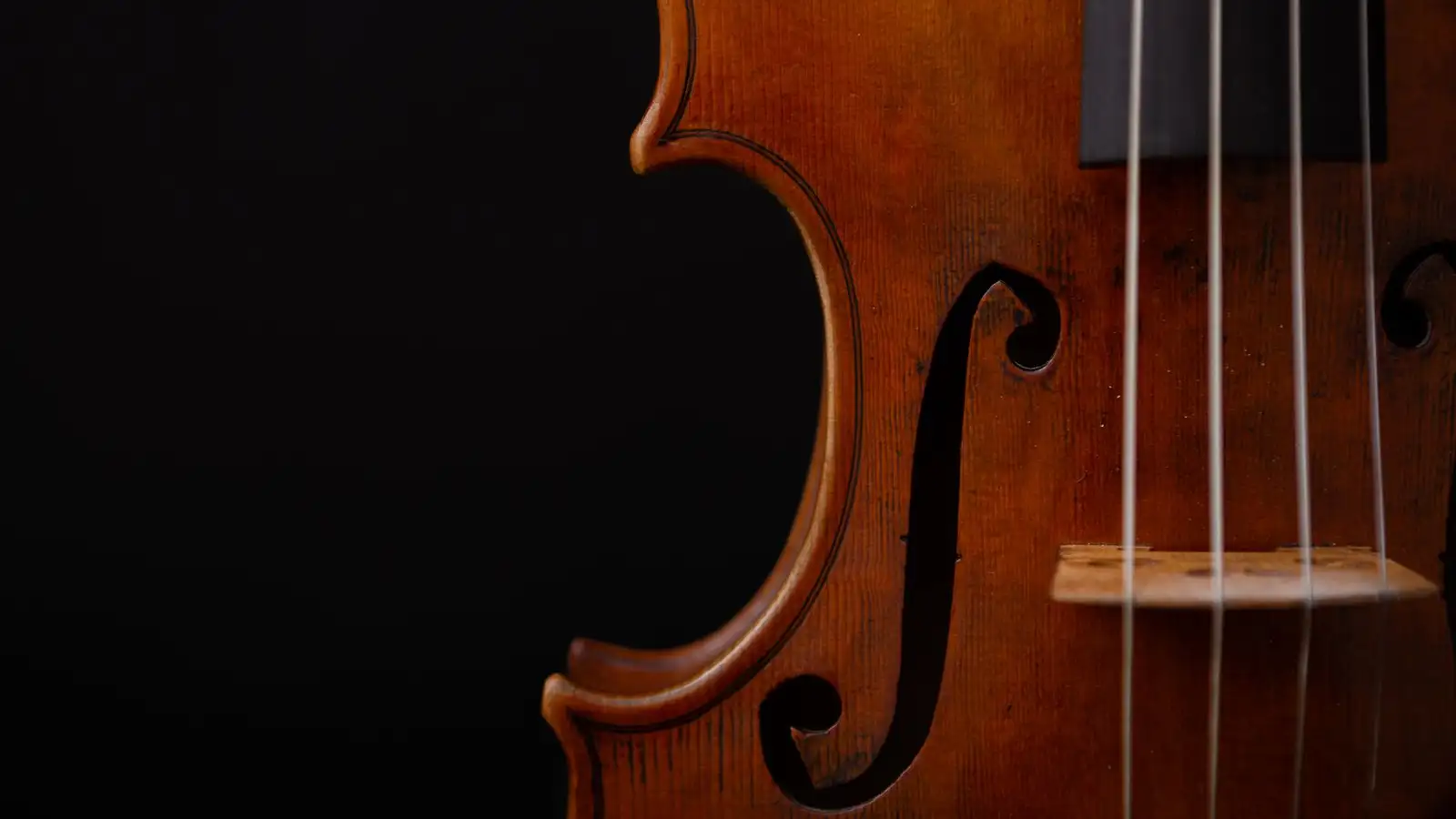
Violin strings are the part of the instrument your hands touch most, and caring for them comes down to three habits: wipe rosin and skin oil off after every session with a dry, soft cloth, keep them at the tension your instrument's setup was built for, and replace them somewhere between six and twelve months, or sooner, the moment they start giving you false notes. What the strings are made of, a steel, synthetic, or gut core wound with aluminum, silver, or gold, decides how they sound, how often they drift, and how long they stay honest.

Now sit down next to me and tilt the violin under a lamp.
I want you to see what I saw the first time someone showed me this. Angle the body so the light rakes sideways across the strings instead of hitting them head on. The strings stop looking like four thin wires and start looking like four dirty ropes. There's a pale gray film packed into the windings, thickest where the bow crosses and where your fingers press down. That's rosin dust mixed with the oil off your skin. Rub a fingertip along one of the wound strings and then look at your finger. That gray smear is what's sitting between the windings right now, and it's sitting there because nothing in your routine removed it.
That's where string care actually starts. Not with a schedule. With seeing the string.
What you're actually holding
Most beginners think of a string as a wire. It isn't. A violin string is a core wrapped in one or two layers of finer metal. The core does the vibrating and carries most of the tension. The winding adds mass without adding stiffness, and gives the bow something to grip. Change the core and you change the whole personality of the instrument. Change the winding and you change the color and the lifespan.
Steel cores behave the way a beginner expects. They settle fast, hold pitch for days, and forgive a slightly clumsy bow. What they don't do is bloom. You get clarity and a kind of edge, and if that's not the sound you want, no amount of practice will turn a steel string into something else.
Synthetic cores, usually nylon-based, are the middle road most adult beginners end up on. They have more warmth and a rounder response than steel, they take a few days to settle instead of a few hours, and they're sensitive enough that you'll hear yourself improving on them. That sensitivity cuts both ways. A synthetic string will also tell on you when your bow is skating.
Gut cores are the old sound. Warm, complex, alive under the bow, and the most demanding thing you can put on a beginner violin. Gut moves with humidity. It drifts. You'll be tuning it far more often than steel or synthetic, sometimes mid-practice, and if that friction would break your habit of daily playing, that's a real answer, not a cop-out. Gut isn't better. It's different, and it costs you attention.
The winding matters more than you'd think
The metal wrapped around the core isn't decoration. Aluminum winding gives you brightness and a fairly short life. Silver is denser, which usually means a fuller, darker tone and a longer usable stretch before the string goes false. Gold is the top end of that same idea and shows up mostly on single strings rather than full sets.
You can't see any of this from the outside, and the practical takeaway isn't that one metal beats another. It's that a string is a system, and the two parts of that system wear at different rates. The core can still be perfectly fine while the winding has flattened under your fingers, and a flattened winding is where false notes come from. That's the string that sounds slightly off no matter where you put your finger, or that wavers when you hold a long note.
The two minutes after you play
Every session ends the same way for me now. Bow down, violin still under my chin or resting on my knee, and a dry, soft cloth. Not a rag, not a paper towel, not anything with a nap that leaves lint behind in the windings. I fold it, pinch each string between thumb and cloth, and slide the whole length, from the fingerboard down to where it meets the tailpiece. Then under the strings, along the fingerboard, where dust piles up in a little gray ridge.
Dry. No polish, no oil, no cleaner. Anything wet works its way into the windings and stays there, and some of those products will quietly eat the varnish if they touch the body. Rosin is a resin. It goes on sticky and it sets. The only reason it doesn't build a hard crust on your strings is that you take it off before it cures.
The cloth lives in the case. If it's in the case, I use it. If it's on a shelf across the room, I don't, and after a month the strings look like the ones in that window light.
Tuning stability is a material property
You'll hear people say a string holds tune well. That's not a compliment, it's a category. Steel strings hold pitch so reliably that a beginner on steel can sometimes go several days without touching a peg. Synthetic cores stretch for the first week and then settle into something stable, so expect more tuning at the start and less later. Gut keeps moving with the weather, and on a humid July afternoon it will not stay where you put it.
That has a consequence nobody mentions. If you're tuning for ten minutes before you play, you're spending the part of the session where your hands are fresh and your attention is highest. Which material is right for you depends partly on how much tuning you can tolerate before it starts eating your motivation. That's a legitimate way to choose. It's not how people usually talk about it, but it's the honest one.
When a string is done, and how you know
Six to twelve months is a starting point for someone playing regularly, and it's the number most teachers give. It is not a schedule. I've had strings that were finished in five months and strings that were still fine at fourteen. The calendar can't hear your instrument. Your ear can.
A dead string gives you a few signatures. The sound goes dull in a way no bow pressure fixes. You push harder and it just gets louder and uglier. Harmonics that used to ring come out thin, or not at all. The string starts to drift sharp or flat in the same spot on the fingerboard, so a note that was fine last month is suddenly sour. And if you look, the winding has flattened where your fingers land, or it has started to fray, or there's a visible kink near the bridge.
Fraying means replace it now, not next month. A frayed string can break under tension, and it usually picks the worst moment.
One more thing that gets left out: new strings are not yet what they'll be. For the first few days they stretch. You'll tune, play, tune again, and hear the pitch sag while you're holding a note. Nothing is wrong. You haven't broken anything. The string is just finding its length, and that's why a fresh set feels slightly harsh and unmusical on day one and lovely by day five.
One at a time, always
When you do change strings, take them off one at a time. Never strip all four at once.
This isn't superstition. Your bridge is held in place by string tension and friction, and your sound post, that little spruce dowel standing inside the instrument, is held by the pressure of the top against the back. Cut all four strings and the whole arrangement relaxes. The bridge can shift or fall, and the sound post can drop. A fallen sound post means a trip to a repair shop, and moving the bridge even a millimeter changes your intonation and response in ways a beginner won't know how to correct.
So: loosen and remove one old string, thread the new one, bring it up gradually to pitch, wipe your hands, and move to the next. As each new string comes up, check that the bridge is still standing square, feet flat against the top, not leaning forward toward the fingerboard. Lean is the early warning sign, and you can catch it with your eyes long before it becomes a repair bill.
Tension isn't a preference
Every violin is built and set up to sit within a range of total string tension. Strings come in gauges, and heavier doesn't mean better or louder in any simple way. Too much tension on an instrument that wasn't set up for it and you get a stiff, choked response, unevenness across the strings, a bridge that leans, and a top working harder than it should. Too little and the instrument sounds weak and won't project.
For an adult beginner this mostly matters as a rule: don't mix gauges carelessly, and if you want to change anything about the tension your instrument lives under, let a teacher or a luthier look at the setup first. The strings and the setup are one decision, not two.
The part that took me years
Strings are the only part of the violin that wears out from being used correctly. Everything you do right, bowing, stopping, tuning, spends them a little. That isn't a flaw. It's how the instrument keeps producing sound.
Which means caring for your strings isn't really maintenance. It's the daily evidence that you're playing. The cloth in the case, the two minutes at the end of a session, the moment you notice a note has gone sour and realize it's the string and not you. That's what it looks like to have a relationship with an instrument instead of just owning one.
If there's one thing I'd want a beginner to take from all of this, it's that the ear you're building is the same ear that diagnoses a tired string. Wiping them down teaches you what they feel like when they're clean. Tuning them teaches you what they sound like when they're healthy. By the time they go, you'll know before the calendar does.