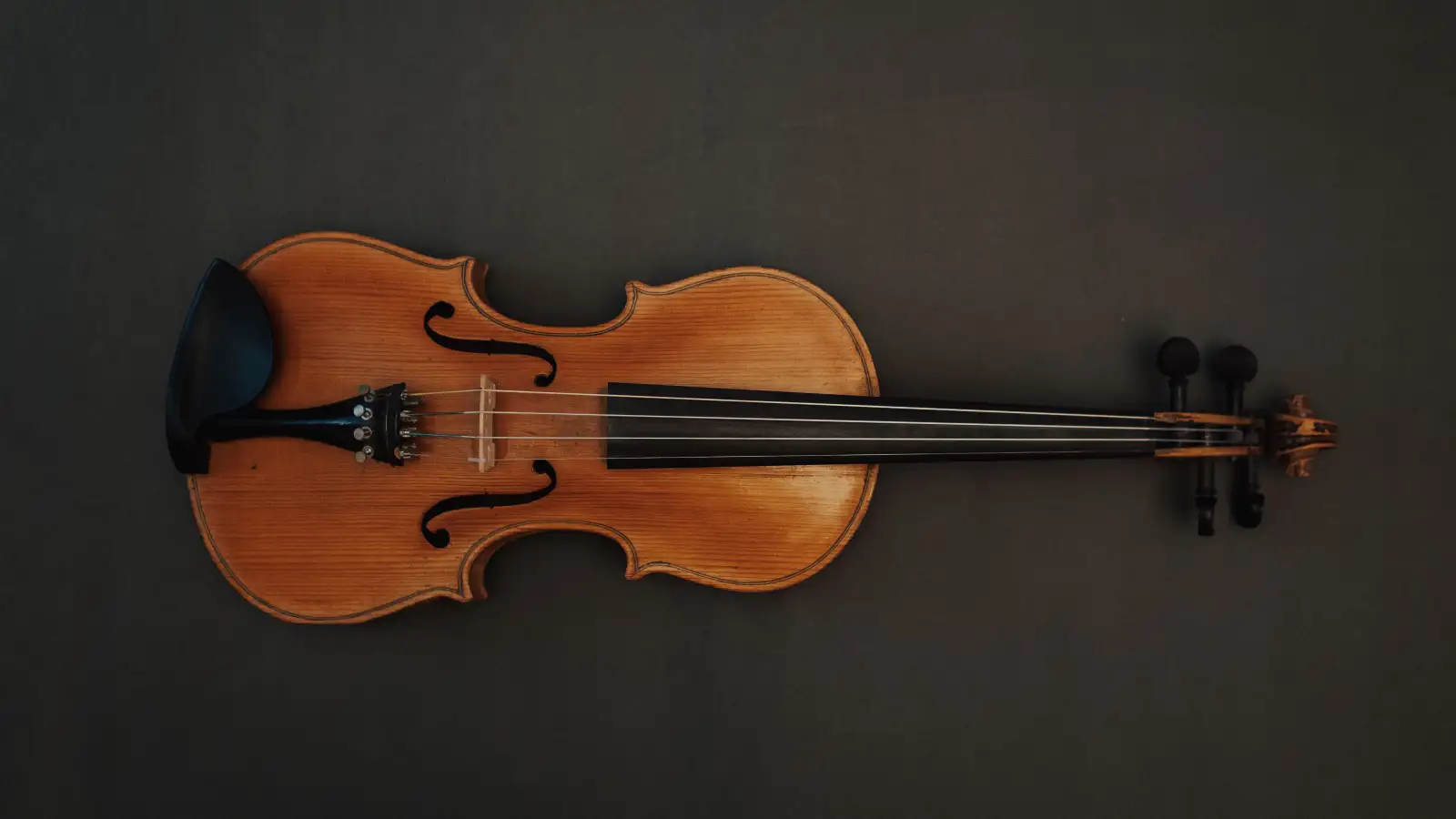
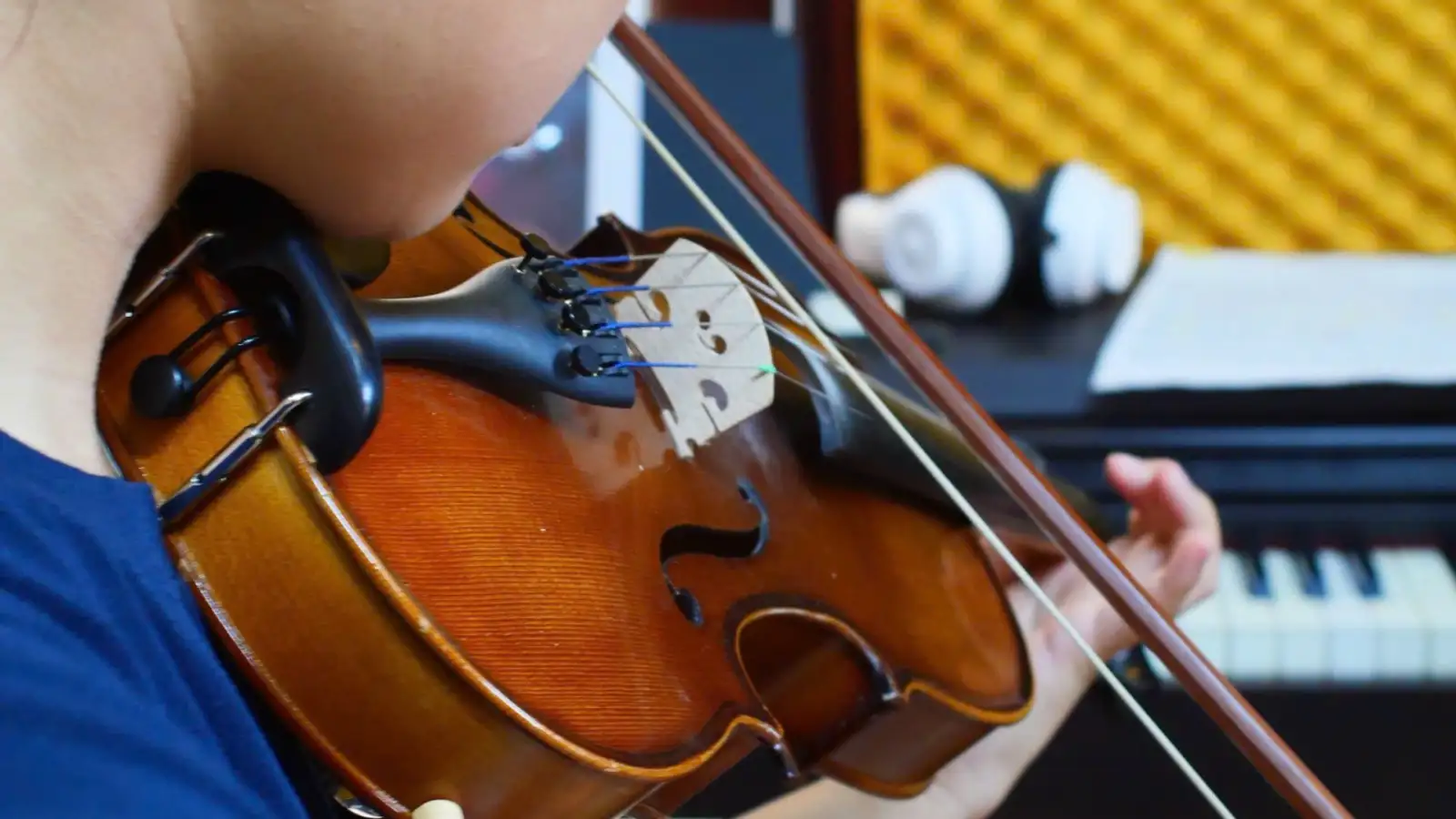
The reason a gentle household cleaner can ruin a violin is that "gentle" is a claim about countertops, not about resin, and a violin's finish is a resin film with a completely different set of weaknesses: it softens in seconds when the right solvent touches it, it turns cloudy when moisture gets inside it, and it scratches under a paper towel. Dirt sits on top of that film. A cleaner that is actually safe for it has to stay on top of it too. Most of what lives under the kitchen sink does not stay on top. It dissolves the film, soaks into it, or leaves something behind that changes it for good. Once you can see the finish as a material with its own rules instead of a surface with a warning label, the whole shelf becomes readable, and you stop needing a banned list.
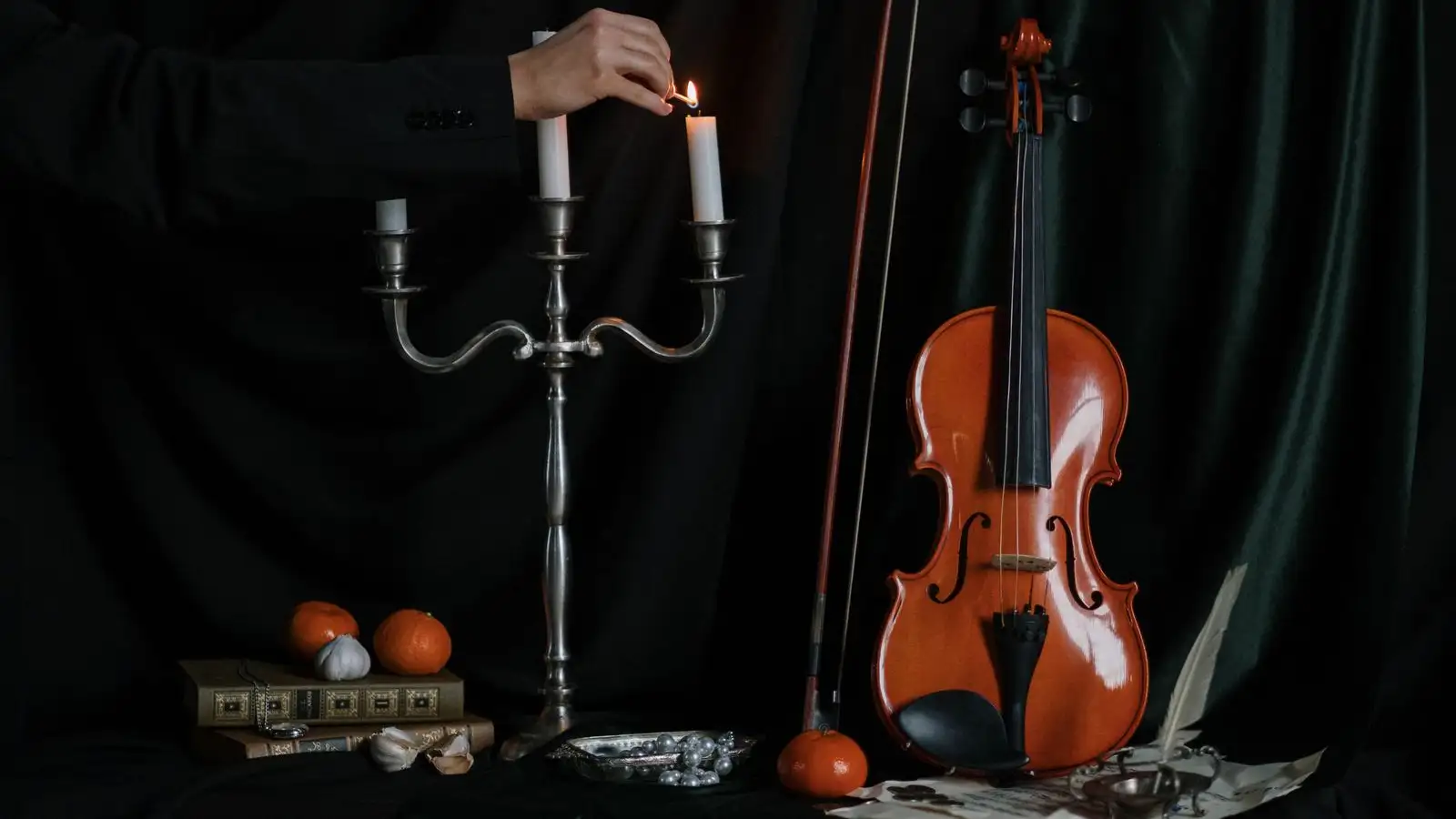
I found this out on a Sunday afternoon with the violin lying flat on a folded towel on my kitchen table, the window light coming in low across the top.
That light is what did it. Low light rakes across a finish and shows you everything: a dull haze of rosin dust in front of the f-holes, a smudge on the lower bout where a hand had rested, a fingerprint on the upper edge. Seen in that light, the instrument looked like it needed cleaning. In ordinary light, it looked fine.
I reached under the sink for a wipe. I remember the smell, that cold, sharp hospital smell isopropyl alcohol has, and the small satisfaction of the grey-brown smear coming up off the top. Then I saw the patch. About the size of a quarter, right where I had started, not dirty anymore but not clean either. Dull. Flat. The varnish around it still had that depth where the grain shows through, and this spot just didn't.
I waited for it to dry. It stayed soft. I touched it with my fingertip and left a print.
That was the moment I stopped thinking about cleaning products as strong or mild and started thinking about them as things that do chemistry to a specific material. I have spent a lot of time since then learning what that material actually is, because I don't want to do it again, and because "just use something gentle" is not information.
What you are actually wiping
A violin's varnish is not paint, and it is not the plastic coating on a table. It is a thin film of resin, sometimes with oil, sometimes laid down from a solvent, applied in several passes and cured over weeks. Its thickness is measured in thousandths of an inch, and on a well-made instrument it is deliberately uneven: thin in the middle of the top where the wood needs to move, thicker at the edges where it needs to survive.
That thinness is why small mistakes show up fast. But the other thing to know is that varnish does two jobs, and only one of them is cosmetic. It protects the wood, and it is part of how the instrument sounds. Varnish that has gone soft, gummy, or uneven is a muted instrument, not just an ugly one. So a cleaner that softens varnish is not doing a small amount of harm to a cosmetic layer. It is working on the same material the sound comes through.
There are two families you will run into. One is oil-based, cooked from a drying oil and a resin; it cures hard and is fairly resistant to a quick wipe. The other is spirit-based, dissolved in alcohol when it was made, and it stays vulnerable to alcohol for the rest of its life. Some factory instruments today have a synthetic finish that shrugs off a lot. And here is the honest complication: you cannot tell which one you have by looking at it, and neither can I. Some instruments have had a spot polished or touched at some point with something different from the rest.
That is exactly why the answer has to come from understanding the material rather than from a list. A list can't know that your instrument is a different case from mine.
Alcohol, and why the patch does not dry back
Alcohol is the fastest way to hurt a violin. Isopropyl wipes, hand sanitizer, glass cleaner with alcohol in it, the little pad you use on your glasses; they are all the same idea.
Like dissolves like. Varnish resin is an organic material, alcohol is an organic solvent, and it goes straight into the film instead of sitting on top of it. On a spirit varnish it starts working on contact. On an oil varnish it may not visibly damage anything the first time, which is the trap, because it is still softening the surface and lifting a little of what is there.
The part people don't expect is what happens after. When the alcohol evaporates, it does not leave the film the way it found it. Resin that has been softened and re-dried does not always re-flow evenly. You get a clouded patch, or a bloom that looks like a whitish haze, or a spot that stays faintly tacky. And it did not just move around. A little of the finish came up on the cloth. You can see it, if you look at the wipe afterward.
The reason it never quite goes back is that cured varnish is not a solid you can melt and re-freeze. Its hardness came from a chemical change, and once you have disturbed the top layer, the new surface is different: softer, more porous, and better at holding dirt than the surface you started with.
Water is slower, which makes it sneakier
Water is not a solvent for cured oil varnish. That is why "just a damp cloth" feels safe, and why it is not automatically safe.
Three things happen, and none of them are dramatic on any single day.
The first is clouding. Water that sits on a finish, especially in a spot where there is a chip or a fine crack, gets into the film. Trapped moisture scatters light instead of passing through it, and the spot goes milky. Sometimes it clears as it dries. Sometimes it doesn't.
The second is raised grain. Anywhere the varnish has worn through, at the edges, along the chin rest area, beside the fingerboard, down at the bottom edge where an arm has rubbed for decades, you are on bare wood. Wood fiber swells when it gets wet and does not shrink back flat. It dries standing up. The surface goes from slick to fuzzy, and you can feel it with a fingertip even when you can't see it. No cloth will press it back down.
The third is the one that costs real money. Violin seams are held with hide glue, which is water-soluble by design. That is not a defect; it is a safety valve. When an instrument is stressed, the seam is supposed to let go before the wood cracks. Warm moisture along a seam edge softens that glue. You will not hear anything that day. You might hear a faint buzz two winters later, when the wood shrinks and the seam is already looser than it was.
Tap water adds its own small contribution. Every drop leaves a little mineral behind when it dries. On a dark varnish you can see the faint rings if you look for them.
So water is fine in the narrow case where the cloth is barely damp, you are working on an intact finished surface, and you dry it immediately. It stops being fine the moment the cloth is wet enough to leave a shine that has to evaporate on its own.
Oil, silicone, and the problem that waits years
Furniture polish and general-purpose sprays are the worst category to keep near an instrument, and the damage is mostly deferred, which is why people keep using them.
Read what is in them and you'll usually find three things: a petroleum-based carrier that evaporates, some kind of oil that stays, and often a silicone. The oil sits on the surface and holds dust. Now the instrument gets dirty faster, so you wipe it more, so it gets scratched more. That is the short loop.
The silicone is the long one. Silicone migrates. It creeps into worn spots, into cracks, into the wood at the edge of a chip, and it does not come off with soap and water. When someone later needs to touch up the varnish in that area, the new varnish will not wet the surface properly. It pulls away from the contaminated spot and dries in little craters. The trade word for it is fisheye, and it is the reason a person who repairs varnish will look at an instrument that has been polished with a silicone product and tell you that area has to be dealt with before anything else can be done.
I want to be fair here: not every furniture polish contains silicone, and "contains silicone" is not printed in large type. That is the point. You cannot manage this risk by reading the front of the bottle.
The oils have a smaller version of the same problem. Anything oily that soaks into an open seam or into bare wood darkens it and stays dark, and it softens the hide glue it touches.
The grit is usually in your hand, not in the bottle
Abrasion is the category of damage that has nothing to do with chemistry, and it happens with products everyone agrees are safe.
Paper towels are wood pulp. That is literally what they are made of. The fibers are short and stiff compared to a soft cotton cloth, and they do not have the give that lets a fiber roll over a soft surface instead of cutting it. The textured shop rags sold in a bag are the same story with an extra problem: they hold grit, so a grain of dust gets caught in the weave and dragged across the top.
Scouring pads are obvious. What isn't obvious is that a dry cloth on a dusty violin does the same thing in miniature. You are not wiping dust off; you are dragging it.
You will not see any of this in normal light. Take a small lamp, put it on the table, and hold the violin so the light skims across the top at a shallow angle. Now the scratches appear, a fine haze of them, sitting exactly where you have been wiping. Under raking light you can also see the difference between a scratch in the varnish and a scratch through it.
Micro-scratches matter more than they look like they should. A scratched surface scatters light, which reads as dullness rather than as damage. It also holds dirt better, so the instrument looks dirty sooner, so you clean it more. That loop is how a violin that gets wiped weekly ends up looking worse than one that gets wiped twice a year.
Why "gentle," "natural," and "non-toxic" tell you nothing here
Labels describe a target surface. That is the entire reason they are misleading on a violin.
A product earns the word gentle by being tested on laminate counters, sealed stone, glazed tile, stainless steel, and painted walls. Those surfaces are either non-porous or meant to be refinished every few years. None of them is a thin resin film over spruce, and none of them is supposed to make a sound.
The same goes for the other words.
Plant-based tells you where the carbon came from, not what the molecule does. Citrus oil is plant-based. The main component of citrus oil is a terpene, and terpenes are real solvents; they are the active ingredient in a lot of adhesive removers. If a so-called natural citrus cleaner lists citrus oil high in the ingredients, you are holding a solvent, regardless of the leaf on the label.
Non-toxic means it will not poison you. It is a statement about human biology. Varnish is not a human liver. A cleaner can be perfectly non-toxic and still be a solvent for resin.
Biodegradable means it breaks down in the environment. That has nothing to do with the fifteen seconds it spends on your instrument.
And the phrase to be most careful with is the one that sounds best: safe for all surfaces. That phrase exists because the manufacturer checked the surfaces it thought of. It is not a claim about violin varnish, because violin varnish is not a market they test for.
Here is the test I use instead. Ask what the liquid is, and what a cured resin film is. If the liquid is a solvent, a strong acid or base, an oil, or something with an abrasive in it, it is not safe on the finish, no matter what adjective is printed above it.
What I do now, and where I stop
The routine is short enough that I don't have to think about it.
After playing, I wipe the chin rest area and the neck with a soft, dry cloth that has been washed without fabric softener. Fabric softener leaves a residue that acts a little like the oils in furniture polish. I use a cloth on the strings too, but it is a different cloth from the one that touches the body, because a cloth that has been over the strings and the bow hair picks up rosin grit and metal dust that I don't want to drag across the top.
Then I put it away. That is the whole procedure.
If there is a smudge the dry cloth will not lift, I breathe on the spot to fog it lightly and try again with the dry cloth. That is the ceiling of what I will do at home. It removes a surprising amount, and it is a hard stop by design.
This is the point where the instinct to escalate is strongest and most dangerous. The progression people follow goes dry cloth, then damp cloth, then a wipe, then a spray, then a stronger spray. Each step is chosen because the previous one didn't work, and each step is doing more damage than the one before, at the exact moment the finish has already been compromised.
So I don't take the next step. I put the instrument in the case.
The thing to do first is decide whether what you are looking at is on the surface or in it. A clean fingertip against the spot tells you a lot. If you can feel a ridge, a tackiness, or raised fiber, you are not looking at dirt, and no cleaner will help, because there is nothing on top to remove. If it is smooth and it is a deposit, it is still possible that a dry cloth is the wrong tool, because what is on there might be rosin that has fused to the varnish, or a bit of grease, and both of those need a person with experience and the right solvent.
Then, next time you are near someone who works on violins, ask. That is not a cop-out; it is the actual answer. A person with a bench and a bottle of the correct solvent can lift a spot like that in about twenty seconds, and they can look at it under a lamp and tell you whether it is on the varnish or in it, which is information you cannot get any other way.
Why I stopped keeping a list
The reason this is worth understanding rather than memorizing is that a list only covers the products someone already thought of. New wipes come out. Someone gives you a bottle of something. You stay in a hotel and there is a packet of sanitizing wipes on the desk next to the case.
When you know that the finish is a thin resin film, that alcohol dissolves it, that water moves into it and into the glue at the seams, that oil and silicone leave something behind that no cloth will undo, and that grit is a problem regardless of what liquid it is in, you don't need the list. You can look at a bottle and make the call. And the call is almost always the same one: put the bottle down, use the dry cloth, and if that isn't enough, take it as a signal to stop rather than a signal to try harder.