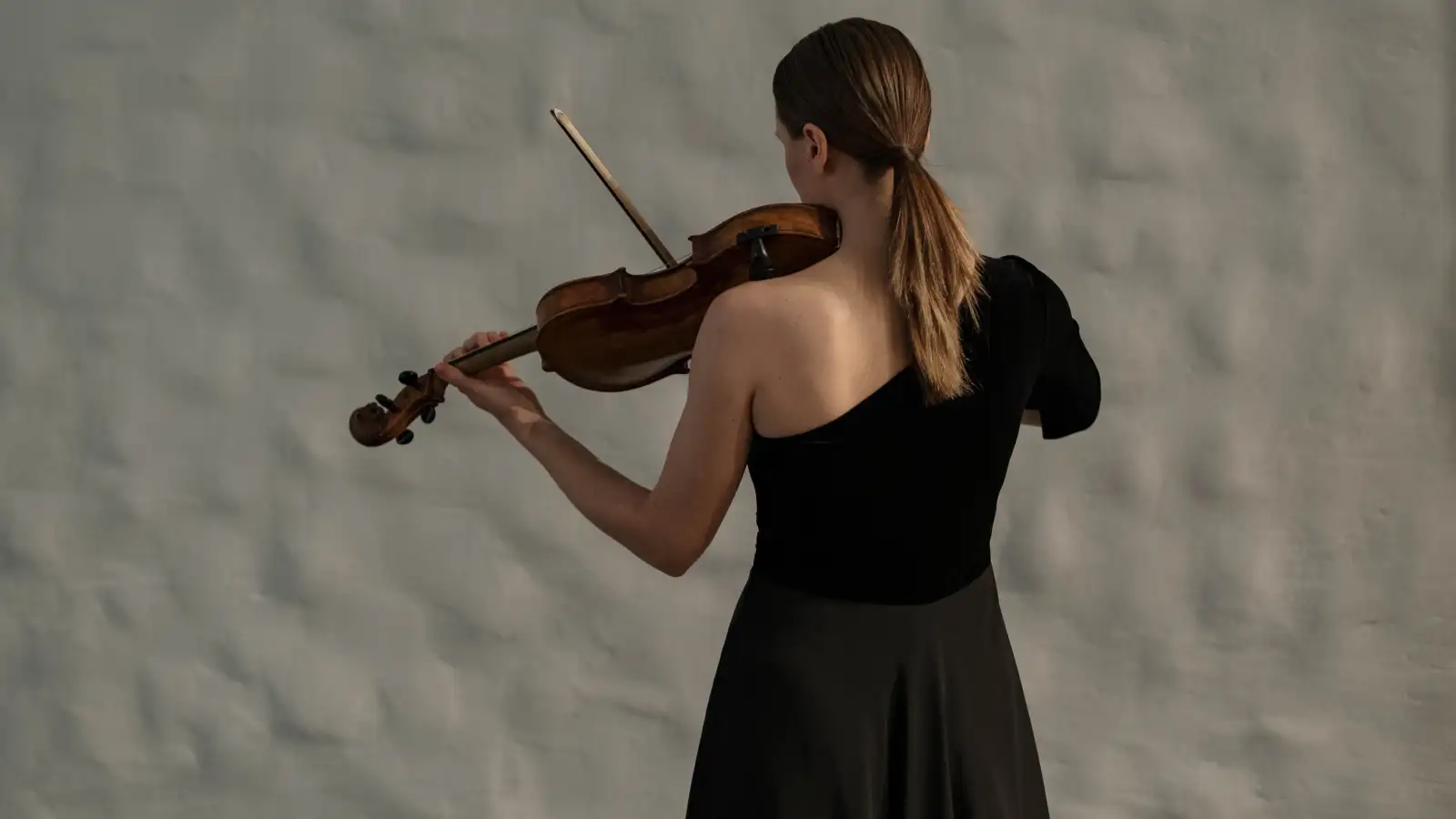
The left hand guides the violin; it does not carry it. The weight of the instrument lives between two contact points, the jaw on the chin rest and the collarbone or shoulder rest underneath it, and the left hand's only job is to steer the neck and keep it from wandering. That is why the thumb aches and the neck presses into the base of the first finger for so many beginners: the hand has quietly taken over a job the frame stopped doing, and squeezing harder only gives the hand more work to do.
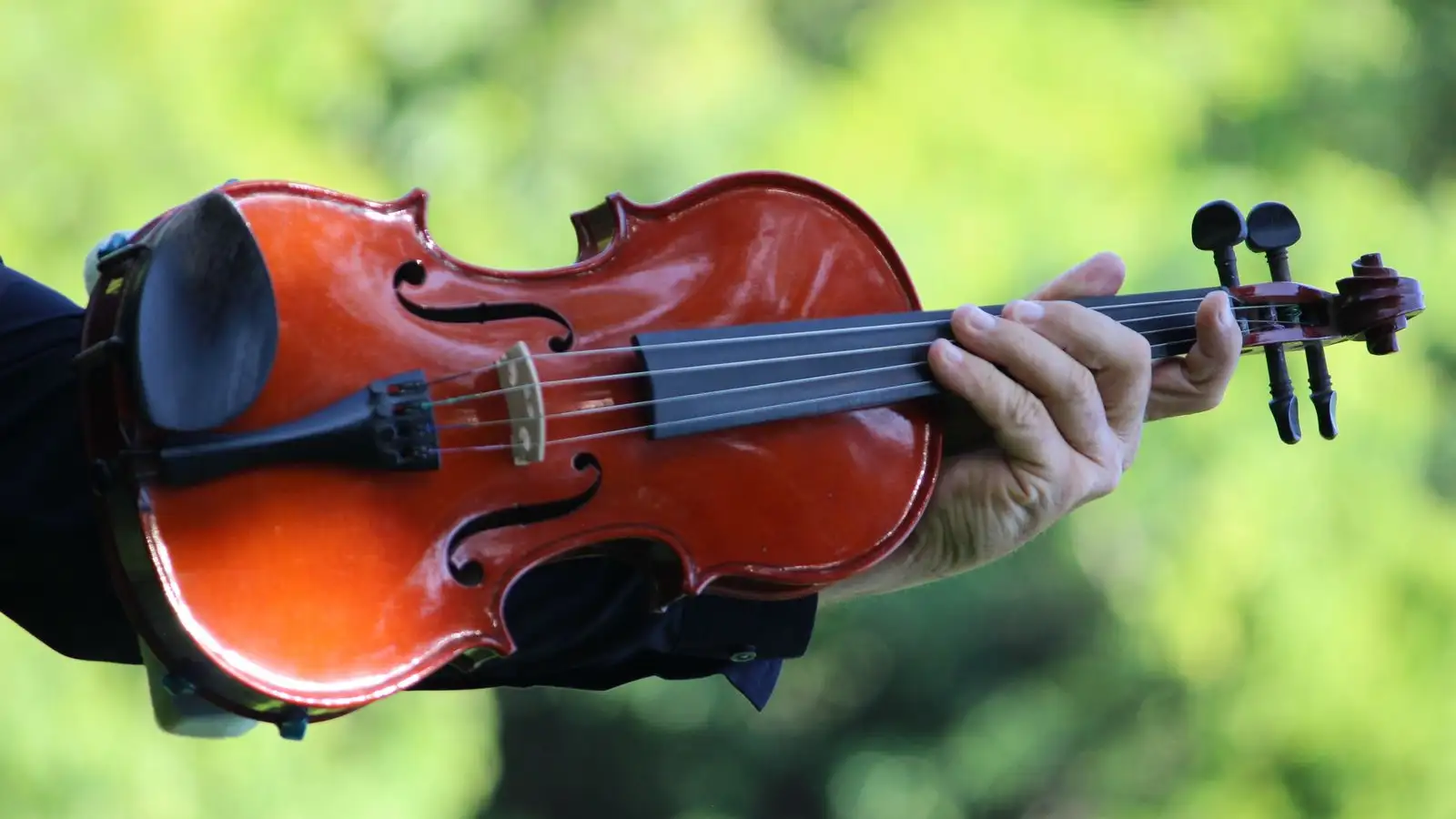
I want you to test that before you take my word for it. Set the violin on your shoulder the way you normally do. Settle your jaw onto the chin rest. Then drop your left hand away from the neck entirely, open it, let it hang at your side, and count to five while you watch the scroll.
If the scroll stays level, your frame is already carrying the instrument and the rest of this is confirmation. If the scroll dives toward the floor, or the whole violin slides down the front of your chest, that dive is the real reason your thumb has been gripping. The hand was never the problem. It was covering for something above it.
Where the violin is actually supposed to sit
Two places take the weight. First, the chin rest under the left side of your jaw. Not the point of your chin, not the center of your jaw, but the flat bone along the side, the part that would rest on your hand if you propped your head up on your palm. Your head is heavy, and heavy is enough. It does not need to clamp.
Second, the collarbone. The back edge of the violin sits on top of it, whether the violin rests there directly or on the feet and pad of a shoulder rest. The shoulder stays down. If the shoulder lifts up to meet the violin, you have replaced the collarbone with muscle, and muscle gets tired in a way bone never does.
Nod slowly while the violin is up. The instrument should ride a little with your head, not stay pinned like it is in a vise. If it stays pinned, your jaw is doing the clamping, which is the same mistake as the thumb, just moved to the other end.
The arm frame underneath
Stand up. Let your left arm hang at your side first and feel how heavy the elbow is. Now bring the hand up to the neck without lifting the shoulder or pulling the elbow back.
That is the shape you are after: a loose V under the violin, elbow below the instrument and slightly forward of it, not pressed against your ribs.
It matters more than it sounds like it should. When the elbow drifts back to the ribs, the forearm gets shorter, and the hand has to reach up to the neck to close the gap. Reaching means holding. Holding means the hand is carrying the violin, and once the hand is carrying it, no amount of relaxing your fingers will help, because the fingers are not the ones holding on.
With the elbow under and a bit forward, the forearm rises to the neck at a comfortable angle, and the base knuckles of the hand end up roughly in line with the forearm. The wrist stays straight. Not bent up, not collapsed down, just a straight continuation of the arm.
In first position the hand turns slightly so the fingers can drop onto the strings from above. The palm faces neither straight at the neck nor rolled fully inward toward you, but somewhere between the two. Flatten the palm toward the neck and the wrist collapses. Roll it too far in and the fingers come at the strings from the wrong side, which usually shoves the thumb under the neck where it starts squeezing.
The thumb is a guide, not a clamp
Rest the thumb on the side of the neck, around the level of the first finger, with a soft bend in the joint. Light. Light enough that a piece of paper would slide between the thumb and the neck without tearing.
Then prove it to yourself. Bow a slow open string with no fingers down and lift the thumb completely off the neck. On an open string, almost nothing changes. The violin does not fall, the tone does not collapse, and the only thing you notice is how strange it feels to have your hand that free. That strangeness is the amount of carrying the thumb was never supposed to be doing.
The squeeze is a frame problem wearing a hand costume
Here is the part that took me longest to believe. When the thumb presses the neck against the base of the first finger, that squeeze is real and it is uncomfortable, and it feels like a hand problem. It is not. The clamp is what a hand does when the frame above it has sagged and something has to hold the instrument up. The hand volunteers.
Which is why every fix that stays inside the hand fails. Gripping differently does not work. Telling yourself to hold it more lightly does not work either, because the hand is correctly solving the problem it has been handed. Take the weight off the hand and the squeeze disappears on its own.
So when you feel the clamp, work upward instead of inward.
Where is your elbow? If it is against your ribs, the hand is reaching and the frame has already given up. Let the elbow fall under the violin and slightly forward.
Where is your scroll? If it is dropping, your jaw and collarbone are not taking the weight, or your shoulder rest is set so the instrument cannot sit flat on the collarbone. Fix the contact, not the hand.
Where is your head? Pressing down is a clamp too, just a quieter one. Let the head rest rather than push.
Set it up so you can watch the scroll
Put a mirror in front of you, or prop your phone on a music stand and record thirty seconds. Play a slow open string and watch the scroll. If it drifts downward over a few seconds, your frame is leaking. If it holds level while your left hand opens and closes in the air beside the neck, the frame is doing the job.
A doorway works too. Stand with a wall an inch or two from the scroll and watch whether you drift into it or away from it.
The reason to watch the scroll instead of your hand is that the hand lies to you. It always feels like it is about to drop the violin, even when it is doing nothing at all.
What the first couple of weeks actually feel like
Honestly? Precarious.
The clamp feels safe. That is the whole problem with it. When you finally let the jaw and collarbone carry the instrument and free the left hand, there is a stretch of days where the violin seems to hover over a drop. Keep a hand an inch under the neck to catch it, and let it not fall. Give it two or three weeks of short daily sessions and the new position stops feeling like a risk and starts feeling like the only sensible way to hold the thing.
It depends on your setup, and that is fine
Shoulder rest or no shoulder rest, this stays the same, because the point is only that the contacts carry the weight and the hand does not. Some players use a full shoulder rest, some a sponge, some a folded cloth, some nothing. If the violin slides around on your collarbone, add friction rather than grip: a cloth, a pad, a different rest. Friction is cheap. A clenched thumb is not.
If no chin rest you have tried lets your jaw sit comfortably on it, that is a setup question, not a posture question, and no amount of arm work will solve it.
The left hand does its best work when it has nothing to carry.