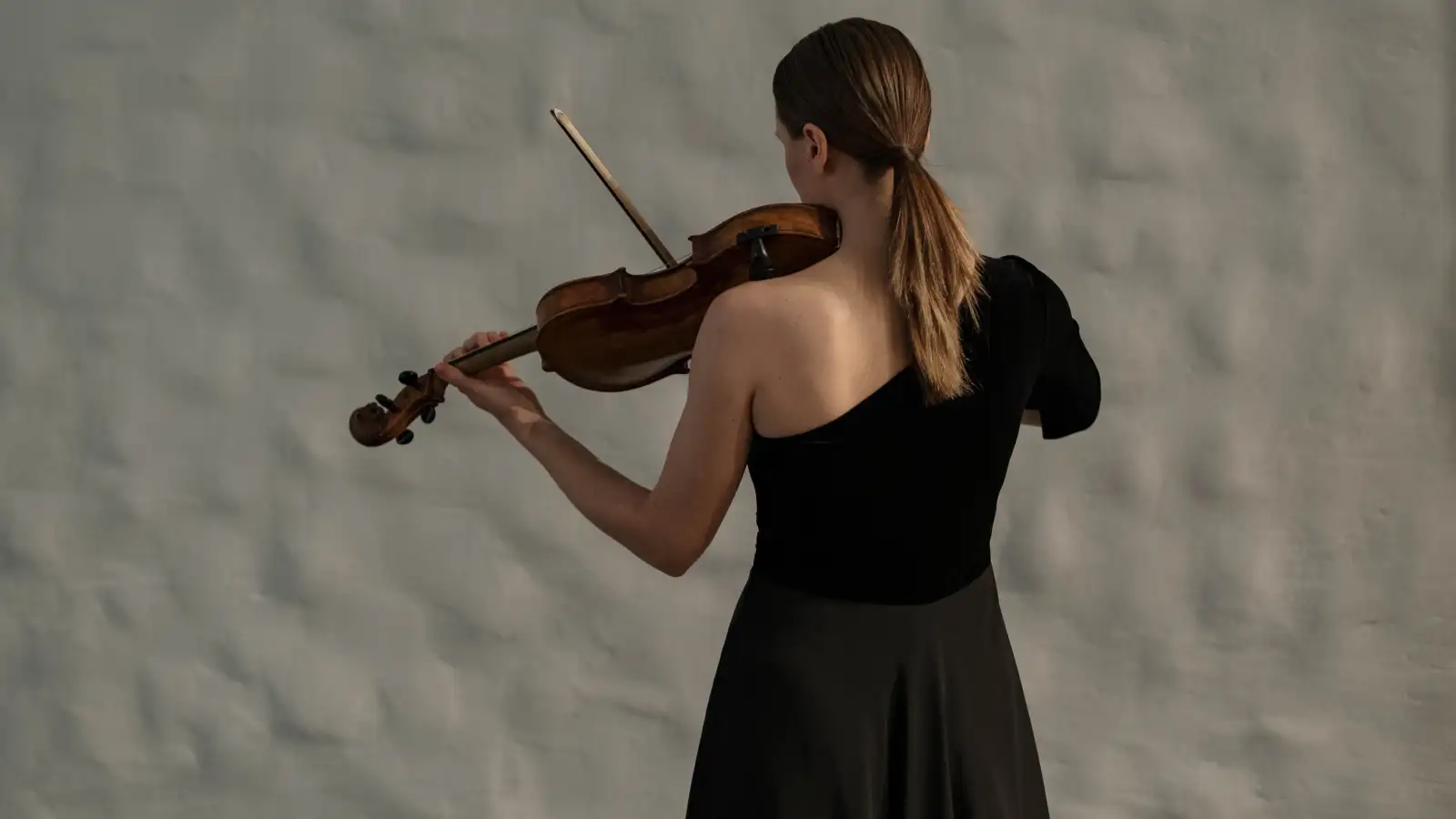
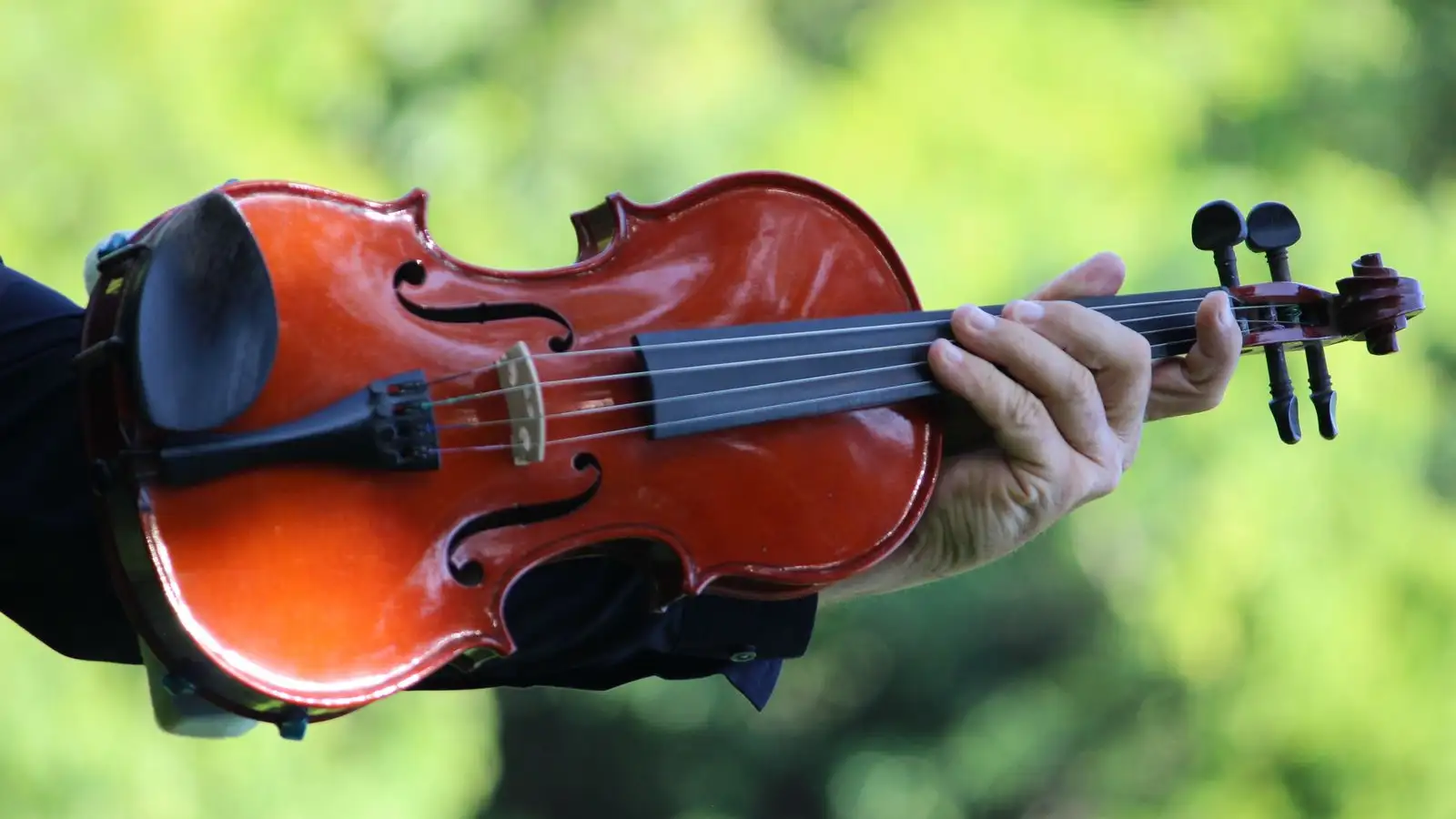
Three posture checks belong at the top of every violin practice session, and none of them needs a teacher in the room: a wall that shows where the head goes once the instrument is up, a doorway or mirror that shows whether the violin is level, and a slow slide of the left thumb up the neck that shows whether the hand is holding or gripping. Run the set before the first note, again at the halfway mark, and once more before the case closes. Posture does not collapse while you play. It drifts, and the drift is the part you cannot feel from inside it.
I keep the checks hooked to three things that are already in whatever room I practice in — a wall, a doorway, a chair — because a checklist taped to the music stand gets read for a week and then becomes scenery. Objects don't become scenery. You walk past the doorway on your way to the case whether you meant to or not.
Wall first, instrument second
Stand with your heels about a hand's width from the baseboard so the back of your head, your upper back, and the backs of your hips are all close to the wall. Close, not pressed. Take one breath and step away.
What you just read is where your head sits when nothing is asking anything of it. Raise the violin, and the head comes forward and down to meet the chin rest. That is not a flaw — the instrument lives out in front of you and the head has to travel to it. The wall exists to tell you how far it traveled, and that is a number you cannot get any other way.
Order matters more than anything else on this list. Run the wall check after ten minutes of playing and it will show you almost nothing, because by then the playing position has become your normal. The wall is honest at minute zero and agreeable at minute twenty. That is the entire reason it goes first.
Doorway or mirror: read the scroll without moving your head
Stand in a doorway with the frame just past your scroll, or in front of a mirror if you have one. You are looking for two things: a fingerboard roughly parallel to the floor, and a scroll pointing at about nose height. Not eye height, not chin height.
Here is the part that usually gets left out. Do not turn your head to look at the mirror. Turning to check is not a neutral act — you have just moved the thing you were measuring, and now you are checking a position you are no longer in. Learn to read it in peripheral vision, or stand so the edge of the doorframe stays in view without a single degree of head movement. If the scroll is only level when you look at it, it is not level.
Two shapes show up here more than any others. A scroll dropping toward the floor usually means the left hand has taken over the weight of the instrument and the left shoulder has risen to help it. A scroll floating above nose level usually means the left elbow has tucked in under the violin and the palm is pushing up. Neither is a crime. Both are information.
One honest caveat: level is not a universal law. Shoulder rest height, chin rest shape, and your own proportions all move the number, and plenty of players — especially in fiddle styles — play with the scroll well below nose height on purpose. The check is not "nose height or else." It is "the same height as last time," which is the only thing that makes it readable at all.
The chair check, for feet and for resets
If you practice seated, skip the stool with arms and use a hard chair. Sit on the front third, both feet flat on the floor, knees roughly over the ankles, both heels down. Rock your weight left and right once so you know which foot is doing more of the work. Most people are surprised.
If you practice standing, put the same chair behind you and give it a job: it is where the violin goes every time you stop. A reset with a physical action attached — instrument on the chair, hands off, shoulders down — happens far more reliably than a reset you are supposed to remember to do.
The one-minute landmark sweep
This is the check you can run without leaving the position, which makes it the one that survives a busy day. Four landmarks, in order, silent, under a minute.
- The jaw rests on the chin rest. Resting, not lifting — the jaw settles down onto the rest rather than the rest being pressed up against the jaw.
- The left elbow sits roughly under the instrument. Not pinned against the ribs, not swung out wide.
- The right shoulder is down. The fastest way to find out where it is: lift it an inch and let it drop.
- Both feet are flat and planted.
If you keep only one habit from this whole routine, keep this one, and run it right after you finish a piece rather than in the middle of a phrase.
Let the thumb do the reporting
The left thumb is the best sensor on the instrument. On a long open bow or the last note of a slow scale — not while shifting, not in the middle of a run — slide the thumb slowly along the side of the neck toward the scroll and back again. A thumb that is merely touching the neck slides freely. A thumb that is clamping does not move, and you will feel the whole hand resist the slide. That resistance is the readout. You do not have to decide whether the hand is tight; the thumb already decided for you.
Minute one: drop the shoulders and touch nothing
Play for a full minute. Stop. Let both shoulders fall. Then leave the violin alone — no adjusting with the left hand, no hitch of the chin.
If the instrument stays where it is, the jaw and the shoulder are carrying it. If it slides, or if you feel a small scramble to catch it, the hands have quietly taken the job back.
I would rather be straight about this one: a violin is never weightless. How much the left hand legitimately helps depends on your shoulder rest, your chin rest, and the length of your neck. The question is not whether there is any support. It is whether the release costs you a re-grip or just a small settling.
Why the three timestamps matter
Your sense of "this is normal" recalibrates within about a minute of playing. Whatever the body settles into stops feeling like a position and starts feeling like you. That is why posture drift is so hard to catch in the moment and so obvious in a photograph.
The clock is the fix, not willpower:
- Before the first note, roughly forty-five seconds: wall, doorway, chair, in that order.
- At the halfway point of the session, whenever that is for you: the landmark sweep, then the thumb slide.
- Before the case closes: the shoulder release, plus two words written in the margin of your music — "scroll low," "thumb tight" — as a note to yourself for tomorrow.
What these checks cannot do
A wall cannot tell you whether your shoulder rest is the right height for your neck, or whether your chin rest suits your jaw. Those are fitting questions, and they get answered in person, with the instrument in hand, by a teacher or at a shop. These checks report on position and habit, nothing more.
What they can do is tell you what you did with the setup you already have. A player with a modest setup and settled habits will show less drift against the wall than a player with a beautiful setup and a head that creeps forward every session. Drift is the thing you can actually work on alone, in a bedroom, on a Tuesday, with a wall and a doorway and a chair.