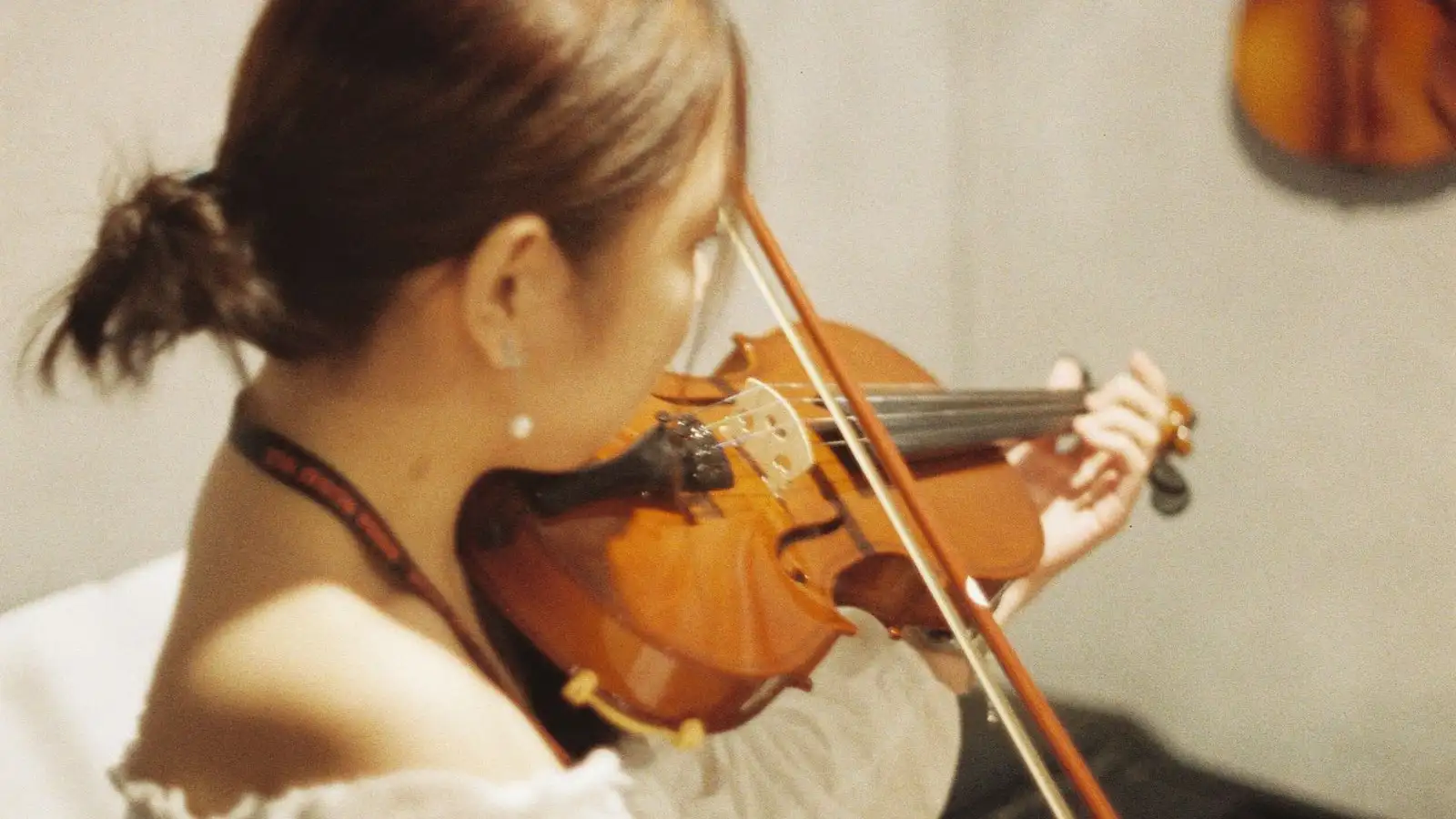
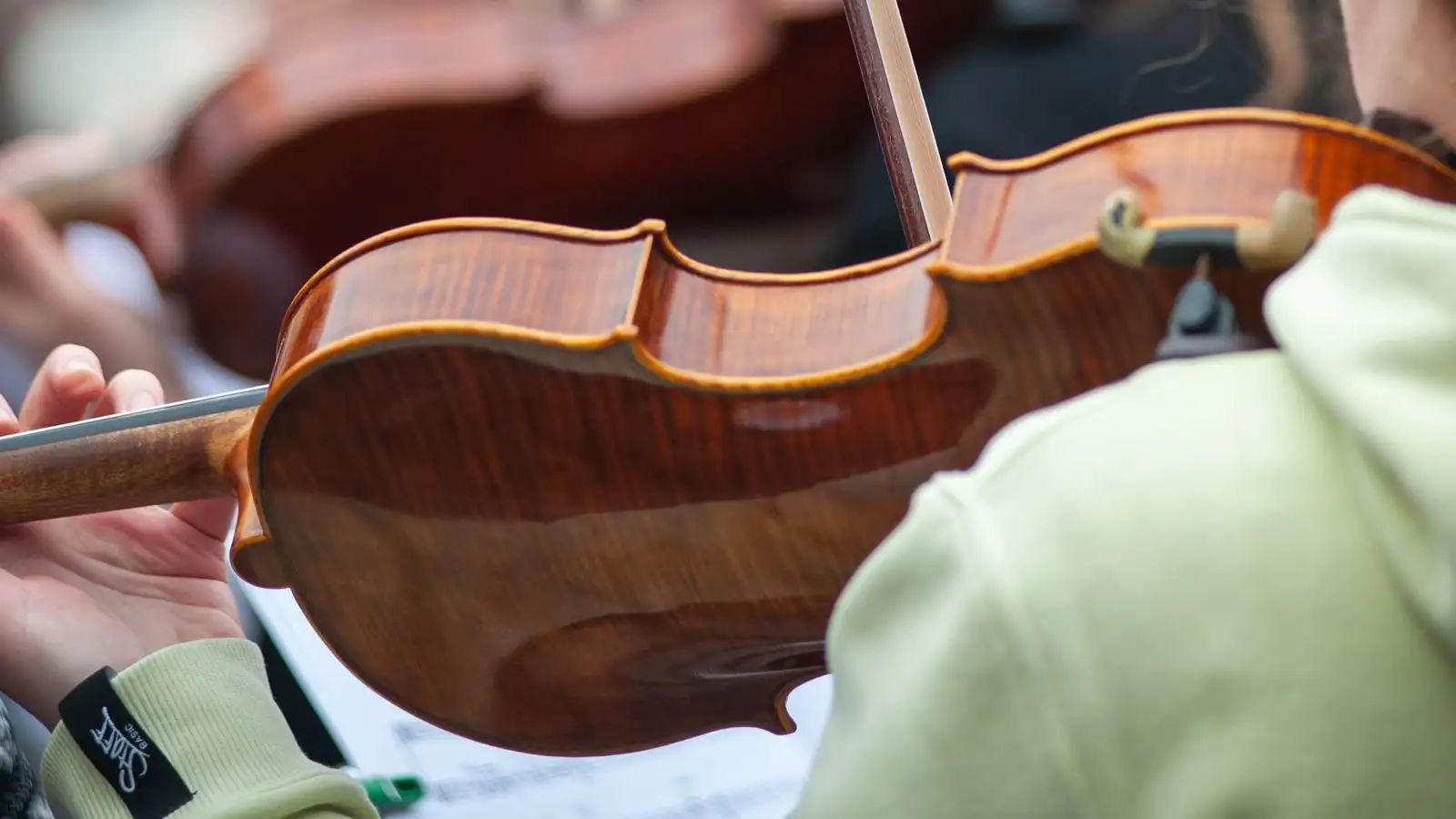
Three adjustments decide where a shoulder rest actually sits, and they only work as a set: height, tilt, and position along the lower bout. Height determines whether the chin can reach the chinrest without the head dropping or the shoulder rising. Tilt determines whether the rest meets the slope from collarbone to shoulder or fights it. Position determines which part of the shoulder ends up carrying the instrument. Change any one of the three and the other two feel different, which is why turning the height screws alone almost never fixes anything. All three have to be set with the violin up in playing position, and the session ends with a release test — left hand off, light chin contact — that confirms whether the setting holds.

I start with the violin already up, left hand loose at the neck, bow arm hanging, standing the way I'd stand if I were about to play and got distracted. Then I take the left hand away for a second and watch what happens. Does the violin sit level, or does the scroll drop? Is my shoulder quiet, or is it already climbing? Is my chin resting on the chinrest, or pressing down into it like I'm pinning a phone to my ear with my shoulder?
That first read is the honest one. It's the setting I've actually been playing on, not the one I think I have.
Everything happens with the violin already up
The reason for that is simple. The back of a violin is more or less flat. A shoulder is not. A rest that looks like a perfect fit sitting on the little cradle in a shop case will sit completely differently once it's pressed against a collarbone that slopes and a shoulder that rounds forward.
So the whole session happens with the instrument on my shoulder. I loosen the feet, set them somewhere, put the violin up, and feel it. Loosen again. Up again. It's tedious for the first ten minutes and then it's done and I stop thinking about it for months.
Two mechanical things come first, because they aren't really adjustments. They're just right or wrong.
The feet go over the edge of the violin, straddling the edge of the back — not clamped onto the ribs, the curved sides. Clamp them on the ribs and two things go wrong at once: the rest can't slide where you want it, and you've effectively made it shorter. The screws only need to be firm enough that the feet don't wander. Cranking them down doesn't make anything more stable. It distorts the feet and eventually marks the varnish.
One variable at a time
I do height first, then tilt, then position, mostly because height is the biggest lever and I can't judge the other two while it's wrong. If the rest is wildly misplaced I'll rough in the position first and come back. The order isn't sacred. The discipline is. One change, then the violin goes back up, then I retest.
Height is checked with the chin, not the eyes. Put the violin up, let the head come down the way it wants to, and see whether the chin lands on the chinrest without the head tipping down to reach it and without the shoulder coming up to close a gap. If I have to lift my shoulder even slightly to make contact, the rest is too low. If my chin has to press down and my neck gets shoved back, it's too high. The chin comes to the rest. The rest doesn't come up to meet the chin.
Some rests change height by swapping the feet for longer or shorter ones, some by a separate screw, some by a spacer under the feet. When I'm testing, I'll sometimes stack a folded cloth or a thin sponge between the rest and the back of the violin to find the height I want before I go hunting for the right feet. It's crude, it won't hold, and it tells me the number in about thirty seconds.
Tilt comes next. The violin's back is flat. The line from my collarbone out to my shoulder drops. So the rest shouldn't sit parallel to the violin — it should sit lower at the shoulder end, following the body. I get that by setting the two feet at different heights, and often by rotating the rest a little on its long axis so the curve meets my chest the way it was shaped to. When the tilt is wrong, the rest touches at one end and floats at the other. I feel it as a pressure point instead of a contact: a single spot digging in near the collarbone while the far end hovers.
Then position along the lower bout. Slide it toward the chinrest and more of the load moves in under the collarbone. Slide it toward the middle of the body and the load moves out over the shoulder. Small shifts only. A quarter inch is a big move. And it isn't independent of height, because the body drops away as the contact point moves outward, so sliding out also lowers the rest on that end. That's what I mean about these three being one shape instead of three fixes.
One more thing, plainly: if the height you settle on is a compromise because the chinrest itself is too low or too high, you're adjusting the wrong end of the instrument. The chinrest and the shoulder rest share the same job, and there's a point where a different chinrest solves in one move what you've been chasing with the shoulder rest for twenty minutes.
And none of my numbers transfer to you. Neck length, jaw shape, shoulder slope, how much you round forward when you concentrate — all of that moves the answer. What I'm describing is a process, not a setting.
The release test is the only verdict
Once I think I have it, I stop trusting my hands and test it. Left hand off the neck entirely. Bow arm wherever it falls. Chin resting on the chinrest with maybe the weight of an apple, no more. Then let the violin decide.
What I want: the violin stays level. The scroll stays roughly where it was. Nothing slides out to the left, nothing pushes up into my face.
If the scroll drops toward the floor, the violin isn't being supported. The height is probably too low, or the rest has slid inboard of where my shoulder actually is. If the neck pushes back and up toward my jaw, the rest is too high and the violin is pivoting on it.
Then the second half of the test: put the left hand back, bow a few open strings, and do it again. A setting that survives the release test cold but fails after thirty seconds of bowing isn't finished. And do the release both standing and sitting if you play both. Shoulders change shape when you sit. I don't chase a rest that's perfect in one and wrong in the other; I'll take the setting that's mildly off in both directions over the one that's perfect in one.
The two ways it usually goes wrong
Almost every bad setting I've ended up with came from one of two places.
A rest set too high drives the neck backward. The violin pivots up, the fingerboard tips toward my face, my chin ends up pressing down to hold the instrument at an angle the rest created, and my head tips back. It feels like the violin is competing with me for space. The tell is that I'm pressing with the chin instead of resting on it.
A rest set too low forces the shoulder up. There's a gap between the chin and the chinrest that has to be closed somewhere, and if the head isn't allowed to drop, the shoulder closes it. The tell there is that my left shoulder is still up and working after I've stopped playing. It just doesn't come back down.
In both cases the fix is often not more height or less height. It's tilt or position, which is the part everyone skips because it's the part you can't see.
That's the whole reason I bother with all three instead of chasing the height screw. The height screw is the only one that's easy to observe. Tilt and position are invisible on a table. They only show up when the violin is on your shoulder, in playing position, left hand off, chin barely touching — which is exactly the moment nobody wants to stop and fiddle. Do it once, properly, and you stop thinking about it. That's the point.