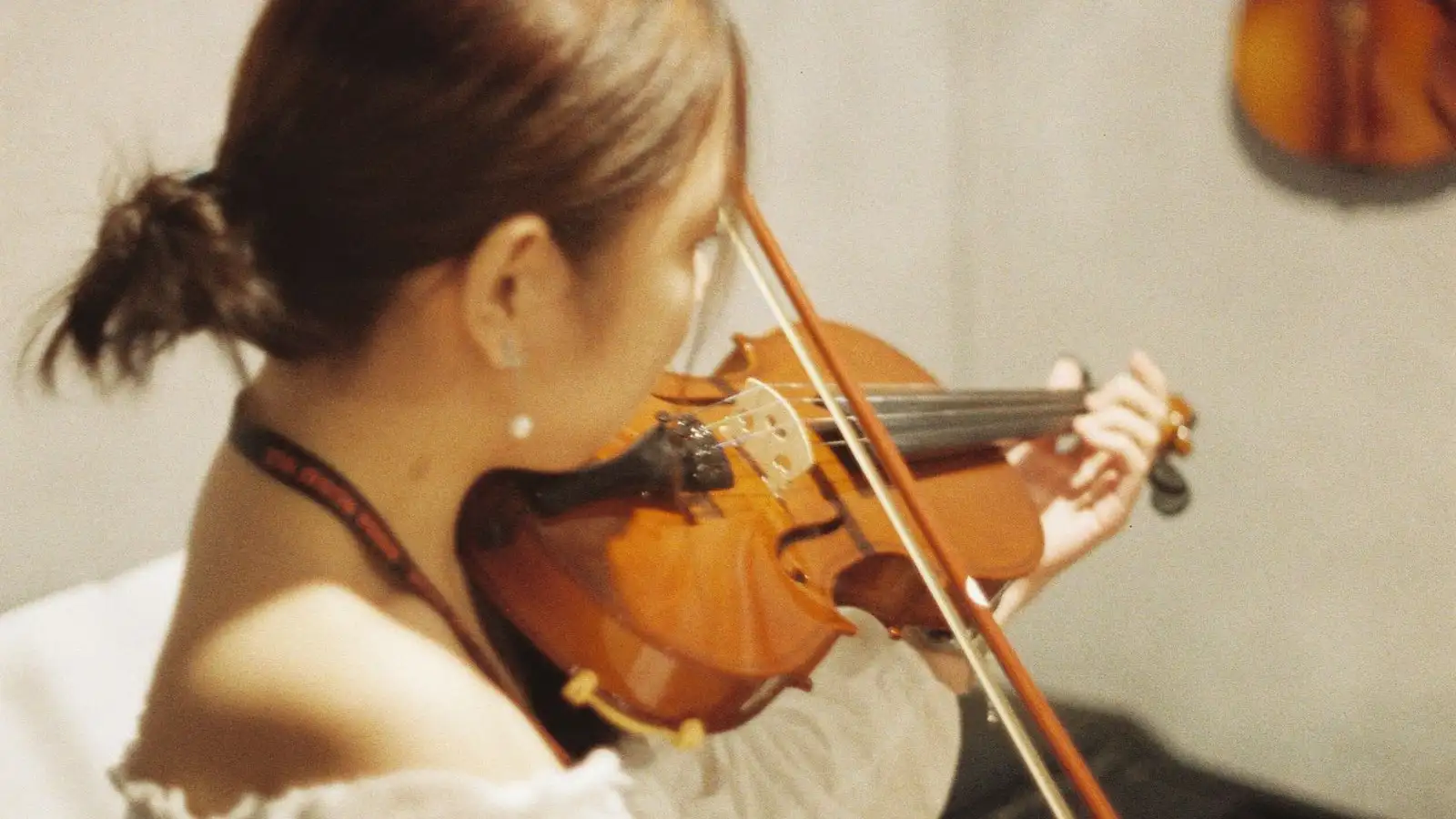
The violin is held by two contact points, and only two: the chinrest under your jaw, and the shoulder rest against your collarbone. Together they do one job — keep the instrument level enough that the left hand never has to hold it up — and they split that job between them. They are not separate accessories you shop for separately. They are one system. Anything that changes one of them has just changed what the other one is being asked to do, which is why fixing a slipping violin works best as a sequence of single adjustments rather than a shopping trip.
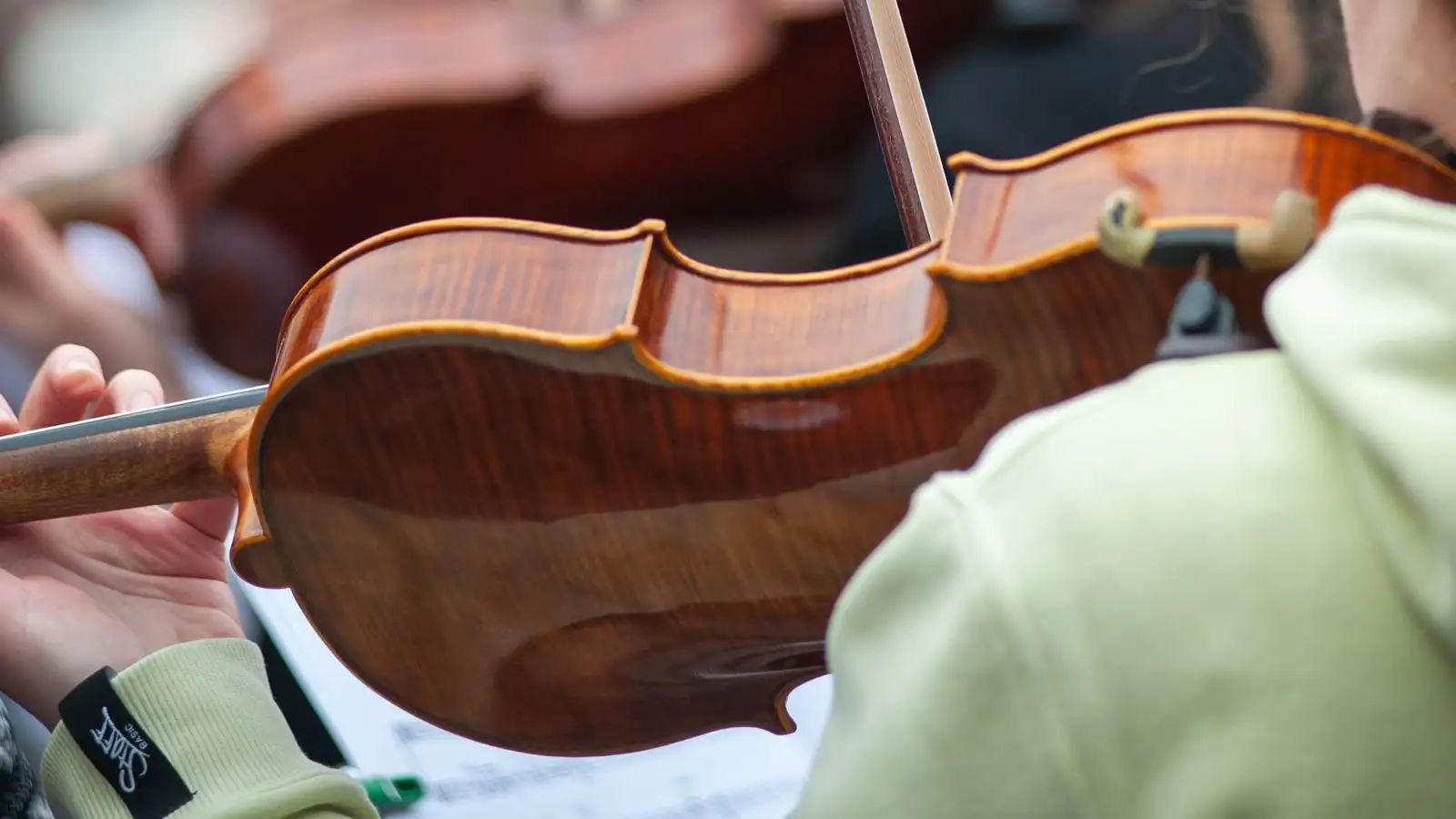
Come stand in front of a mirror. I'm right there beside you. If you play seated, sit on the front edge of the chair the way you normally do. Shoulder rest on. Violin up to your jaw. Now take your left hand away completely and let it hang at your side.
Watch the scroll.
Your instinct will be to grab the neck again, and I understand it, because the first time I did this the violin headed for my belt like a bar of soap in a wet tub. But the two seconds before you catch it tell you everything. If the scroll noses down toward the floor, if the body of the instrument slides down your chest, then your left hand has been carrying the violin this whole time. It just hasn't been saying anything about it.
Put the left hand back now, but only the thumb and the base of the index finger. No grip. Then slide the hand slowly up the neck, all the way to where the neck meets the body, and back down to first position. Do it again, a little faster.
That is the real check, and it's the one I run before I change anything at all: with the violin in playing position, the left hand should be able to travel freely along the fingerboard without being used to hold the instrument up. If the neck slides under your fingers while the violin sits still, your two contacts are doing their job. If the violin rotates, dives, or presses back into your hand, then the contacts aren't carrying their share and your hand has quietly become a third one.
Notice I said "before I change anything." Run the check first, and run it the same way every time. You need a baseline, or every adjustment you make afterward is a guess.
The two heights are really one number
Here's what took me too long to see. The distance from your collarbone to the underside of your jaw is fixed. It's your body. Whatever that number is for you, it doesn't move.
The violin plus its two contact pieces has to add up to that number.
Which means chinrest height and shoulder rest height aren't two independent choices. Raise the chinrest and you have just reduced how much height the shoulder rest has to supply. Lower it and the shoulder rest has to make up the difference, and foam and bent legs can only stretch so far.
People usually experience this as two separate complaints — "the violin sits too high" and "there's nothing underneath it" — when it's actually one number that got divided wrong. The fix isn't a fancier shoulder rest. The fix is moving some of the height from one piece to the other and seeing which side likes it.
The reverse case is the one that catches beginners. A low chinrest sitting on top of a low shoulder rest is the classic sinking setup. There isn't enough total height, so the violin slides down your chest toward your sternum, the scroll drops below level, and the left hand climbs up under the neck to hold the whole thing in the air. You can spend months thinking you have a weak left hand when what you actually have is a missing inch.
Where the chinrest sits changes the angle of everything
Height is only half of it. The chinrest's position on the instrument — centered over the tailpiece area versus off to the left side — changes where your jaw lands, and that changes the yaw of the whole violin across your body.
Put your jaw closer to the instrument's centerline and the violin tends to sit more square in front of you. Move that contact off to the left and the instrument rotates: the scroll swings further left, across your chest, and your left arm has to reach around a different angle to get to first position. Neither arrangement is wrong. But if you change the mount position and leave everything else alone, that rotation is the thing you'll feel, and it will feel like your left arm got longer or shorter overnight.
This is why the jaw contact and the collarbone contact are never really independent. Move the chinrest sideways and you have changed how much of the violin's weight lands on the shoulder rest, and where. The shoulder rest now has to hold a slightly different shape.
Change one piece at a time
I learned this the expensive way. I had a violin that kept sliding, so I swapped to a different chinrest height and a different shoulder rest in the same week. It got better. It got noticeably better. And I had absolutely no idea which of the two changes did it, which meant that the next time something drifted, I had nothing to go back to. I couldn't reproduce the result on a second instrument. I couldn't tell a student what to try first. I had a working setup and no understanding.
So: one contact point per change. Put the original pieces back, change the chinrest height or its mount position, play for three or four days, and run the slide check at the end of each session. If it improves, you've learned something you get to keep. If it doesn't, you put it back and you know for certain that the chinrest is not where the problem lives. Then, and only then, move to the shoulder rest.
Three or four days matters. A contact point you've moved will feel wrong for the first hour no matter how right it is, because your jaw and your collarbone have memorized the old shape. I have talked myself out of good adjustments on day one more than once.
The adjustments that cost nothing
Before any piece gets swapped, there are shoulder rest adjustments worth exhausting, and they're free.
The feet. How far apart they sit along the lower bout, and how far in from the edge, changes where the rest contacts your body and how much of the violin it supports. Widening the feet makes the rest more stable; narrowing it lets the instrument sit closer to you. The tilt of the rest, if yours allows it, changes whether the front of the violin points up or down, and that alone can fix a scroll that keeps nosing toward the floor.
Where it lands on you is worth checking too. A lot of players let the shoulder rest sit out on the meat of the shoulder, which pushes the whole instrument outward and forces the jaw to reach. The contact wants to be more forward than that, out toward the collarbone, closer to the front of your chest than to the side of your arm.
What this can't fix
There's a limit to all of it, and I'd rather say so. Your collarbone-to-jaw distance, the slope of your shoulders, and the shape of your jaw are givens. If your neck is very long or your shoulders drop steeply, the window of setups that work for you is narrower, and the honest goal is the least-bad arrangement rather than a perfect one. Sometimes the answer is that a violin the size of the one you're holding just doesn't fit your frame, and the next size down does.
But you can't tell which of those situations you're in by reading about it. You have to run the check, change one thing, and wait a few days. That's the whole method, and it has never once failed to tell me something true about an instrument.