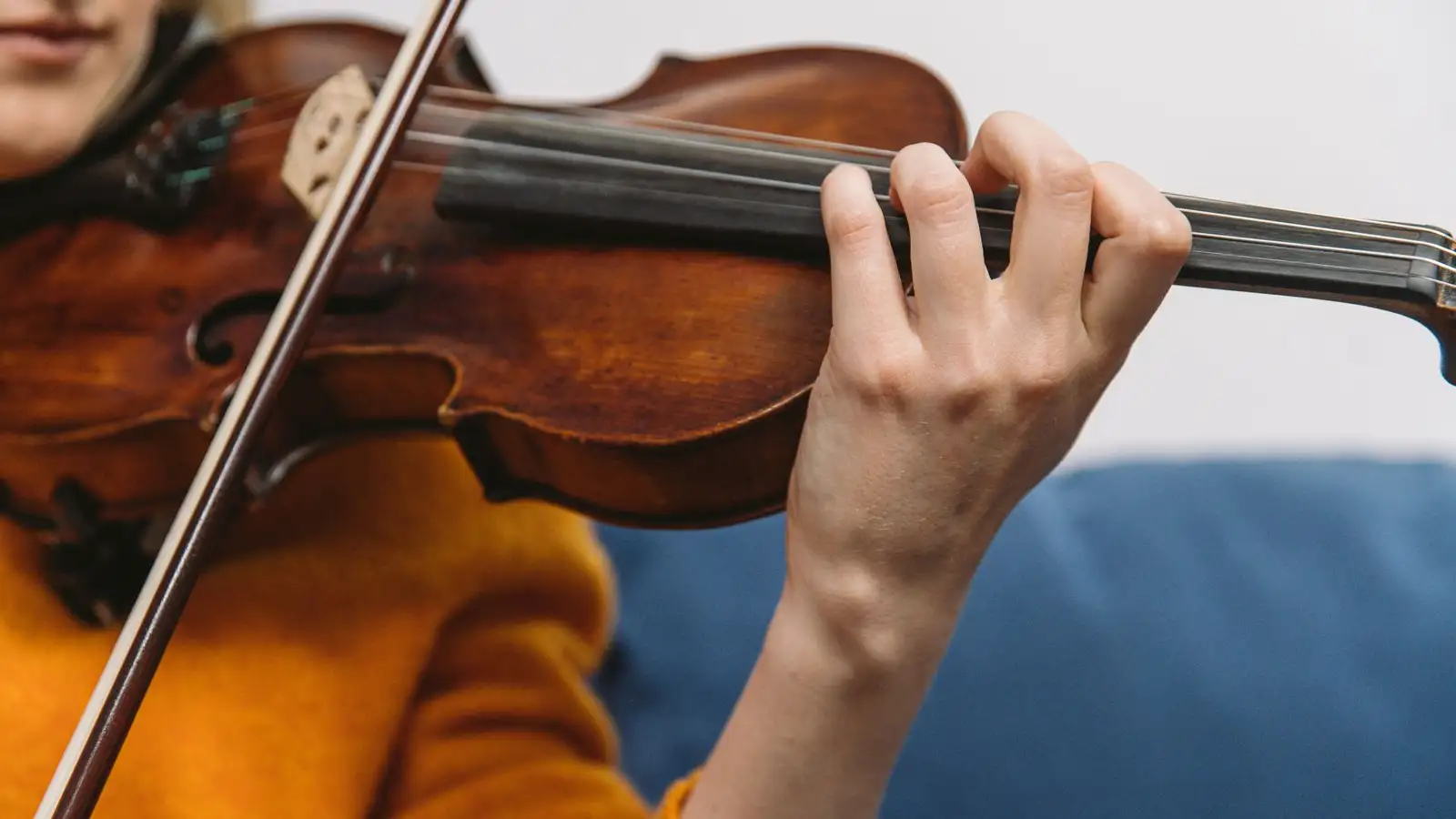
Your bow drifts because your bow hold is too rigid for the fingers to make the small corrections that keep the bow parallel to the bridge, so the shoulder ends up steering a job it was never built for. The drift you see at the string — creeping toward the fingerboard, sliding toward the bridge, or wandering both ways within one stroke — is usually the last visible link in a chain that starts at the hand. Before you spend another week chasing your shoulder, spend ten minutes on your fingers.
I found that out the boring way: standing in front of a mirror near the end of a practice session, watching my bow slide toward the fingerboard for the fortieth time, and finally asking a different question. Not why does my shoulder keep drifting, but why isn't my hand doing anything about it.
Picture the setup, because it's probably yours too. Small room. A mirror propped against the wall, long enough to see from your knees to your chin. You're standing far enough back that your right elbow, the whole bow, and the strip of string between the bridge and the fingerboard are all in the frame. You draw a slow down-bow. Halfway to the tip, the hair creeps up toward the fingerboard. You reset at the frog, draw again, and the creep happens in the same place. So you try to hold your shoulder still. It works for about three inches, then your wrist locks and the bow hops.
Sit in that moment for a second, because what's happening there is not a shoulder problem. It's a hand problem the shoulder is covering for.
The shoulder is a big joint doing a small job
The shoulder moves your whole arm in broad arcs. That's what it's built for, and it's good at it. What it can't do is shift the bow two millimeters sideways halfway through a stroke — and two millimeters is roughly the size of the correction that keeps a bow in its lane. That fine work belongs to the fingers and the wrist, sitting at the end of the chain, right next to the stick.
So when the hand is locked, the arm does what it can. It gets the bow roughly right, and the small error compounds as the bow travels. By the tip, you're off the lane. You feel it in your shoulder because the shoulder is working hard, and hard work feels like the cause. It's the symptom. That's the trap: the place where the problem shows up is rarely the place where it starts.
A test you can run in one minute
Try this on an open string. Play one long down-bow with your normal hold and watch the contact point. Then play another, but this time clamp everything — fingers squeezed together on the stick, thumb locked flat against the frog, pinky jammed straight and stiff. Two things happen. The bow goes crooked almost immediately, and it goes crooked in roughly the same direction and at the same spot your normal bow drifts. You've just made your own hold visible by exaggerating it.
Now the other half. Keep the same arm motion and let the hand be soft: thumb rounded rather than pressed, fingers draped over the stick instead of gripping it, pinky curved and light. Draw one slow bow. The bow tends to stay in the lane with almost no arm correction at all, because the hand is quietly making the corrections you couldn't see.
What the hand is doing from frog to tip
At the frog, your elbow sits closer to your body and the wrist carries a little more bend. As the bow travels toward the tip, the elbow opens, the arm extends, and the fingers extend with it. The hand follows the path the bow is already taking. That's the whole mechanism, and it only works if the fingers are free to move.
When the fingers are frozen in one shape for the entire stroke, the bow has nowhere to go but sideways. The lane is narrow — the strip of string between the bridge and the end of the fingerboard is only a couple of inches wide, and on the E string it feels tighter than that. Nothing about a stiff hand keeps the bow inside that strip. Aim for the middle of the lane as your default, and try to hold the same contact point from frog to tip instead of starting near the bridge and sliding toward the fingerboard as you go.
Signs the hold is the rigid part
White knuckles. A thumb locked straight and pressing up. A pinky pushed into the stick like a kickstand. Fingers that can't open even a fraction at the tip. A wrist with no give in it. If any of those are true while you play, and your bow drifts, you don't need a shoulder exercise. You need a hand that can move.
Mirror work that actually tells you something
Open strings, slow, in front of the mirror. One bow per string, four counts down and four counts up. First pass: watch the hair, not your hand. The gap between the hair and the bridge should stay about the same from frog to tip. If it shrinks as you go down-bow, the bow is drifting toward the bridge. If it grows, the bow is drifting toward the fingerboard.
Second pass: watch your hand instead. Does it stay quiet, or does the whole thing clench as you approach the tip? A cheap trick that helps is to stand so the bow crosses a fixed horizontal line in the room — a window frame, a strip of painter's tape on the mirror, the edge of a shelf — and check whether the bow stays parallel to that line or rotates away from it.
When you see drift, don't fix it mid-stroke
That's the instinct, and it's the wrong one. If you yank the bow back with your shoulder while it's still moving, you're rehearsing a correction that will never be fast enough. Stop. Reset at the frog. Check three things before the next bow: is the hold soft, is the contact point where I want it, is my elbow free to open. Then draw one slow bow and let the hand make the adjustment instead of the arm.
The cases where it isn't the hold
I don't want to pretend this is the only variable, because it isn't. If your bow drifts in the same direction no matter how soft your hand is, look at a few other things before you keep blaming the hand.
Arm level matters. If your elbow drops toward your side on the down-bow, the bow tips and the contact point changes even when the hand is doing everything right. The fix there is elbow height, not grip.
Violin position matters. If the violin is rotated too far to your left, the bow has to travel on a diagonal to stay anywhere near the bridge, and no bow hold will fix that geometry.
Bow tension matters. Hair cranked too tight makes the stick stiffer and less forgiving, so it amplifies small hand movements instead of absorbing them.
And sometimes it isn't drift at all. Changing the contact point on purpose — closer to the bridge for a stronger sound, a little toward the fingerboard for something softer — is a normal part of playing. What you're hunting is accidental change, not deliberate change.
Straight bowing is three things working together: the hold, the arm level, and the contact point. The hold is simply the one to check first, because it's the one that produces the drift you can see and hides the cause you can't.
The two-minute reset before every practice
Before you play a note: fingers draped, thumb rounded, pinky light, bow resting in the hand rather than clamped. Then one open string in the mirror, watching whether the drift shows up where it usually does.
If it doesn't show up, you found the cause. If it does, you've narrowed the search to something else on the list. Either way, you're no longer standing there trying to hold your shoulder still and wondering why it won't listen.