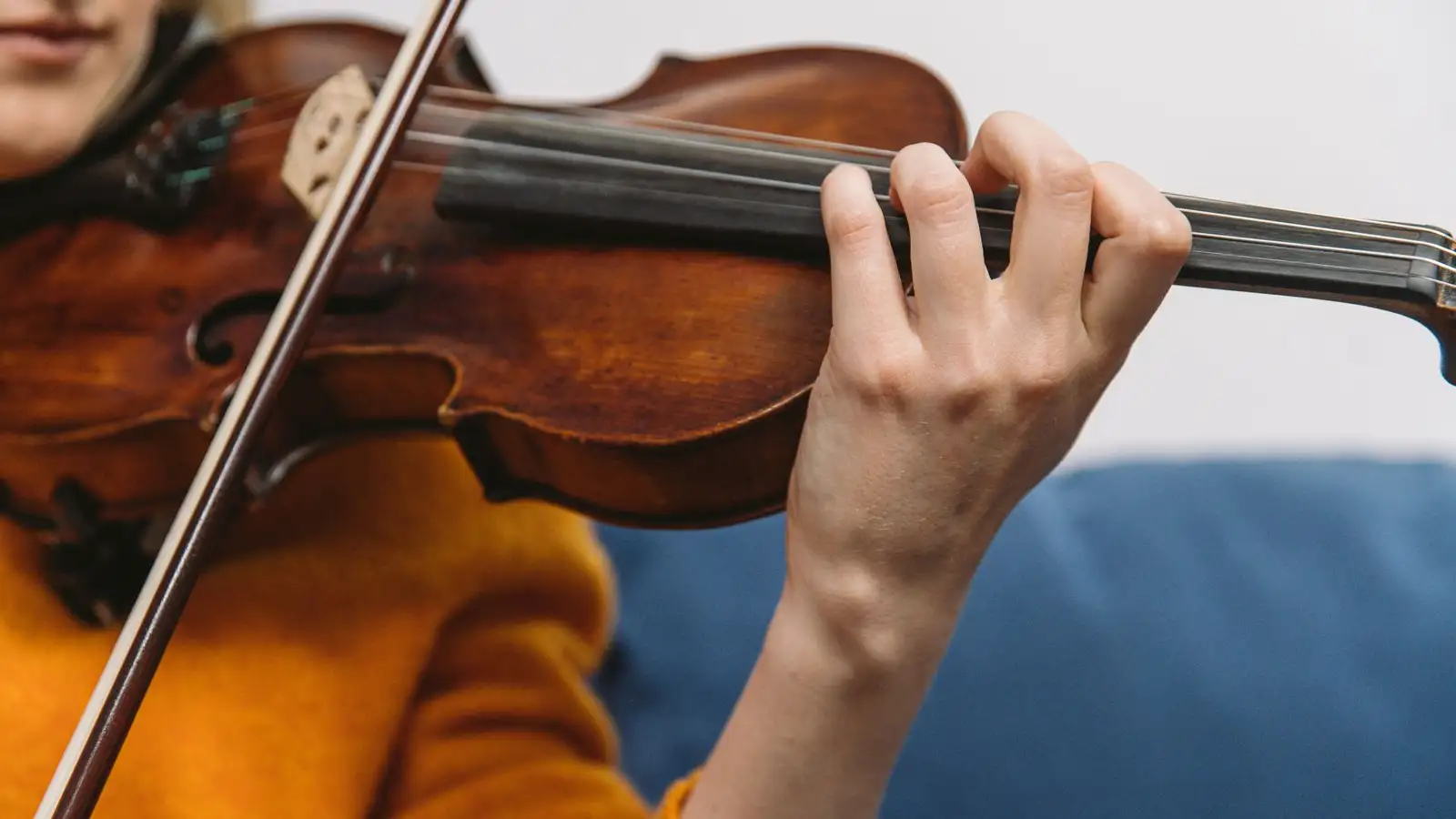
Your hand is tired before the scale is over because the bow hold is already working too hard, not because the scale is long. Four errors account for nearly all of it: a thumb pushed straight under the stick, fingers clamped around the frog, a wrist bent inward toward the forearm, and a pinky that has drifted up off the bow. They usually arrive together, which is exactly why trying to rebuild the entire hold in one practice session backfires. Pick one, run the check for it, and leave the other three alone until the next session.
I want you to feel the diagnosis before you read it. Put the bow on the D string, somewhere near the middle, and start a one-octave D major scale. Down bow, up bow. Somewhere around the fourth or fifth note your right hand starts to feel like it's holding a rope that somebody on the other end is pulling. By the top of the scale your forearm is warm and the pinky has quietly left the building. Set the bow down across your knee for a second and look at your hand.
Here's the part I had to learn slowly: the squeeze was already there on note one. The scale didn't create it. Eight notes just made it visible. So the answer isn't endurance, and it isn't a new bow hold copied from a video. It's figuring out which part of the hand was tense before you played anything at all.
Start With the Thumb, Because the Thumb Sets Everything Else
Look at your thumb while you hold the bow. Not the tip, the outline. From the big knuckle down to the nail. If it reads as a straight line, like a small stick propped under the frog, that thumb cannot bend, and neither can the fingers sitting above it.
A straight thumb turns the whole hand into one rigid unit. The fingers stop flexing, the frog stops working as a hinge, and every bow change gets absorbed by the wrist and forearm instead of by three small joints that cost almost nothing to move.
Self-check: with the bow in playing position and resting on the string, lift your thumb off the stick for a second and set it back down. If your other fingers clench or shift when the thumb moves, the thumb is welded to the stick rather than resting under it. Second version of the same check: find the bend. The tip of the thumb should sit on the stick near the leather wrapping, and the joint nearest the tip should look soft. If you can't find a bend anywhere along its length, you found your first error.
A Collapsed Wrist Steers the Bow in an Arc
Collapsed means the hand bends inward toward the arm. The back of the hand drops, the wrist folds, and the bow starts traveling in a shallow curve instead of a line. You can spot it from across a room. Players who do this usually compensate with the shoulder, which is a much more expensive way to move six ounces of wood.
Self-check: put the bow on the string at the frog and look at the line running from your elbow, along your forearm, and through the back of your hand toward the knuckles. It doesn't have to be perfectly straight, because hands aren't built that way. But the back of the hand should not be sinking down toward your wrist.
A second version catches it while you're moving. Draw a slow down bow and watch the contact point between hair and string. If the bow slides toward the fingerboard as you go, the wrist is steering. If the contact point holds steady, the wrist is staying out of the way.
The Pinky Doesn't Play, It Balances
Near the frog the bow is heavy on the tip side, and the pinky is the only thing keeping it level. Beginners solve that problem in the worst possible way: they lock the pinky straight and rigid, or they let it float up and off the stick entirely. Either one and the bow feels top-heavy the moment you get near the frog.
Self-check: set the bow on the string right at the frog. Now relax your index finger completely, letting it hover off the stick if it wants to. The tip of the bow should stay roughly level, held up by the little finger and the thumb. If the tip dives, the pinky isn't carrying anything.
Then the opposite check. Bend the pinky so it sits curved on top of the stick. If that position feels like something you're holding rather than something you're resting in, the pinky is locked. A locked pinky is worse than a floating one, because it transfers tension straight down the back of the hand.
Watch the Hand When the Bow Changes Direction
Set your eyes on the spot where the stick touches your index finger. During a bow change, a hand with rigid fingers keeps still while the bow slides through it. A little roll is normal and even useful. The problem is when the bow drifts to a new home and stays there.
Self-check: play a slow down bow and up bow on one open string, and keep watching that contact point. The bow shouldn't crawl out toward your fingertips on the up bow or back toward your palm on the down bow. If the contact point travels more than a few millimeters in either direction, something in the hand is too rigid to let the bow pivot. Usually it's the thumb again. Sometimes it's the pinky. Rarely is it both at once, which is good news.
Are You Even Holding the Right Part of the Bow?
This one gets skipped constantly, and it undoes a lot of good work. If the hand sits too far from the frog, with the thumb wandering out into the middle of the leather, you lose leverage and the pinky has a longer lever to fight. If the hand sits too far toward the tip, you lose the weight of the frog as a counterbalance and the whole bow suddenly feels heavier than it is.
Self-check: look at your thumb. It should be resting on or immediately behind the leather wrapping, with the frog sitting against the far side of your hand, roughly where your ring finger and pinky attach. If the thumb is out past the leather, slide the whole hand back toward the frog and try the scale again. A surprising number of grip problems disappear when the hand simply moves an inch.
The Squeeze Test That Ties All Four Together
Put the bow back on the string, middle of the bow, and move it with your arm alone. No finger action, just a slow draw from the elbow and shoulder. If the hand tightens just before the bow starts to move, the grip is doing the work instead of the arm.
Softening until the bow almost drops on the down bow, then adding back a fraction. That fraction is your real bow hold. Not the maximum you can produce, the minimum that keeps the bow on the string. When you can move the bow without the hand clamping first, you've passed the test.
Fix One Thing Per Week, Not Five Things Per Practice
I know the urge. You read four errors, so you try to correct four errors, and forty minutes later the hand is tighter than when you started. The reason is attention. A hand can track one new sensation at a time. Monitor four things at once and you have nothing left to notice with, and the thing you notice last is always how hard you're squeezing.
So write them down and take them one at a time. Thumb this week. Wrist next. Pinky after that. Hand position last, because moving the hand changes everything above it and you'll want the other three settled first. One check, one scale, and stop while it's still going well.
A Few Things That Are Not Errors
Hand size matters, and so does the instrument. Someone with a small hand may sit a little closer to the frog and still have a perfectly good hold. Two players the same size can hold the same bow differently and both be right. A slow learner isn't necessarily a tense one either; scales are just where tension becomes visible first.
The one thing that doesn't bend is this: the hand has to be able to move the bow without gripping it. If you can pass the squeeze test, most of what looks wrong is just style.
Now play the scale again. Same tempo, same bow speed, no changes except the one thing you picked. If the last note arrives and your hand feels light instead of tight, you found it. If it doesn't, set the bow down and check the thumb again.