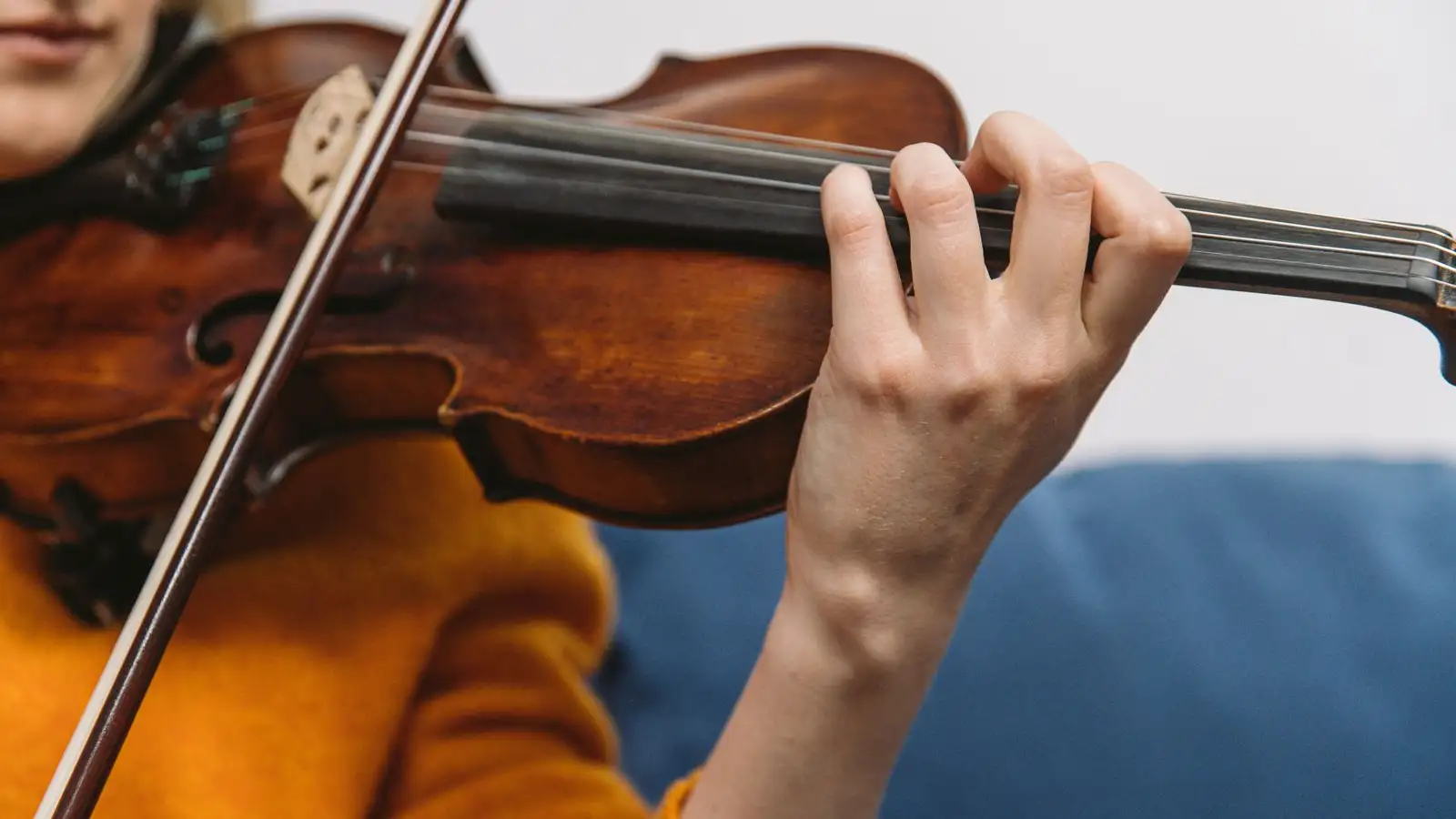
The fastest way to improve a child's bow hold is to stop touching the bow and start using words: pick one thing per practice, say it in five words or fewer, and let the child find it themselves. Wrapping your hand around theirs and walking each finger into place feels like teaching, but it trains a child to wait for your hand instead of learning what a correct hold actually feels like.
I'm sitting on the floor with my back against the couch, and my kid is standing on the strip of blue painter's tape we laid down for foot position. Third pass through the same eight bars, and the thumb has gone flat again, lying the long way along the frog with the whole hand locked around it like a fist. My right hand is already moving toward the bow before I notice it happening. That reflex is the thing I've had to retrain in myself, and it's the first thing I'd point out to any parent sitting where I'm sitting.
Because here's what I noticed after a few months of this: every time I reached in, my kid's hand went quiet. Not relaxed, quiet. It stopped doing its own work and waited for me to finish. Twenty seconds of my fingers on their fingers bought me a nicer-looking hold and cost me a small piece of their ability to feel it themselves.
What I do with my own hand instead
I hold the bow. Not toward the child, not as a correction, just in front of me where they can see it, and I open and close my fingers around the frog slowly a couple of times. Kids copy what they see much more reliably than what they're told. Two seconds of my own hand doing the thing is worth a paragraph of explanation, and I don't have to touch anybody.
It also forces me to be honest about whether I actually know what I'm asking for. Try describing a bow hold out loud without demonstrating and you find out fast how vague your picture is.
One thing, not five
My early attempts sounded like this: "thumb bent, pinky curved, wrist soft, don't squeeze." Four corrections in one breath. It lands as noise, and the child hears only that they're doing it wrong again.
So now I pick one element for the whole session. A bent thumb on Monday. A curved pinky on Wednesday. It goes on a sticky note on the music stand so I don't drift. Everything else I let go, even when I can see it, even when it's obvious.
The prompt itself stays short and stays the same. "Check your thumb." "Soft pinky." "Tall fingers." Same words every time, until it becomes shorthand between us and I can say two syllables from across the room and the hand changes on its own.
Timing matters as much as wording. I don't correct mid-phrase or mid-song. I wait for the space between repetitions, say the one thing, and then stay quiet while they play it again. If I comment on every pass, practice turns into a running commentary and nobody wants to be the subject of that.
The check that costs nothing
Some days I don't correct at all. I just watch one repetition without saying anything, then ask, "Show me your bow hold." Not "fix your bow hold." Show me. The difference is that the child has to build it from scratch and I get to see whether they can.
That question is also my honest test of whether any of this is working. If my kid can set the hold without me, and play four bars without me saying a word, they own it. If I have to rebuild it every single time, then I'm the one holding the bow and they're just borrowing my hand.
If your child hates being stared at while they play, and plenty do, record twenty seconds on your phone and watch it together afterward. Same information, no audience.
Before you blame the hand, look at the bow
I spent weeks coaching a thumb that turned out to be a bow problem. If the frog keeps sliding into the palm and the child has to reach for the balance point, or if the grip tightens the moment the tip comes up, the bow may be a size larger than the arm wants. A longer bow puts the weight further from the hand, and the hand answers that weight by squeezing.
The reverse happens too, though less often: a bow that's too short pushes the hand past the frog and the fingers end up somewhere they can't work from. It's worth checking the size at the start of every growth spurt, and kids grow out of bows faster than anyone expects.
None of that is a reason to buy something. It's a reason to look at the bow before you spend another session coaching fingers that are being asked to do an impossible job.
The pencil on the kitchen table
Most of our bow hold work doesn't happen in the practice room. It happens at the kitchen table with a pencil, thirty seconds at a time, while somebody is waiting for toast.
Hold it in bow hold, tip up, tip down, tip up, tip down, using only the fingers. No instrument, no sound, no one listening, nothing to get wrong musically. The pencil is light enough that a squeezed grip shows up immediately, and light enough that a relaxed one holds it fine.
A short pencil, a dowel, a stick from the yard, it doesn't matter. What matters is that it's a separate, low-stakes thing from playing, so the bow hold stops being the part of practice where someone gets corrected. Thirty seconds, three times a day, beats a fifteen-minute session we both dread.
That's the other piece I'd hand to any parent: shorter and more often wins. Ten minutes twice a day, or even five, does more for a hand than one long session where the last fifteen minutes are just fatigue and correction. Tired hands grip. Gripping hands are the thing you're trying to avoid.
What I let go of
In the first few weeks, maybe the first few months, I don't chase a perfect hold. A relaxed hand with a slightly flat pinky will fix itself as the fingers get stronger and the child gets more comfortable. A textbook hold on a locked, white-knuckled hand will fight me for a year.
So the rule I actually practice by is this: if I have to choose between relaxed and correct, I choose relaxed, and I choose it out loud so my kid knows that's the choice too. The correctness comes. It comes a lot faster when nobody's hand is being pried open.