The index finger sits at its first crease on the stick, the middle and ring finger pads rest on the frog, the pinky stays curved on top of the stick near the screw, and the thumb bends underneath to face the middle and ring fingers, with the stick crossing the hand diagonally from index to pinky. Set your hand on a pencil first and you can verify all five of those contact points in about ten seconds, before the bow's weight pulls the hand into shapes you didn't choose.
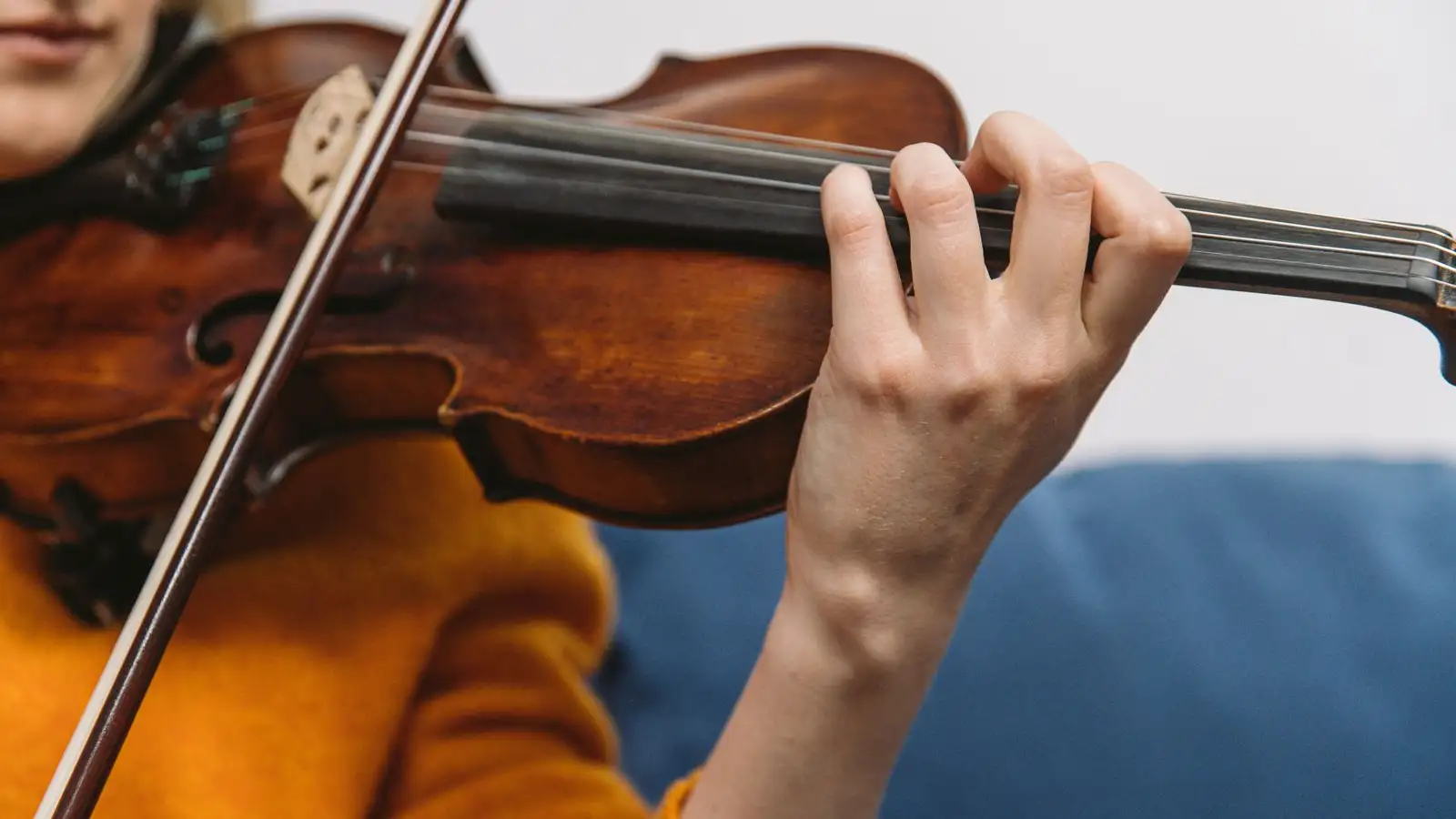
Grab a pencil before you grab the bow. That's the whole trick, and it isn't really a warm-up exercise so much as a way of seeing. A bow carries weight out toward the tip, and the second you pick it up that weight drags your hand down and sideways. Your fingers correct for the dragging without asking you first. By the time you look down at your hand, you're looking at a correction, not at a position. A pencil doesn't pull. It just sits there and shows you what you actually built.
I keep one on the music stand now, an unsharpened yellow one, because the flat sides give my fingers something to register and the eraser end makes a little bump my pinky can find without me looking.
Here's the order I walk through it.
Start with the loose bunny shape
Hold the pencil in your left hand for a second. With your right hand, let the fingers curl down toward the palm and bring the thumb up to meet them, the way you'd shape a shadow puppet. You're after a loose C with a gap in the middle wide enough to slide a pencil through. Nothing touches yet. The fingertips hang, the thumb is bent at its joint, and the whole thing is limp.
If your fingers are pressed together or your knuckles have gone pale, you've already overshot, and that hand will not survive a full down bow.
Now slide the pencil into that gap from the side, so it enters between the thumb and the index finger and comes to rest on a diagonal. Then check each point one at a time.
The index finger
The pencil should land on the index finger at the first crease, or just between the first and second joints. Not on the fingertip. If the tip is doing the work, that finger is pointing down at the stick and your hand has rolled too far over the top. The opposite mistake is letting the stick sink into the webbing between the thumb and index, which usually means the hand is buried too deep. Both of those feel secure for about a minute and then stop working.
The middle and ring fingers
These two do most of the quiet work. Their pads, or their tips if your fingers are short, touch the frog, the small block at the lower end where the hair meets the stick. On a pencil there is no frog, so I just let these two curl in and touch the pencil wherever they naturally fall. On the bow, that same curl puts them on the frog or on the stick just above it. Pads, not claws. If the middle fingertip is jabbed into the stick, the hand has tightened.
The pinky
The pinky sits on top of the stick near the screw, and it stays curved, bent at both joints like it's resting on a windowsill. Locked straight, it can't do its job, which is to counterbalance the weight of the tip end when you play near the frog. On the pencil, rest it on top and check the curve by looking at it from the side rather than from above. A lot of beginners let the pinky drift off into the air entirely. It's allowed to be light. It shouldn't be a passenger.
The thumb
The thumb is bent, not straight, and it sits underneath, opposite the middle and ring fingers, usually resting against the frog. Bent means the joint near the tip is soft and flexed. A straight, locked thumb turns the whole hand into a clamp within a few bars of playing. Place the pad of the thumb on the pencil, then look: is the middle finger roughly above it, close enough that the two could pinch? If not, one of them moved.
The diagonal is the check that actually matters
Here's the thing I wish someone had said to me in plain words. The stick crosses the hand on a diagonal, entering near the index finger at the first crease and exiting under the pinky near the screw. If it lies flat across the fingers, parallel to the knuckles, then everything above it is wrong in a way you can't fix finger by finger.
Look down at the back of your hand. You should see the pencil running corner to corner. On the bow, that same diagonal is what lets the weight travel down your arm instead of collapsing into a fist.
When your hand doesn't match the diagram
Hands come in sizes that don't agree with each other, and I don't think there's a single correct millimeter for any of this. On a smaller hand, the pinky often can't reach the top of the stick without the wrist twisting, and the thumb usually needs to sit a little differently to stay opposite the middle finger. On a larger hand, the middle finger sometimes lands more on the stick than on the frog.
The honest limitation of the pencil is that it has no frog and no screw. Your middle and ring fingers lose their landmark, and your pinky has nothing to feel but wood. So the pencil confirms the diagonal and the thumb relationship, and the bow confirms the rest. You will re-check on the bow. That's expected, not a failure.
Moving the same hand onto the bow
When the pencil position starts feeling like a resting position, when you can pick it up without rearranging anything, pick up the bow. Same hand, same diagonal, same bent thumb. It will feel enormous. The frog will sit where your middle and ring fingers expected a hexagon, and your pinky will find the screw.
Set it down. Pick it up.
I do that a lot, and not because it's a drill. It's because the second version of a bow hold is usually better than the first, and the fifth is usually better than the second, and I can't tell which one I'm in unless I start over.
The point was never the pencil. The point is having one test you can run in ten seconds when the sound goes bad: set the bow down, pick up the pencil, check the diagonal, check that the thumb is bent and facing the middle finger. If the pencil hand looks right while the bow hand looked wrong, you've found the problem without guessing at it.