How long you hold a note in beginner violin music comes down to one number: the note's value, counted in beats against the time signature. In 4/4 time that means four beats for a whole note, two for a half note, one for a quarter note, and half a beat for an eighth note. Every one of those values has a matching rest, and a rest is counted with the same syllables as the notes. That last part is the one most beginners treat as blank space on the page — and it is usually the reason the next entrance comes in early.
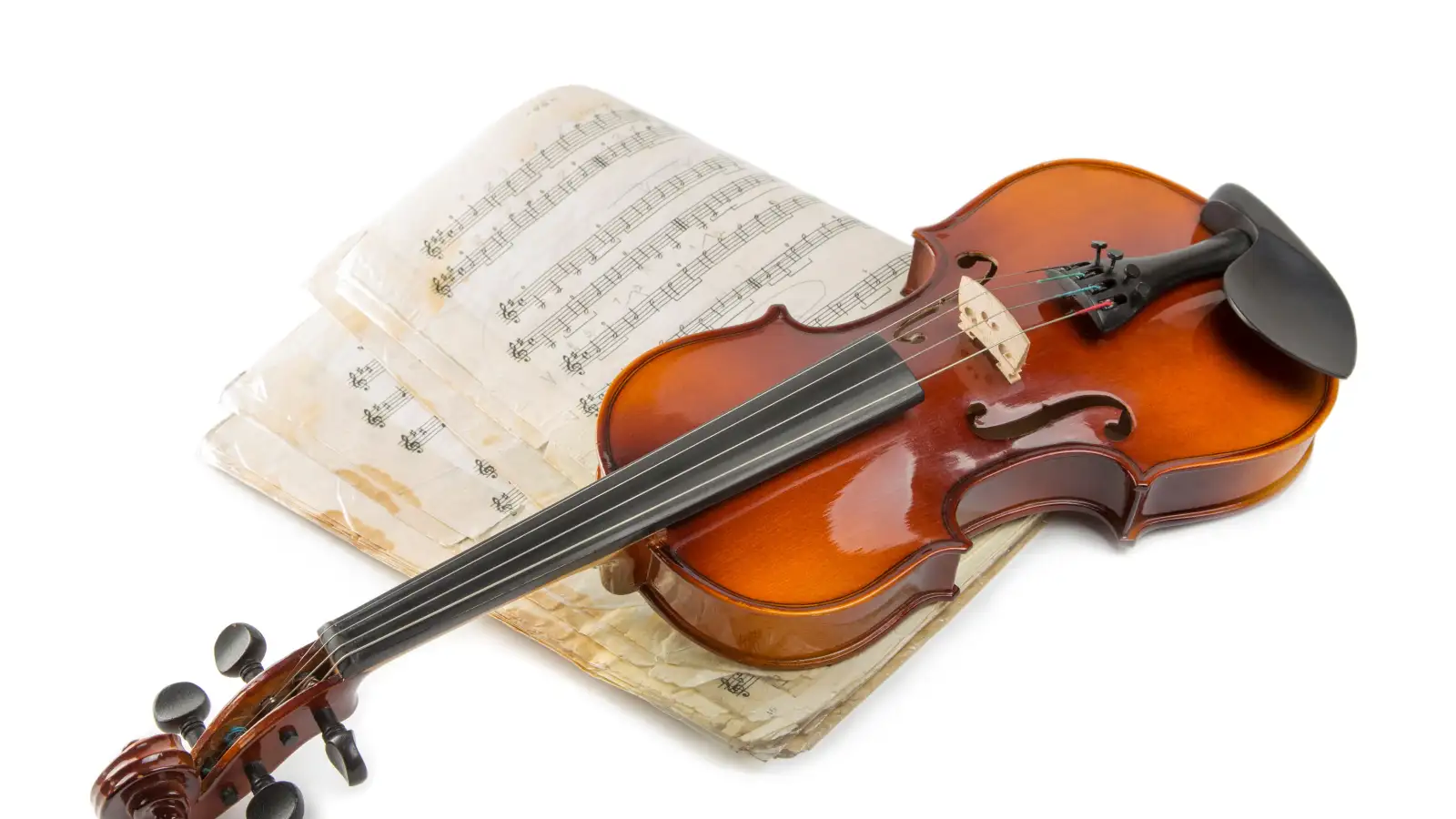
I keep a metronome on the stand at 60, not because 60 is magic but because at 60 a beat is one second and I can hear myself think. The book is open to a short piece in 4/4, eight bars, almost nothing but open strings. I put the bow on the D string and say the beats out loud before I play a note.
That habit did more for my rhythm than anything else I tried, and it started with learning to read the symbols as instructions to my arm instead of shapes on a page.
What the symbols actually tell your bow
A quarter note is a filled-in oval with a stem. One beat. On the violin that is one bow stroke, down or up, and it eats a certain amount of bow hair. If I take a full bow for every quarter note in a four-beat bar, I run out of arm somewhere around beat three.
A half note is a hollow oval with a stem. Two beats. Same stroke, half the speed, roughly twice the bow.
A whole note is a hollow oval with no stem at all. Four beats in 4/4. Beginners run out of bow on whole notes more than on anything else, because four beats is a long time to keep an arm moving at a steady rate. The fix isn't to move faster. It's to plan where the bow starts so it has somewhere left to go.
An eighth note is a filled oval with a stem and a flag. Half a beat each. Two eighths usually get beamed together under one thick line, and both of them live inside a single beat — one-and, two-and. Two notes, one pulse.
A dot after any note adds half of that note's value. A dotted half note is three beats. A dotted quarter is one and a half beats. Dots aren't decoration. They change which beat the next note lands on, and if you ignore them the whole bar slides out from under you.
Rests get counted, not skipped
A rest occupies beats exactly the way a note does. That's the whole idea, and it took me months to actually believe it.
The whole rest is a small rectangle hanging below the fourth line of the staff. The half rest is the same rectangle sitting on top of the third line. Same shape, different position, four beats versus two. I mixed those two up for weeks and could not figure out why my counting kept coming out a bar off.
The quarter rest is the squiggly one that looks like a bent lightning bolt. One beat. The eighth rest is a small hook with a single flag. Half a beat.
Here's where it gets practical. In a bar of four beats, a quarter rest is "one." One full beat where the bow does not move. If I count one, two, three, four out loud but I only say the numbers that have notes under them, my bow comes in on the wrong syllable. The silence has to get a syllable too. Saying the word rest out loud on that beat feels ridiculous for about two days, and then it stops feeling ridiculous, because it works.
One exception worth knowing: a whole rest can also mean an entire measure of silence, even in 3/4 or 2/4, where a measure isn't four beats long. So in a waltz, a whole rest means count three, not four, and let the barline tell you when you're done.
Waiting is a physical skill, not a passive one
Playing a note is a positive instruction. It tells the arm what to do. A rest is a negative instruction, and negative instructions are harder for a body to follow.
My bow arm has momentum. It wants to keep moving. On a piece with two beats of rest, I would lift the bow, hover, and set it back down a fraction early, because the silence felt longer than it counted. The rest wasn't restful at all. It was the most active part of the bar, because I was trying to hold still on purpose.
Two things helped. First, I stopped treating every rest the same way physically. Some rests the bow stays on the string and simply stops moving. Others are a genuine lift and reset. A rest at the end of a phrase is usually a lift, because the next phrase wants a fresh start; a rest in the middle of a bar often isn't.
Second, I started using rests to fix my bow. If I've drifted out toward the tip and a long note is coming, a rest gives me a place to reset the bow direction and the amount of bow I have left. That only works if I know how long the rest is. Which means counting it.
Count it away from the instrument first
The sequence that stuck for me goes: speak, clap, air-bow, play.
Speak the rhythm on a steady syllable for notes and a closed-mouth hum for rests, with a foot keeping the pulse. Clap on the notes and keep your hands apart on the rests. If you can hold your hands apart for a full beat without an itch to clap, you've got the rest. Air-bow next — bow arm in playing position, moving through the rhythm without the violin, freezing where the rests fall. Then play on the instrument, at whatever tempo still lets you count out loud.
Clapping and speaking before playing isn't a warm-up formality. It separates two problems that fight each other. On the violin, rhythm and tone production compete for the same attention. Take the violin out of your hands and you find out whether you actually know the rhythm or were just following your bow.
Where the simple answer gets complicated
Tempo changes how long a beat lasts in seconds, but not how many beats a note holds. A half note is always two beats. At 60 it takes two seconds; at 96 it takes less. Beginners sometimes try to fix a rushing problem by dropping the metronome number, which mostly hides the problem. If the counting is wrong, a slower tempo just gives you more room to be wrong in.
Time signature changes how many beats fit in a measure, not what the symbols mean. A quarter note is one beat in 4/4, in 3/4, and in 2/4. What changes is where the bar ends and which beats feel strong.
And counting out loud while bowing is genuinely difficult. I won't pretend otherwise. Most people can't narrate and play at the same time at first, and that's normal, not a defect. That's exactly why the counting happens in the air first, on one open string second, and with the left hand added last.
What finally clicked
The rest is not a gap between two events. It is one of the events. The note tells me when to start; the rest tells me when to start next. Both sit on the clock, both get a syllable, both get a share of my bow's attention.
Once I started counting the silence instead of waiting it out, my entrances landed on the beat instead of just before it, and the piece stopped sounding like a series of small apologies.