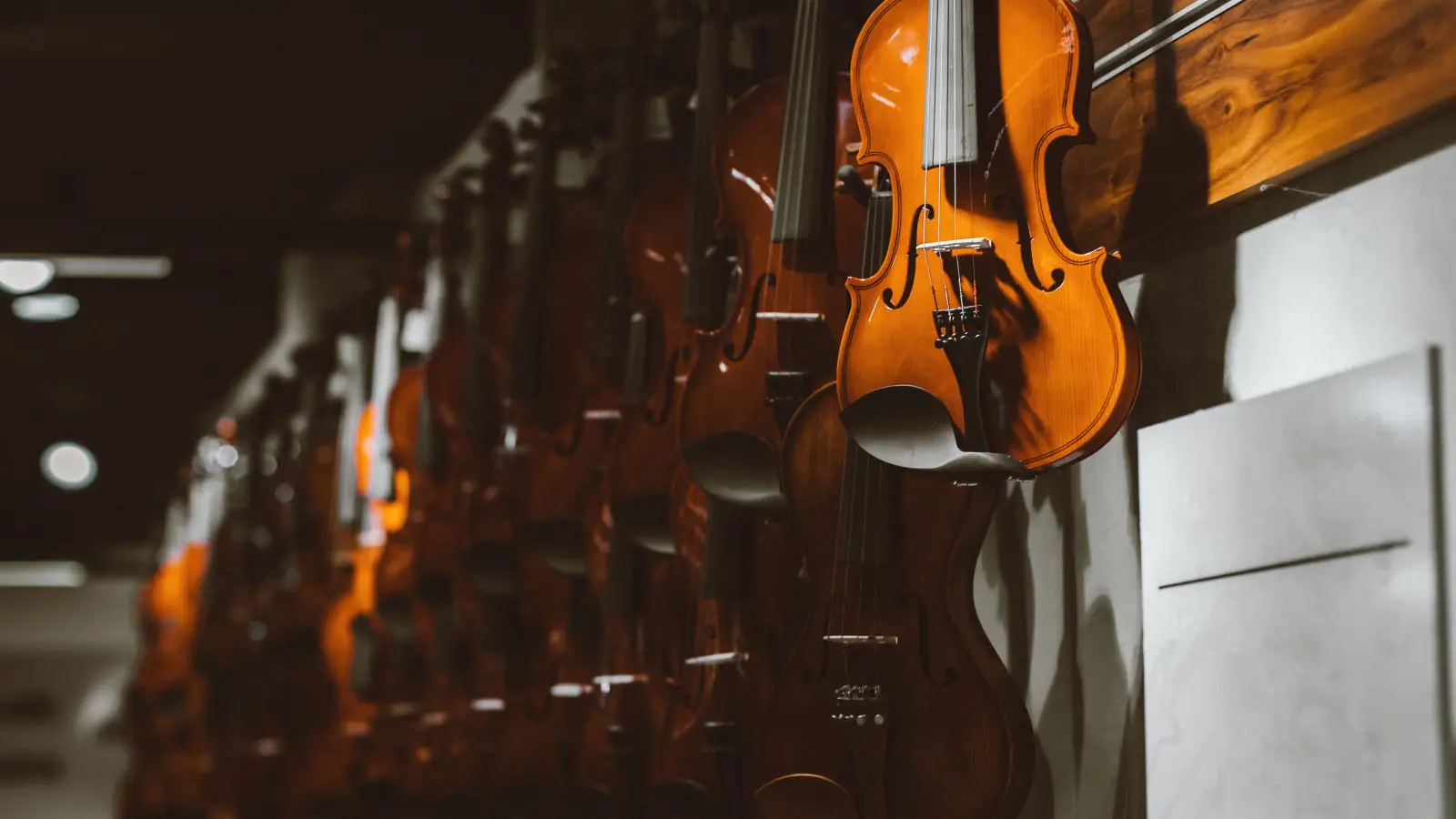
A 1/2 violin does not measure half the body length of a full-size (4/4) instrument. A standard full violin body is about 14 inches; a 1/2 violin body comes in at approximately 12.5 to 13 inches — a reduction of only 10 to 15 percent. The fractional label is a naming convention inherited from 19th-century workshop practice, not a literal ratio. The disconnect between the label and the ruler is what confuses parents and adult beginners who expect a far more dramatic size cut.
When the Fraction Triggers a Mistaken Expectation
A parent uses a standard arm-length sizing chart and lands on "1/2 violin." The mental arithmetic is straightforward: half of 14 inches equals 7 inches, so the instrument should be about as long as a large paperback. The actual 1/2 violin that arrives is only slightly shorter than the full size — visually, a completely different object. The expectation was wrong not because the parent misunderstood the chart, but because the label is a poor proxy for size.
Exposing the Misalignment Between Number and Measurement
The Actual Body Lengths of Full, 1/2, and Other Sizes
A full (4/4) violin body measures close to 14 inches (356 mm) from the end button to the neck root. A 3/4 body is approximately 13.25 inches (337 mm). A 1/2 body falls between 12.5 and 12.9 inches (317–328 mm). The step from full to half is roughly 1.5 inches — not the 7 inches a literal reading would predict. Smaller fractions like 1/4 and 1/8 shorten by even smaller absolute amounts, so the numeric label becomes even less indicative of the actual reduction.
The Fraction as an Archival Label, Not a Specification
In 19th-century European workshops, luthiers needed a shorthand to sort instruments for young players. Early labels may have loosely referenced string length proportions, but the system quickly fossilized into arbitrary categories — more like shirt sizes (S, M, L) than engineering fractions. Once the convention spread among teachers and catalogues, inertia kept it in place. The term "1/2" in this context is a semantic artifact, not a dimension.
Scaling That Prioritizes the Player, Not the Equation
A fractional violin is built by scaling the whole instrument so that a smaller player can maintain the same ergonomic relationships as an adult. The critical variable is arm length; hand size and finger spread are secondary. A 1/2 violin preserves the geometry between chinrest, shoulder, and fingerboard so that posture, bowing, and left‑hand shape remain functional. That is why the system works despite the misleading numbers — the increments follow human proportions, not arithmetic halves.
Misconceptions That Turn a Sizing Chart Into a Guessing Game
“Half Must Mean Half the Length” — And Why the Number Fails That Test
If the fraction were literal, a 1/2 violin would have a 7-inch body. No such violin exists. The label describes a size tier that is about 89–93% of the full body length. Treating the fraction as a dimension leads a buyer to expect a miniature that doesn't exist, then to discount a properly scaled instrument because it "doesn't look small enough."
“Every Step Down Uses the Same Fractional Ratio”
The gap from 4/4 to 3/4 is about 0.75 inches, while the drop from 3/4 to 1/2 is closer to 0.5 inches. The fractions suggest a uniform scaling pattern, but the actual inches don't shrink at a constant rate. This makes it impossible to infer the next size's measurements from the fraction alone. The labels are rank-ordered, not ratio-based.
“The Fraction Tells You Which Size to Buy”
Two children with identical birth years can require different violin sizes because arm length, not age or the label, is the deciding factor. A 20-inch arm measurement generally points to a 1/2, but a child with a 19-inch reach may fit better in a 1/4. The fraction is a convenient sorting bucket, not a fit guarantee.
Common Questions That Follow From the Half-Not-Half Confusion
Is a 1/2 violin exactly half the size of a full violin?
No. The body length of a 1/2 violin is roughly 90% of a full violin, not 50%. The term “half” is a legacy label, not a measurement.
How long is the body of a 1/2 violin?
A typical 1/2 violin body (the back, excluding neck and scroll) measures about 12.5 to 13 inches. Total length, including neck and scroll, is around 20.5–21 inches.
What size violin should a 7-year-old use?
Many 6- to 7-year-olds with average arm length use a 1/2 violin. The only reliable method is to measure from the left side of the neck to the center of the wrist. If that measurement is between 20 and 22 inches, a 1/2 usually fits.
Why are violins labeled 4/4, 3/4, 1/2, and so on?
The system arose in the 19th century as a simple way to sort smaller instruments. The numbers were never precise dimensional ratios. They persist because the system still functions for sizing purposes, and no one has had a strong reason to replace it.
Can an adult play a 1/2 violin?
Adults rarely need a 1/2 because their arm length typically requires a larger instrument. However, an adult with a very small frame or hand size may find a 1/2 or 3/4 more comfortable. The violin should fit the player, not the age category.
What to Remember When the Sizing Chart Shows a Fraction
Ignore the fraction as a literal size indicator. Instead, check the instrument’s actual back length and match it to the player’s measured arm. If a chart says “1/2,” confirm the body is in the 12.5–13 inch range. Understanding that the move from 1/2 to 3/4 is a minor step, not a 25% jump, helps time the upgrade based on comfort and playing readiness rather than on a number that was never meant to be taken literally.