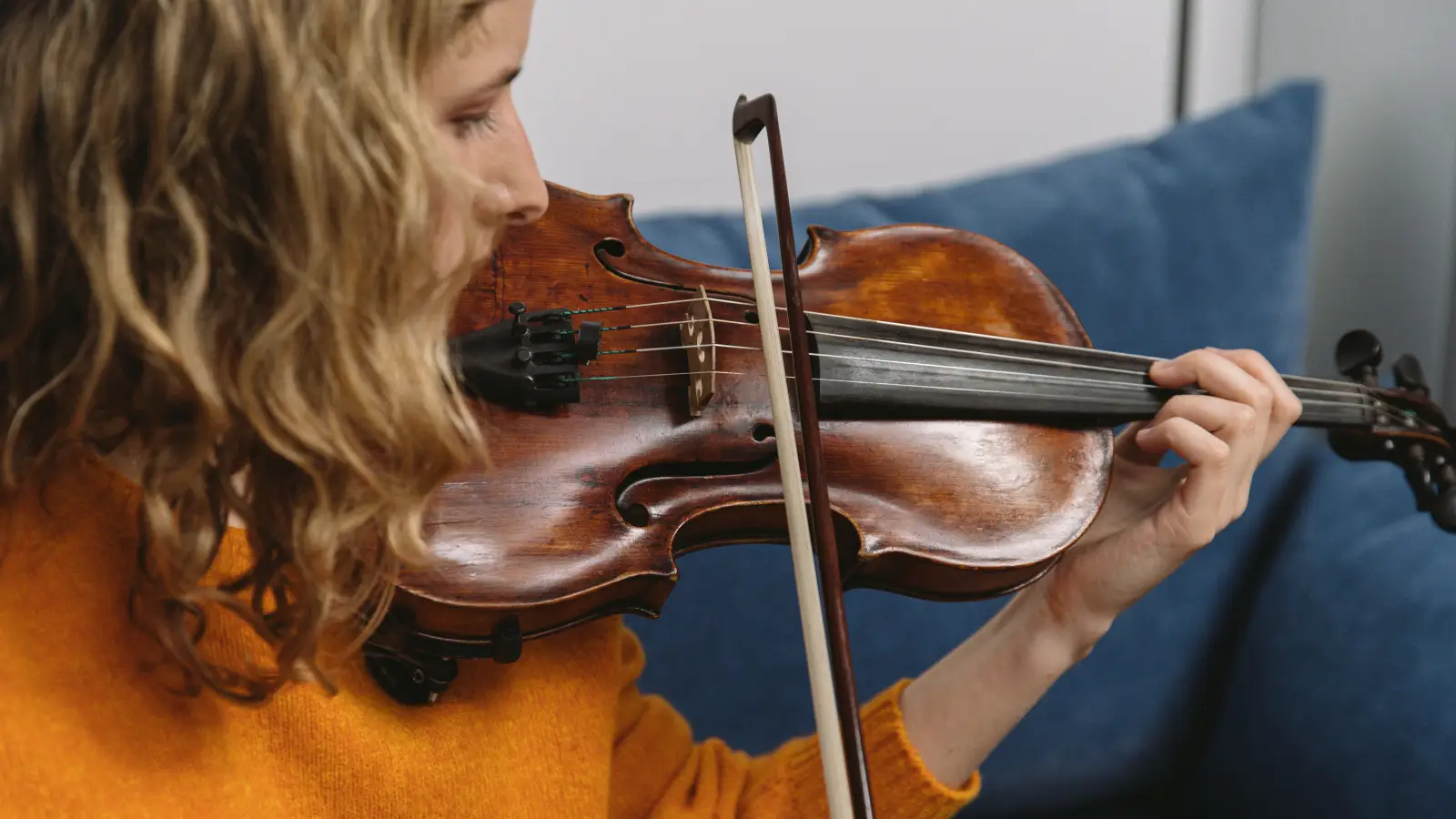
Rhythm problems in violin bowing rarely come from a bad sense of pulse. More often, the gap between hearing a steady beat and the bow actually changing direction at the right instant causes uneven détaché and shaky string crossings. These five open-string exercises isolate that coordination gap by removing left-hand distractions and forcing attention onto the precise moment of bow change.
Your Shortlist: Which Exercise Fixes Which Timing Problem
Best for Uneven Détaché: Half-Bow Sustain ·
Best for String Crossing Timing: Cross-String Pulse Drill ·
Best for Solidifying Internal Pulse: Metered Bow-Change Stops ·
Best for Whole-Bow Consistency: Full-Bow Subdivision
Exercises That Isolate the Bow-Change Instant
For violinists whose timing wobbles right at the direction switch, whether on a single string or when crossing strings.
Half-Bow Sustain
Play repeated half bows on one open string, holding the sound fully until the instant of change. The goal is to eliminate any break in tone while still hearing a distinct pulse. Work at a speed where the bow feels smooth and the change sounds intentional, not rushed.
Standout strength: Exposes the precise moment the bow reverses by making any gap immediately audible.
Main limitation: Requires a fairly relaxed bow arm; too much tension can mask the feel of the change and let unevenness slide by unheard.
Metered Bow-Change Stops
Bow a single open string while stopping the bow completely at each direction change for a set number of metronome clicks, then resume. The silent pause between strokes trains the ear and arm to treat the change as its own defined step—not as a blur between notes.
Standout strength: Builds the habit of resetting the bow at the change, preventing rushed entries on a new stroke.
Main limitation: Can become mechanical if the pause is not gradually shortened. The stop must eventually feel like a prepared lift, not a frozen moment that breaks the musical line.
Exercises for a Steady Subdivided Pulse
For violinists who keep the downbeat but lose clarity between beats—especially during long bows.
Full-Bow Subdivision
Play an entire down-bow or up-bow on one open string while mentally subdividing it into groups of two, three, or four. Place a slight accent or a light tap of a left-hand finger against the violin rib at each subdivision, without interrupting the bow stroke.
Standout strength: Installs a reliable internal clock that survives long sustained notes.
Main limitation: Mental subdivision takes concentration; starting with the simplest grouping (two) at a very slow tempo prevents the mind from drifting off the beat.
Accented Pulse on an Open String
On a single open string, play a series of even bow strokes and accent every second, third, or fourth beat by pressing slightly more at the start of that stroke. The accent creates a physical reference point for where the beat falls inside the bow change.
Standout strength: Directly links the physical sensation of bow pressure to rhythmic grouping.
Main limitation: Over-accenting can create a habit of crunching the tone. Keep the accent small and deliberate; transfer it to fingered notes only once the pattern feels automatic on open strings.
Exercises for Coordinated String Crossings
For violinists who lose rhythmic precision specifically when moving between strings.
Cross-String Pulse Drill
On two adjacent open strings, alternate bows exactly on the metronome beat. Lift or sink the elbow to cross strings while maintaining constant bow speed, so the change of string and change of bow direction land together. Later, shift the exercise to off-beat crossings or syncopated patterns.
Standout strength: Forces the arm to synchronize two movements—bow direction change and string level change—to a single beat.
Main limitation: Success depends on the left-hand frame staying stable; if the violin moves, the arm’s internal map of how far to cross is thrown off, making the timing unreliable.
If You’ve Landed on a Group, Here’s How to Choose
If the problem sits right at the bow-change moment, start with the Half-Bow Sustain. It leaves fewer variables to manage and directly maps the sound to the feeling of reversal. Move to Metered Stops once the sustain is clean; the pause adds the temporal boundary. For subdivision issues, begin with Full-Bow Subdivision at a slow tempo to build the internal grid before adding accents. The Accented Pulse exercise is a natural second step after you can hold the subdivision. For string crossing troubles, stay with the Cross-String Pulse Drill as the primary exercise, since it mirrors the coordination demand of real repertoire more closely.
How the Five Exercises Compare at a Glance
| Exercise | Timing Focus | Starting Tempo (bpm) | Risk If Rushed |
|---|---|---|---|
| Half-Bow Sustain | Bow-change smoothness | 60-72 | Tone breaks become an inaudible blur |
| Metered Bow-Change Stops | Predictable reset at change | 50-60 | Stop loses defined length, reverting to guesswork |
| Full-Bow Subdivision | Long-note pulse maintenance | 40-56 | Subdivisions drift off the beat |
| Accented Pulse | Physical beat placement | 60-80 | Accent turns into a bow-crunch |
| Cross-String Pulse Drill | Arm coordination across strings | 52-66 | String crossing overshoots or gets tense |
Common Questions When Starting These Exercises
Why practice on open strings instead of melodies?
Open strings strip away left-hand variables so all attention goes to the right arm’s timing. Once the bow-change coordination is reliable, adding fingered notes becomes a matter of transferring the same rhythmic feel to a new context.
How long should I practice each exercise?
Begin with three to five minutes per exercise per session, long enough to settle into the coordination but not so long that mental fatigue sets in. Consistency across days matters more than duration on any single day.
Can these exercises help with off-the-string bowings like spiccato?
Yes, because spiccato and other off-the-string strokes still rely on a clean direction change and a predictable lift. The bow-change timing drilled here directly underpins the moment the bow leaves and returns to the string.
Should I always use a metronome?
Initially, yes. The metronome provides an objective reference for whether the bow is landing on the beat. Once the exercises feel rhythmic without it, practice without the metronome to test whether the internal pulse holds; then return to the metronome to check for drift.
The One Exercise to Build Everything Else On
Most timing inconsistencies vanish once a violinist can locate and control the exact bow-change moment. Start with the Half-Bow Sustain on an open A or D for two minutes a day, staying slow enough to hear the instant the sound reverses. From that foundation, the other exercises add coordination demands one at a time.