Within two years, renting a student violin can drain $500 to $800, while an entry-level outfit sells for $250 to $500. The real cost difference, though, depends on two things most comparisons skip: whether the player will need a larger size before those 24 months end, and what maintenance the shop actually covers under the rental fee.
This breakdown calculates the total cash outlay for renting versus buying a student violin over 24 months, including size upgrades, maintenance, and the built-in costs that rental credits often hide. By the last section, you will know exactly when buying stops being a risk and starts costing less.
What 24 Months of Rent Actually Costs
Rental fees for a student violin outfit — instrument, bow, case — typically run $20 to $40 per month. At $25 a month, that’s $600 over two years; at $35, it’s $840. Most shops also charge a non-refundable initiation fee of $10 to $25.
Monthly Rates and What They Include
Two plans dominate the market:
- Basic — covers the violin, bow, and case only. You pay for strings, bow rehairs, and any repairs.
- Maintenance-inclusive — adds $5 to $10 per month and covers string replacements, bow rehairs, and accidental damage.
For a child who plays regularly, strings need changing every 6 to 9 months ($40–$60 for a set, plus installation) and a bow rehair runs $50–$70 annually. Out-of-pocket maintenance can reach $150–$250 in two years. The maintenance-inclusive rental often costs less in the end than a basic rental plus your own repairs.
The Size Problem: Why Children Rarely Stay on One Violin for 24 Months
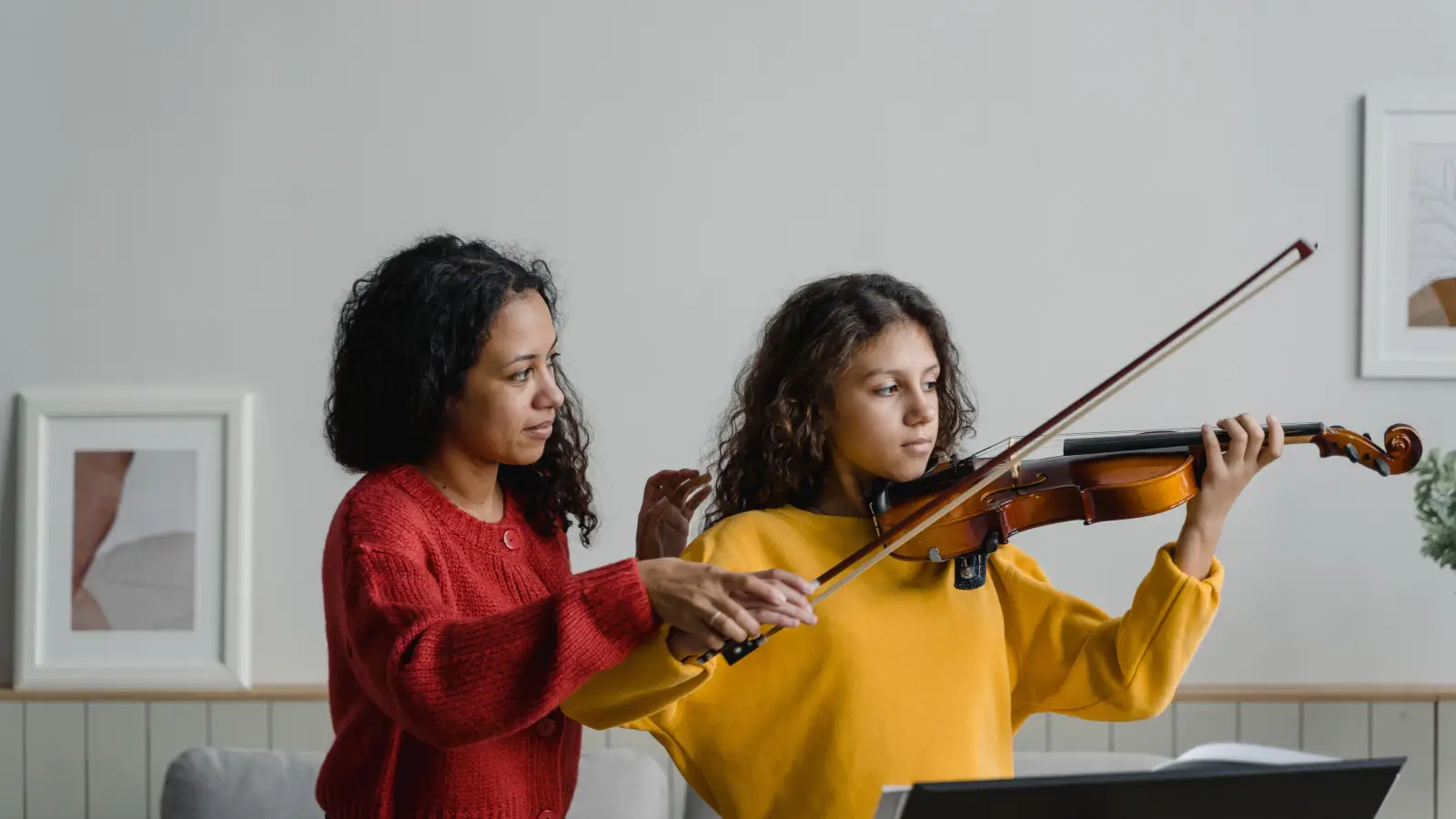
A beginner on a 1/4 or 1/2 size won’t finish 24 months in the same instrument. Growth forces a size change, and playing on a violin that’s too small creates tension and poor form. Over two years, a child might need one size change, sometimes two.
Typical Growth Timelines and Size Progression
- Ages 5–7: start on 1/8 or 1/4; often move to 1/2 within 12–18 months.
- Ages 7–9: 1/2 to 3/4; the shift can happen in a single academic year.
- Ages 9–12: 3/4 to full-size; some reach full size by 12, others stay at 3/4 through middle school.
If a size change occurs during the 24-month window, the cost comparison resets.
How Rental Size Exchanges Compare to Buying Every Fractional Size
Rental agreements typically allow free size exchanges — you return the small violin and take home the next size without extra fees or loss of credit. Buying works differently. You purchase a fractional size, then sell it later at a discount and buy the next size.
A typical scenario: buy a 1/4 outfit for $300, sell it a year later for $150, then buy a 1/2 for $300. Total outlay: $450, plus maintenance. Renting both sizes at $30/month for 24 months totals $720, but $300–$400 of that builds as credit toward a future purchase. The buyer spends less if the resale price is decent; the renter spends more but avoids the hassle of selling and gains credit if a full-size purchase is planned.
Maintenance Costs: Strings, Bows, and the Bills No One Talks About
Maintenance hits differently for owners and renters. An inclusive rental plan absorbs most costs; an owner pays for everything.
What You’ll Pay on a Purchased Violin
- Strings: $40–$60 per set, replaced every 6–9 months. With installation, $60–$80 each time.
- Bow rehair: $50–$70, typically once a year.
- Rosin, shoulder rest, minor adjustments: $30–$50 upfront, then replacements as needed.
Two years of ownership upkeep lands between $150 and $250. When comparing a $400 purchase against a $30 maintenance-inclusive rental ($720), the purchase still saves $70–$170. But a single major repair — a cracked pegbox or a soundpost reset — can cost $50–$150, erasing that margin.
How Renters Avoid Most of Those Surprises
Maintenance-inclusive rentals cover string changes, bow rehairs, and accidental damage. The shop handles repairs, so you don’t need to locate a luthier for every issue. The trade-off is the higher monthly rate, but for families without repair know-how, that predictability is worth the premium.
The Break-Even Point: When Buying Becomes the Cheaper Path
If the player is an adult or a teen who has stopped growing, the math is simple. A $350–$500 outfit pays for itself against a rental rate of $30/month in 12 to 17 months. Past that, every rental dollar is extra cost with no asset at the end.
Quick-Reference Cost Table
| Scenario | 24-Month Rental Total (maintenance-inclusive) | 24-Month Purchase Total (incl. maintenance + resale) | Cheaper Option |
|---|---|---|---|
| Adult beginner (full-size, no size changes) | $720 | $400 + $200 maintenance = $600, no resale loss | Purchasing |
| Child, one size change (buy fractional, then upgrade) | $720 (rent both sizes) | $300 (buy fractional 1) + $300 (fractional 2) – $120 resale + $200 maintenance = $680 | Near parity; buying often edges ahead if resale price is fair |
| Child, two size changes inside 24 months | $720 (rent all sizes, credit builds) | $300 + $300 + $300 – $250 total resale + $250 maintenance = $900 | Renting is clearly cheaper |
Rental amount uses $30/month estimate. Purchase costs use typical student outfit prices and conservative resale values. Maintenance includes strings, bow rehair, and minor adjustments.
The numbers shift with each size change. A child staying on one fractional size the whole 24 months comes out ahead by buying that size outright. When two sizes are needed, renting protects the budget from the friction of buying and selling fractional instruments.
Rental Credits and Rent-to-Own Plans: Where the Math Can Fool You
Rent-to-own programs let you accumulate a portion of each payment toward purchasing the instrument. The catch is the cap. Shops commonly limit credits to 50%–80% of the violin’s retail price, and some stop building credit after 24 months, pressuring a buyout.
What That Means for Your Wallet
A 60% credit cap on a $600 violin means the most you can build is $360. After paying $720 in rent over 24 months, you’d still owe $240 to own the instrument. Total outlay: $960 for a violin that retails at $600. If you had bought a comparable outfit elsewhere for $400, you’d be $560 ahead.
A rent-to-own plan only works in your favor if you plan to trade up to a pricier instrument and the credit transfers fully. Even then, you’re still paying more in rent than the instrument’s worth unless you hit the cap early and buy out immediately.
Key Takeaways
- A 24-month rental costs $500–$800; a purchased student outfit runs $250–$500 plus $150–$250 in upkeep.
- For a player with no size change in two years, buying a decent student violin is consistently the lower-cost option.
- When a child needs one or two size swaps, renting with free size exchanges often keeps the total cash outlay lower and avoids the loss from reselling fractional instruments.
- Rental credit is rarely dollar-for-dollar — check the cap and the buyout amount before committing.
- Budget for maintenance realistically; an inclusive rental plan can save money if the instrument is used heavily.
Common Questions About Renting vs. Buying a Violin
At what point does buying become cheaper than renting a student violin?
For a player who stays on one size, the break-even point is around 12–15 months. After that, rental payments exceed the purchase price plus typical maintenance, making ownership the cheaper path.
Do rental credits cover the full purchase price if I rent long enough?
No. Most programs cap credit at 50%–80% of the instrument’s value. Once you hit that limit, further payments do not increase your credit, so you will still owe a remaining balance to own the violin.
What happens if my child outgrows the rented violin before the 24-month contract is up?
Reputable shops allow free size exchanges at any time without resetting your credit or raising your monthly rate. You return the small violin and take home the next size. If you had bought the instrument, you’d need to sell it at a loss and purchase the larger size.
Should I buy a used violin instead of renting for 24 months?
A used student violin from a reliable source can cost $100–$250 and may not lose much value on resale. For a child who still needs a size change, buying used can be cheaper than renting, but you must get it checked by a luthier — budget $30–$80 for inspection and new strings. If you aren’t confident evaluating condition, a rental with a maintenance plan is the safer route.
Is renting always the smarter choice for a complete beginner?
Renting makes sense for the first 6–12 months because it limits financial risk if the child quits. However, if the student stays committed and won’t need a size change quickly, buying an entry-level outfit early can save $200 or more over two years. The real decision hangs on size trajectory, not on experience level.
After 24 months, the math shifts decisively. If the violin fits and the player won’t grow into a larger size soon, buying a solid student instrument is nearly always the cheaper choice. For a child still moving through sizes, don’t treat two years as a single block — look at each size period separately and monitor the rental credit cap. When the numbers show you’d pay close to full retail and still owe a buyout, use that money toward an instrument you own from the start.