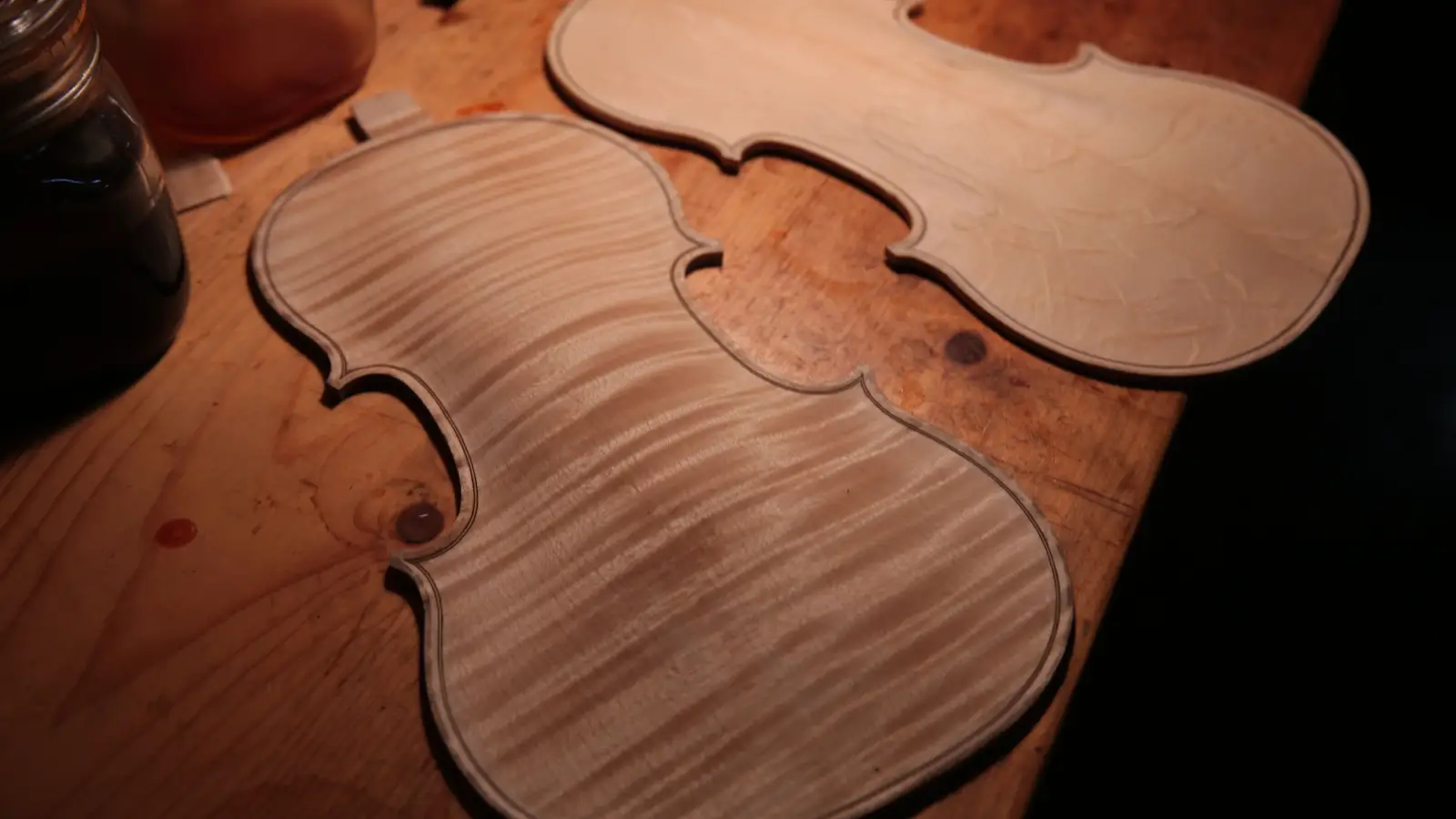
A luthier checks the f‑holes for length, eye width, undercut quality, and notch symmetry because these directly control a violin’s air resonance, projection, and tonal balance. If the f‑holes don’t meet specific acoustic benchmarks, the instrument won’t sound right no matter how well‑made the rest appears. That’s why a luthier doesn’t sign off until the f‑holes pass inspection.
When the F‑Hole Decides Which Violin Comes Home
Two violins of the same model and price often sound completely different in a shop. One fills the room; the other stays trapped under the ear. The gap frequently sits in the f‑holes. A player who knows what a luthier looks for can quickly rule out instruments that will stay boxy or thin, no matter how you adjust the sound post. This matters most when the money is real—upgrading from a rental, buying a step‑up student instrument, or selecting a lifelong professional violin. Skipping this check means risking an instrument that never projects the way it should in a group or a hall.
The Acoustic Checkpoints: What a Luthier Verifies in Every F‑Hole
The Overall Length and Its Position Between Bridge and Purfling
A full‑size violin’s f‑hole runs 70 to 76 millimeters from the top of the upper eye to the bottom of the lower eye. The luthier confirms that length and then checks where the holes sit relative to the bridge—the stop. If the pair is too close together or too far apart, the air resonance (the Helmholtz A0 mode) moves away from its ideal pitch around C♯ on the G string. Low frequencies weaken, and the violin sounds hollow. The measurement from the inner notches to the outer purfling must match the maker’s reference; anything off by more than a millimeter is a problem.
The Width of the Upper and Lower Eyes (Why Tenths of a Millimeter Count)
The upper eye typically spans 7 to 8 millimeters, the lower eye 9 to 10 millimeters. These circles act like the neck of a bottle—they set how easily air flows. A caliper check to the tenth of a millimeter matters because a tiny shift changes the resonance frequency audibly. A clean, circular cut reduces turbulence; a ragged edge chokes the sound. Lower‑eye width that runs too narrow strips away low‑end warmth; too wide and the bass becomes boomy and unfocused.
The Undercut on the Inner Edge That Shapes Airflow
The bevel carved inside the f‑hole—the undercut—is not cosmetic. It creates a smooth exit ramp for air, lowering resistance. A luthier feels the lip with a fingertip or a small tool to check for evenness. A shallow or lumpy undercut forces the air pulses that produce warmth to struggle past a rough boundary, and the instrument sounds nasal or tight. In carefully voiced instruments, this chamfer hits roughly 45 degrees and tapers gradually, a detail that separates a serious top from a stamped factory plate.
The Angle of the Cut and Its Effect on Projection
The f‑hole walls should not stand vertical. A luthier cuts them with a slight outward flare—wider toward the top surface—so the sound wave expands as it exits. That flare acts like a miniature horn, boosting high‑frequency projection without adding harshness. Inspecting the angle means sighting along the hole in raking light; a wall that slopes inward or stays straight compresses the wave front and robs carrying power. Combined with the undercut, this angle is a priority check when a player complains that an instrument doesn’t project.
Symmetry, Notches, and the Integrity of the Wings
The small triangular wings at the center of the inner side stabilize the wood in a high‑stress zone and, with the inner notches, mark the correct bridge position. A luthier checks that the wings match in length and thickness, that the notches align with the bridge’s center, and that no crack starts from a notch tip. Asymmetry signals a sloppy cut and can unbalance how each side of the top moves under string tension, creating uneven response from string to string.
Misconceptions That Send Buyers in the Wrong Direction
Larger F‑Holes Always Produce a Louder Sound
A bigger opening does not equal more sound. Enlarging the f‑holes beyond the classical window raises the air resonance too high and decouples the top plate from the air cavity. The result: a thinner, less focused tone that projects poorly in a room. Loudness near the ear is not projection; the optimal f‑hole area lives in a narrow band, and overshooting it hurts more than it helps.
Hand‑Cut Vs. Machine‑Cut F‑Holes Determine Quality
Hand‑cut does not automatically mean superior. A skilled hand can refine the undercut and flare beyond what a machine manages, but a badly executed hand‑cut f‑hole is worse than a clean CNC‑cut one. Many high‑end workshop instruments now start with CNC roughing and finish by hand; the luthier judges the final geometry, not the tool that roughed it out.
The Shape of the F‑Hole Is Purely Cosmetic
Different makers have distinct outlines, but shape carries acoustic weight. How the stems taper and curve affects the top’s stiffness around the hole and the effective air‑column length. An overly wide stem creates a structural weak point; an overly narrow one restricts plate motion. The luthier reads the shape as a functional variable, not a stylistic signature.
Frequently Asked Questions About F‑Holes and Sound
What is the purpose of f‑holes on a violin?
F‑holes let air move in and out of the body, creating the Helmholtz resonance that amplifies low frequencies and couples them with plate vibrations. Without them, the violin sounds boxed in and quiet.
How does the size of the f‑holes affect the sound?
The total area sets the pitch of the air resonance. Larger area raises the resonance; smaller area lowers it. Even a change of one or two square millimeters can shift the tonal balance noticeably.
Can the shape of the f‑holes change the tone?
Yes. Shape influences top stiffness and effective air‑column length. A narrower, elongated f‑hole tends toward a tighter, more focused sound; a wider, rounder cut produces an open, airy quality, all else being equal.
What are the ‘wings’ or ‘notches’ on f‑holes for?
The wings reinforce the center of the f‑hole against splitting. The inner notches give a reference for bridge placement: the bridge sits so its center aligns with the line connecting the notches of both f‑holes.
From the Workbench to the Stage: Why This Inspection Matters
When you evaluate a violin, bend down and look at the f‑holes. Check the undercut with your eye and note whether the wings are symmetrical. A pair that passes a luthier’s standard means the maker cared about the acoustics, not just the varnish. F‑holes alone do not make a great violin—arching, graduation, and setup all carry weight—but a violin that clears this check has cleared one of the most reliable indicators of voicing quality. Use that knowledge to steer toward instruments that will project clearly and respond evenly, whether you are moving up from a rental or looking for your last violin.