Yes, you can read violin music and play at the same time — but the way most beginners attempt it guarantees failure. The trick isn’t faster mental note-naming; it’s abandoning note names as your primary tool. Interval reading, paired with a disciplined look-ahead, is a more efficient path. In a few weeks of focused practice, you’ll sight-read melodies that once seemed impossible.
Before You Attempt Interval Reading: What’s Already Under Your Fingers?
The violin fingerboard on the left hand is simply a grid of repeatable whole- and half-step shapes. You don’t need theoretical perfection — just a few concrete handles:
- A steady, ringing tone on open strings G‑D-A‑E. If the bow still skates, spend a few sessions only on long, even bows.
- A working map of first-position finger numbers — where your first finger on A lands on B, second on C♯ or C♮, third on D, and the same pattern re‑occurs on every string.
- The ability to look at a treble staff and tell if notes are moving higher, lower, or staying put. That’s it. You don’t even need to name them.
Once those are solid, you’re ready to stop thinking like a translator and start thinking like a map-reader.
Building the Look-Ahead Habit, One Interval at a Time
Step 1: Internalize the Fingerboard’s Whole-Step/Half-Step Geography
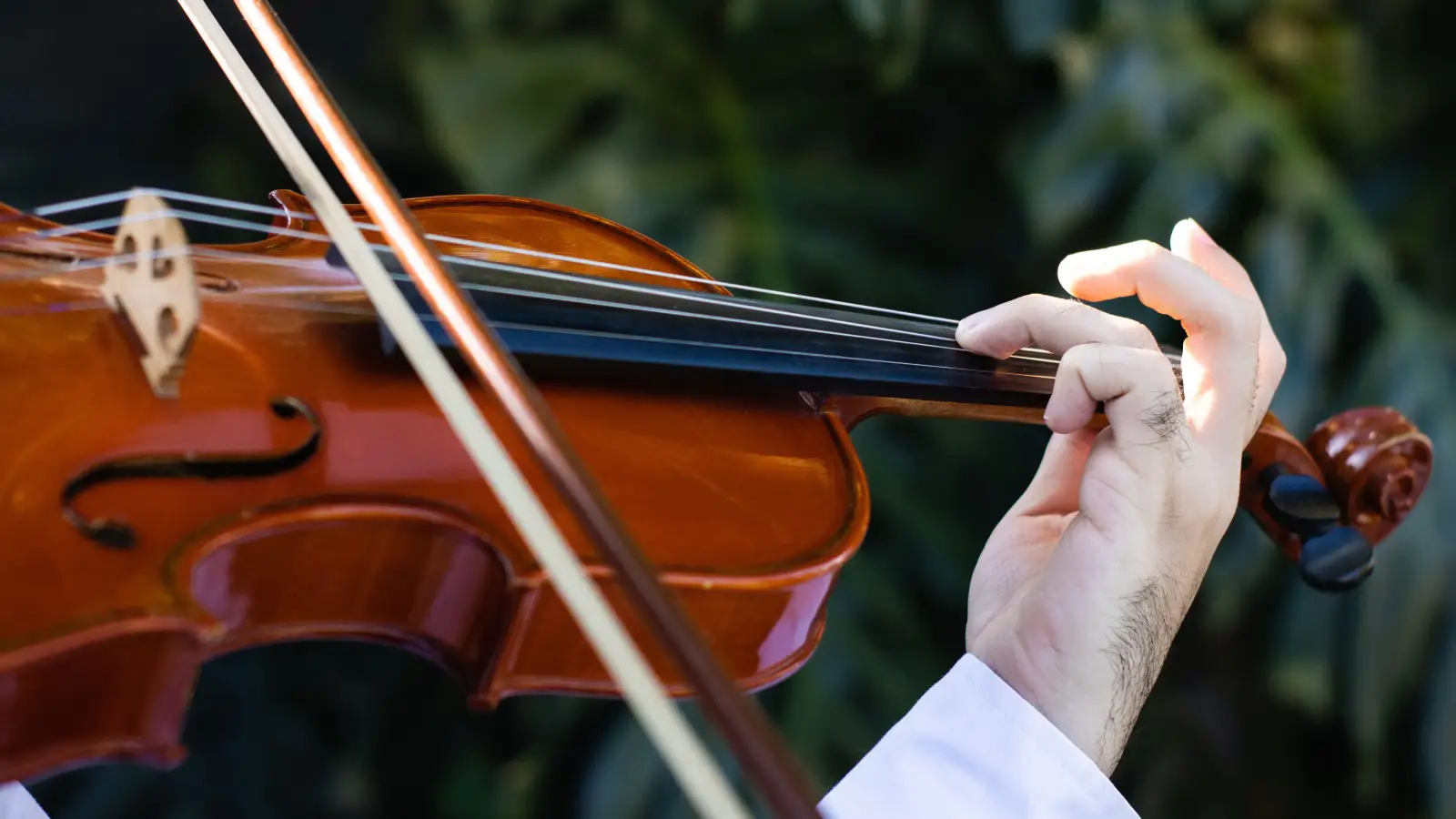
Place each finger on a string and pay attention to the physical gap. On a violin, a whole step is about two finger‑widths; a half step is roughly one finger‑width. The same distances appear on every string — a half step never moves between 3rd and 4th finger (E‑F, B‑C), and sharps or flats push notes closer together. Drill moving between these spacings away from sheet music until your hand “knows” what a second, third, or fourth feels like without looking. This is the raw material of interval reading.
Step 2: Train Your Eyes to See Distances, Not Note Names
Take a nursery rhyme like “Mary Had a Little Lamb.” A typical beginner’s brain reads “E, D, C, D, E.” Your job now is to see “move down a step, down a step, up a step.” A note going from a line to the next space is a step (a second); a line to the next line is a skip (a third). Pick a page and, without your instrument, scan it while calling out intervals aloud — “same, up a third, down a step.” You’re reprogramming the connection from staff ink to fingerboard geography.
Step 3: Practice the “Eyes on the Next Note” Rhythm
Put an absurdly simple pattern in front of you — say, alternating open A and B (first finger). Set a metronome to 60 bpm. The rule: by the time your finger presses the first note, your eyes must already be locked on the second. If your gaze drifts back to the note you’re playing, stop, reset, and try again. This isn’t about speed yet; it’s about building a future‑facing habit that your sight‑reading will depend on forever.
Step 4: Start with Stepwise Melodies and Simple Skips
Choose music where the largest jump is a third or fourth — folk songs, easy études, or pieces from a method book. Play one measure at a time using only the interval as your cue (step up, step down, small leap). Keep the bow on a single string with separate strokes at first so only one variable is in play. Soon, a third on the staff — two lines apart — will automatically trigger the hand to open a whole step or a minor third, because the shape is already wired.
Step 5: Add the Bow, Then Gradually Merge
Once you can read a few stepwise measures without freezing, bring in bow changes, slurs, or string crossings. Think of the right arm as an independent loop: your eyes feed intervals to the left hand, while the right hand keeps a steady, unhurried bowing pattern. Practice the bowing alone on open strings while reading a rhythm, then layer in the left-hand intervals. The end goal is not micromanaging two hands simultaneously but trusting the left hand’s automation so the bow arm can think in phrases.
Pitfalls That Keep Beginners Glued to One Note at a Time
Staring at the Note You’re Playing Instead of the Next One
The instinct is to check, adjust, and then look ahead — which stops the chain dead. A wrong note played with rhythmic momentum trains the look‑ahead far more effectively than a perfect note that halts the music. Accept that the current note will be imperfect; your ear will gradually self‑correct. Keep the eyes moving.
Mentally Naming Every Note Before Your Fingers Move
Turning every dot into a letter name adds a translation step that no brain can sustain at real tempo. If you catch yourself thinking “that’s an E, then an A,” replace the habit by silently saying the interval: “step down, skip up.” Over time, the pathway shortens to “staff shape → finger shift.”
Ignoring the Hand’s Built-in Shape Memory
A third (two lines apart) feels physically identical whether it’s on the D string or the G string. Beginners often approach each string as a separate territory, forgetting that the hand’s stretch is identical. When you see that interval on the page, don’t recalculate the pitch — let your hand reach for the familiar frame. Remind yourself out loud: “a third on any string feels like this.”
Skipping Open-String Cues as Anchor Points
Open strings are fixed, unfingered pitches that appear as empty noteheads on the staff. When you lose your place, glance for the nearest open‑string note to reorient yourself. Over time, these become mental reset buttons, so a brief stumble doesn’t force a full restart.
Frequently Asked Questions
Do I need to know every note on the fingerboard before I start reading intervals?
No. Only open strings and a handful of first-position finger placements are necessary. Interval reading is relative, not absolute, so note names can fill in later as your ear and hand memory deepen.
How long does it take to sight-read simple pieces with both hands?
With 15 minutes of daily interval‑focused work, a motivated beginner usually sight‑reads very basic tunes — quarter notes, stepwise motion — within four to six weeks. Adding string crossings or dotted rhythms extends the timeline, but the core skill of look‑ahead and pattern recognition solidifies surprisingly fast.
Will I still need to look at my fingers?
At first, yes — peripheral glances are normal. As interval reading automates the left hand, you’ll check less. Eventually, your fingers reach the correct distances by feel alone, and your eyes can stay on the sheet music.
Can this method work for viola, cello, or other string instruments?
Absolutely. The principle — reading intervals to trigger rehearsed finger patterns — transfers to any string instrument where shapes repeat across strings. On viola and cello the spacings are wider, but the mental process is identical: see a second, feel the appropriate step; see a third, feel the stretch.
What You’ve Gained and Where to Go from Here
You now hold a practice framework that turns sight-reading from a memory‑draining chore into a pattern‑matching system. Your eyes are trained to move ahead, your left hand is beginning to feel intervals rather than grope for pitches, and your bow arm has its own independent pulse.
The next move: pick a one‑page piece you’ve never seen — a slow folk melody in D major — and play it using only interval cues. Record yourself. Listen for any hesitation; each tiny pause marks a place the look‑ahead broke. Isolate those transitions and run them until they flow. Then swap in a new piece and repeat. That’s how the skill solidifies into muscle and instinct.