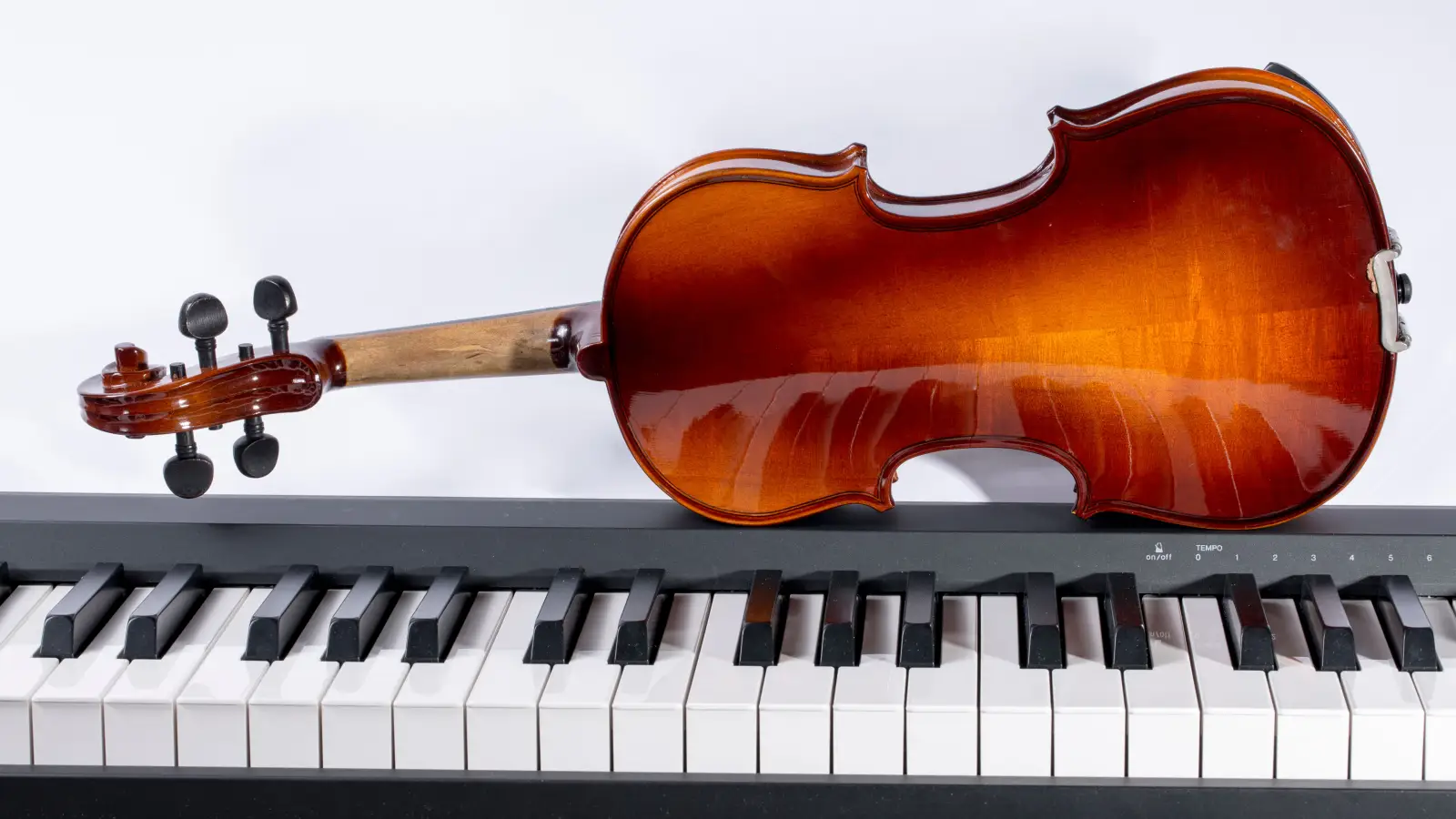
Plug an electric violin into an amp and the sound that comes out often feels thinner and more percussive than an acoustic. The difference is real, but it isn't the amplifier's fault. The raw tone of an electric violin is defined by the missing resonant wooden body and the way piezo pickups capture string motion — a direct electrical pathway that replaces the complex air-moving behavior of a soundbox.
Where the Acoustic Voice Comes From — and What the Electric Replaces
An acoustic violin generates sound through a mechanical chain. The bowed string vibrates, the bridge transfers that motion to the top plate, and the plate — carved spruce, graduated in thickness — flexes. It pumps the air inside the hollow chamber, and the entire wooden structure radiates not just the fundamental pitch but a flood of overtones and transient noise. Every piece of wood from the back to the ribs contributes its own vibrational mode. The result is a rich, three-dimensional voice that fills a room without any electronics.
Remove that body and you cut out the filtering machinery that turns a raw string signal into violin tone. A solid-body electric violin has no air cavity to compress, no thin wooden plate to flex. String vibrations persist, but they are transferred almost directly to a pickup. The instrument’s body is designed to resist feedback, not to color the sound. So the signal that leaves the instrument — before any cable, preamp, or speaker — is already fundamentally different from what an acoustic projects into the air.
How an Acoustic Body Shapes Sound — and What Breaks When It's Removed
The Acoustic Violin: A Tuned Resonator
A traditional violin doesn't just make the strings louder; it filters them. The wooden body acts as a bandpass system. The bridge and top plate accept the broad-band vibration from the strings and reshape it to match the instrument's natural resonances. This is why two violins can sound different even with the same strings. The body enhances certain overtones and suppresses others. The scratch of the bow attack gets absorbed and softened. The result is a cohesive timbre that the ear identifies as “violin.”
The Solid Body: Vibration Without Amplification
On an electric, the rigid body and bridge are designed to transmit string motion to the pickup with as little mechanical loss as possible — not to act as a tone shaper. The bridge may hold a piezo sensor embedded inside, but the rest of the structure stays largely inert. There is no significant air volume to pump and no wooden plate to vibrate sympathetically. The result is a stripped-down signal: mostly fundamental and harmonic partials, with a flat envelope and none of the body’s signature resonance.
Piezo vs. Magnetic: Two Ways to Turn Vibration Into Voltage
Virtually all electric violins rely on piezoelectric pickups. A piezo element — a thin ceramic disc under the saddle or embedded in the bridge — produces voltage when stressed by pressure. It tracks string motion directly and faithfully, which means it also captures bow noise, finger slides, and percussive clatter that an acoustic body would normally dampen. Magnetic pickups, the kind used on electric guitars, sense a disturbance in a magnetic field caused by metal string movement. They struggle with violin strings (synthetic or gut cores with a thin metal winding) and miss the crucial attack transients of bowing. That’s why magnetic violin pickups remain a niche; the piezo offers raw detail, but it’s unforgiving.
The Raw Signal: Why It Sounds Flat
A dry piezo signal often gets labeled “quacky” or “plastic.” It has a fast transient attack, an uneven harmonic profile, and a frequency response that lacks the natural roll-off and peaks a wooden body provides. It is not simply a quieter version of an acoustic; it is a different waveform. Even if amplified to the same volume, the electric violin can’t reproduce the body’s filtering unless you add external processing. The amplifier and speaker can make it louder, but they can’t recreate what was never captured in the first place.
When the Raw Tone Gap Is Obvious — and When It Fades Away
When the Acoustic Difference Is Critical
In solo practice, unplugged direct monitoring, or any intimate setting where the listener expects a traditional violin sound, the gap is stark. The electric instrument will feel percussive under the ear, and a dry recording will betray its piezo origin immediately. To get closer to an acoustic voice, a preamp with careful EQ and an impulse response (IR) unit become essential.
When You Can Stop Worrying About It
Through a band mix with distortion, harmonizers, or dense reverb, the raw signal’s character recedes. Overdrive masks the quack, and the percussive attack can become a useful articulation. For silent practice with headphones, the different tone is just a trade-off for convenience. The difference matters when the listener has a clear expectation of an acoustic violin sound. Remove that expectation and the electric’s distinct voice can be a creative tool instead of a flaw.
Concepts That Connect to the Electric Violin’s Raw Tone
- Piezo pickup — The pressure-sensitive transducer that gives electric violins their detailed but uncolored signal.
- Preamp — An active buffer and EQ stage that is the first practical step toward shaping the piezo’s output.
- Impulse response (IR) — A digital snapshot of an acoustic body’s resonant behavior, used to make a dry piezo signal sound as if it passed through wood and air.
- Feedback resistance — The primary reason solid bodies exist; understanding how eliminating acoustic amplification avoids howling helps explain why the tone changes so radically.
Frequently Asked Questions
Why does my electric violin sound tinny?
Tinniness arises because the piezo pickup transmits high-frequency transients and bow noise with almost no natural damping. An acoustic body would soften those frequencies, but the solid electric passes them through nearly unchanged. A preamp with a slight treble roll-off or a touch of reverb can reduce the tinny edge.
Can I make my electric violin sound exactly like an acoustic?
Getting an exact match is difficult. The body’s complex radiation pattern and air coupling are hard to recreate fully with a pickup and speaker. However, a well-tuned impulse response pedal and preamp can get close enough for recordings and live performance where no side-by-side acoustic reference exists.
Do solid-body electric violins have any resonance at all?
They have minimal acoustic resonance. The solid block may vibrate slightly at certain frequencies, but it is negligible compared to the amplified output. Some semi-hollow designs add a small chamber to introduce a hint of acoustic character while still relying on pickups for volume.
What’s the difference between piezo and magnetic pickups on a violin?
A piezo senses pressure changes and captures the full bow attack, including the scratch and transient detail. A magnetic pickup senses string movement and yields a smoother, more guitar-like signal, but it requires magnetic core strings and loses the delicate bow articulation. For most violinists, piezo remains the only practical choice.
Why does my electric violin sound better through headphones than through an amp?
Headphones bypass room acoustics and amp speaker coloration, delivering a direct signal that can sound clearer. That clarity may also highlight the raw piezo character, so it’s not that the tone is “better” — just that you hear it without the extra variables added by a speaker and a room. You’re still hearing the same fundamental signal.
From Cause to Control: What to Explore Next
Once the physical origin of the electric violin’s sound makes sense, the practical question becomes how to shape that signal. The next logical step is exploring preamps built for piezo pickups, the use of impulse response technology for bowed strings, and EQ techniques that compensate for the missing wooden-body filter.