Counting "one, two, three, four" is a go-to strategy, yet the bow often betrays the brain: rushing, dragging, or slipping off the beat. The error lies in treating rhythm as a declarative memory task—something to recite—instead of a procedure the motor system must embody. The exercises that follow bypass mental rehearsal and build a physical pulse through clapping, marching, and coordinated bowing. By rerouting timing from cognition to sensorimotor loops, you free conscious attention for phrasing and expression.
A 5-Step Body-to-Bow Rhythm Sequence
- Clap the rhythm while speaking the beats aloud.
- March the pulse in place, letting your footsteps drive the subdivision.
- Transfer the march to open-string bow patterns, matching bow direction to footfalls.
- Add left-hand fingers while keeping the march or tapping your toe under the violin.
- Practice with the metronome set off the downbeat to test internalization.
Clapping and Speaking: Giving Shape to Time
Clapping injects a haptic timestamp into each note onset; your palms feel the exact instant of sound. Vocalizing the syllable or number ties Broca's area (speech planning) to motor output, creating a multimodal trace that persists after you stop counting. For simple meters, clapping on the beat while speaking the count works immediately. When the rhythm contains dotted figures or ties, separate the action: first clap only the note attacks without counting, then layer the vocalization once the hands are accurate. If the tempo is high, cut the speed in half and clap a skeletal version of the rhythm before refining.
Marching the Pulse: Let Your Steps Drive the Subdivision
Large muscle groups react more slowly than the fingers, which makes them excellent pacemakers—they resist micro-hesitations. March in place, letting the footfall define the macrobeat. While marching, reintroduce the clapped rhythm from the previous step. In fast passages, march on every other beat to prevent the steps from becoming rushed; in compound time, step on the grouping pulse (dotted quarter in 6/8) so your body feels the metric structure. This step transforms the abstract idea of tempo into gravitational resistance.
Open-String Bow Patterns: Syncing the Arm to the Ground
Remove the left-hand variable. Match a simple bowing on an open string to the footsteps—for instance, downbow when the right foot strikes, upbow when the left foot strikes. Use whole bows to maximize the arm's arc, embedding the foot-to-bow linkage. If string crossings are involved, first pantomime the crossing path with the bow in the air while marching, then apply it to the strings. The goal is a closed loop: ground → leg → arm → sound, with no "thinking" step in the middle.
Adding Left-Hand Fingers: Running the Pulse on Autopilot
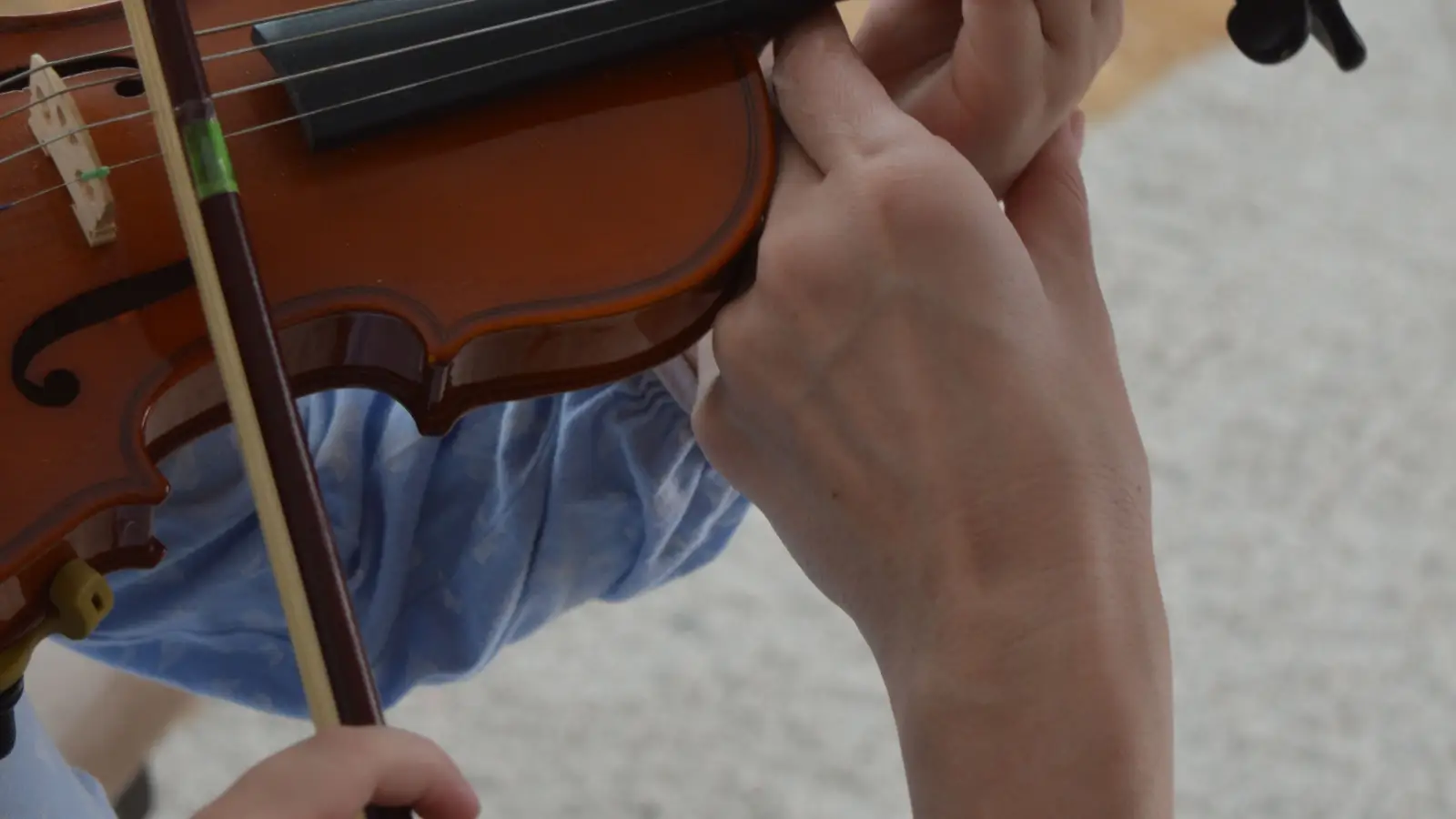
Finger placement often hijacks rhythmic attention. Rebuild the loop by alternating between an open string and a fingered pitch on the same rhythmic cell, all while marching or tapping the heel inside your shoe. Should the pulse collapse, strip back to pizzicato with the left hand only, still keeping the foot movement, then reintroduce the bow. The foot must never stop—even a subtle heel lift inside the shoe suffices to maintain the physical clock.
Off-Beat Metronome Drills: Testing True Internalization
A metronome on the downbeat creates a crutch. Shift the click to beats 2 and 4, or to off-beat eighth notes, to isolate your internal pulse generator. In compound meters, program the click on the second subdivision of a beat rather than the first. Begin with a simple pattern at a slow tempo, then gradually substitute the original music. If the beat feels disorienting, you are still mentally chasing an external reference—return to marching without the click, then try again.
Verifying Each Stage: Signs of Internalized Rhythm
- After clapping and speaking, you can clap the rhythm in silence without mouthing the beats.
- While marching, you can hold a conversation without losing the step.
- On open strings, the bow changes land squarely on your footfalls, even on long notes.
- With left-hand fingers added, you can tap a different hand or foot to a secondary rhythm without the main pulse collapsing.
- During off-beat metronome work, the click feels like a syncopated decoration—not a lifeline.
Quick Fixes When the Pulse Slips
Rushing during string crossings. Go back to marching with the bow movement pattern in the air. Practice the crossing motion slowly, ensuring the arm leads rather than chases the beat.
Bow changes not in sync with foot taps. Isolate a single open string and play a rhythm of all downbows on the foot tap, then all upbows on the tap, until the coordination becomes automatic.
Losing the pulse when adding dynamics. First practice the passage with uniform sound—no crescendo or diminuendo. Once the timing is solid, reintroduce dynamic changes one at a time while maintaining the march.
Off-beat metronome feels impossible. Set the metronome to click on every beat but with a different sound on the off-beats. Gradually shift to fewer clicks, like only the "and" of each beat.
Frequently Asked Questions
Why can't I just count out loud while playing?
Verbal counting involves a separate cognitive stream—language—that competes with motor planning. Adding clapping or marching offloads timing to proprioceptive and haptic systems, which operate on faster, less interference-prone feedback loops.
How long does it take to internalize rhythm this way?
Simple duple rhythms often solidify within one practice session. Irregular groupings or rapid bowing changes may require weeks, but daily short exposures (even five minutes) work better than sporadic long drills because the body consolidates motor patterns during sleep.
Can I skip the marching if I don't have space?
Yes. Heel tapping, toe alternation, or subtle weight shifts all activate the same postural muscles that anchor the beat. The essential element is a slow, controlled, weight-bearing movement—not the amplitude of a march.
Does this work for odd meters like 7/8?
It does. Clap and march the accent pattern (e.g., 2+2+3) rather than the raw count. The body picks up the asymmetry as a physical gesture, bypassing the mental arithmetic that trips up verbal counters.
Once the motor system encodes the pace, counting recedes into a low-level monitor. The obvious next step is transferring this trained physical pulse to a piece with deliberate tempo fluctuations—rubato or accelerando—where the body can stretch and compress time without tearing the underlying grid.