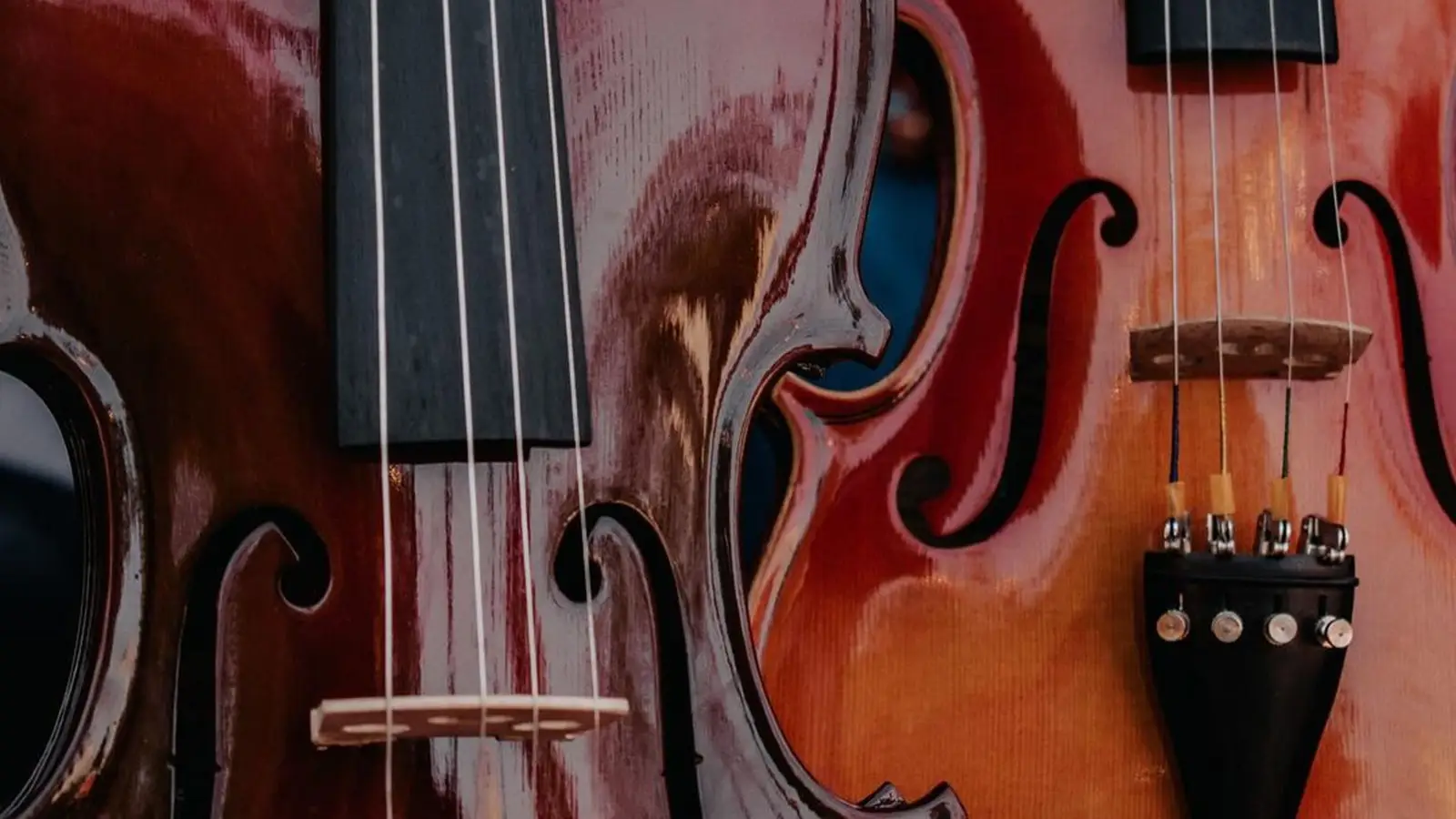
Two thin pieces of wood hidden inside every violin—the bridge and the soundpost—determine the volume and colour of every note. Their asymmetric transfer of string vibration into the body, balanced by the bass bar’s stiffening effect, is the physical mechanism behind tone. This is not a setup manual; it is a breakdown of the interaction that turns a string’s motion into air displacement.
The Mechanical Problem a Violin Solves
A vibrating string displaces almost no air. To be heard, the violin must convert that small motion into a larger volume movement. This conversion depends on a three-part internal chain: the bridge couples string motion to the top plate; the soundpost couples the top and back plates asymmetrically; the bass bar selectively stiffens the bass side so that the treble side can drive air more efficiently. Miss any one of these, and the instrument becomes either quiet or toneless.
The chain exists because passive amplification alone is not enough. A top plate flexing uniformly would produce a weak, unfocused output. The soundpost forces the plates to pump air in a way that matches the Helmholtz resonance of the body, while the bridge directs high and low frequencies to different halves of the instrument. The payoff is a system where a few grams of wood inside the box shape everything the listener hears.
How the Trio Routes Vibration
The Bridge as a Frequency Splitter
The bridge does more than hold strings at height. As a string vibrates, the bridge rocks on its two feet—but not equally. The treble foot, almost directly above the soundpost, acts as a pivot. This means the bass foot moves with a larger amplitude, imprinting lower-frequency energy onto the bass side of the top plate. Higher-frequency vibrations take the shorter, stiffer path through the treble side. The mass and exact contour of the bridge determine how efficiently each frequency band makes it to the wood. A fraction of a millimeter shift in bridge position changes the leverage, and suddenly the high notes lose projection while the lows turn boomy. This is not a subtle adjustment; it’s a direct mechanical consequence.
The Soundpost’s Asymmetric Coupling
Placed just behind the treble foot, the soundpost locks the top and back plates together at a single pressure point. That lock creates a fulcrum: when the bridge forces the top down on the bass side, the treble side rises, and the back plate responds in the opposite direction. In other words, the plates move out of phase. Because the two largest surfaces inside the instrument now push and pull air through the f-holes alternately, the volume jumps. The distance between the post and the bridge foot controls how strongly the coupling works—too close and tone stiffens; too far and response weakens. The tradeoff is built into the millimetre.
The Bass Bar as a Controlled Limiting Factor
Glued under the bass side of the top, the bass bar runs diagonally and adds stiffness exactly where the bass foot’s larger motion would otherwise overdrive the plate. By restraining that side, it prevents the top from wasting energy on uncontrolled flex, funneling the available motion into a cleaner bass radiation. The treble side, left comparatively free, can vibrate at higher frequencies without interference. A weaker bar makes the instrument loud but muddy; a stronger bar makes it clear but thin. The bar’s job is to set the upper limit of bass mobility, not to transmit sound itself, and that limit directly shapes the overall tonal balance.
Situations Where These Parts Matter—and Where They Don’t
When Acoustic Awareness Pays Off
A student notices that a perfectly fine instrument suddenly sounds brittle and quiet after a hard knock. Without knowing about the bridge and soundpost, the reason remains a mystery. Once the mechanism is clear, the same student recognizes that the bridge has shifted or the post has moved. The practical value is not in fixing it personally—that’s a luthier’s job—but in diagnosing the change and knowing when to seek help. Additionally, when trying different instruments, an awareness of these internal interactions lets a player evaluate why one violin projects while another feels muffled, instead of simply guessing.
When Ignoring Them Is the Best Choice
The first months of practice are absorbed by bowing straight and landing fingers in tune. No internal component knowledge changes that. A factory student setup is sufficient to learn the basics, and any attempt at adjustment by an untrained hand risks a collapsed top or a split plate. There is no performance advantage in understanding the soundpost’s function until a player can reliably produce a resonant open string. The physics can wait; the muscle memory cannot.
Terms That Extend the Explanation
- Helmholtz resonance – The body’ primary air mode; the soundpost’s asymmetric coupling amplifies this resonance to generate the violin’s characteristic volume.
- Bridge cut – The shaping of a bridge blank, including thickness and foot fit, that governs how much string energy reaches the top and at what frequency weighting.
- Plate tuning – Graduating top and back thicknesses to control vibrational modes; the bridge and soundpost then interface with those tuned plates, not with generic wood.
- F-hole acoustics – The openings not only let sound out but also set the air resonance frequency, which the soundpost-bridge system exploits.
Frequent Questions from New Players
What exactly does a violin soundpost do?
It connects the top and back plates at a precise point, forcing them to vibrate out of phase and thereby turning the instrument’s large surface area into an efficient air pump.
Will my violin work without a soundpost?
It will produce a thin, weak tone, and the top may collapse under string tension. The post is structurally necessary.
Why does even a tiny bridge shift change the sound?
Because bridge position determines the leverage and the distance to the soundpost. Shifts of 0.5 mm are sufficient to alter both volume and timbre.
What happens if the bass bar detaches?
A buzz, loss of bass, and instability. The bar supports the top asymmetrically; without it, the plate flexes unpredictably and the sound degrades quickly.
Can I straighten a warped bridge myself?
No. Warping indicates the wood is beginning to fail. Straightening without proper knowledge can crack the bridge or damage the varnish; this is a luthier’s task.
The Next Step After the Internals
Once the internal pathway is mapped, the logical follow-up is how the bow arm drives that system. Bow pressure, speed, and sounding point determine which part of the bridge’s lever action is activated, which in turn selects the dominant frequency output. Understanding that link between player input and mechanical output moves the focus from passive setup to active tone control.